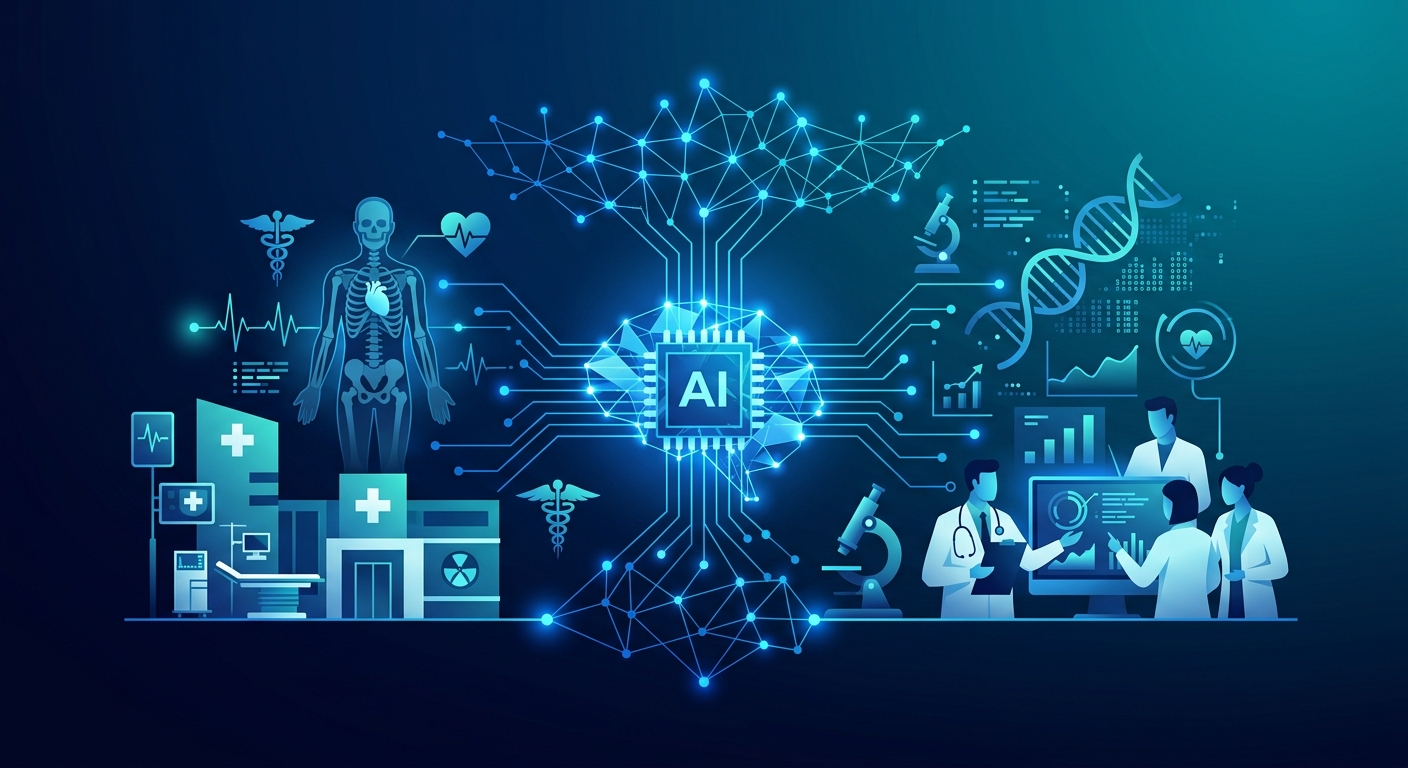
Artificial Intelligence (AI) is the simulation of human intelligence processes by computer systems, while machine learning (ML) is a subfield of AI defined as the use of algorithms and statistical models to enable computer systems to perform specific tasks without explicit instructions. In the modern medical landscape, machine learning and artificial intelligence in healthcare represent a fundamental shift from reactive treatment to proactive, data-driven medicine.
Healthcare organizations are no longer just repositories of patient data; they are becoming intelligent ecosystems where algorithms analyze massive datasets to predict patient outcomes, optimize hospital workflows, and personalize treatment plans. As these technologies mature, they are moving from laboratory research into clinical environments, directly influencing the quality of care and operational efficiency.
Key Takeaways
- Supervised Learning Dominance: Most current healthcare AI applications use supervised learning for disease prediction and image detection.
- Operational Efficiency: AI is significantly reducing administrative burdens through automated medical claims and prior authorization workflows.
- Regulatory Pathways: The FDA primarily uses the 510(k) clearance pathway for AI-driven software, focusing on substantial equivalence to existing devices.
- Explainability (The Black Box): Organizations are adopting interpretability strategies to ensure clinicians can explain AI-generated recommendations to patients.
There Are Many Potential Uses for Artificial Intelligence and Machine Learning in Healthcare Fields
The scope of machine learning and artificial intelligence in healthcare is vast, spanning clinical, administrative, and research domains. According to the Brody Lab at UCI, the largest applications currently include medical imaging, predictive analytics for patient outcomes, and personalized medicine.
In the clinical setting, AI systems excel at pattern recognition. For example, machine learning algorithms are trained on hundreds of thousands of radiological images to identify anomalies like tumors or fractures with accuracy levels that often rival or exceed human specialists. Beyond imaging, these technologies are used to determine stable doses of medications, particularly for complex drugs like anticoagulants where individual patient response varies significantly PMC8822225.
Administratively, AI is reshaping how hospitals manage resources. Predictive models can forecast patient admission rates, allowing for better staffing and bed management. This intersection of clinical and operational data is where the most significant ROI is often realized for enterprise healthcare systems.
2. Artificial Intelligence and Machine Learning: Technical Foundations
To understand the impact of these technologies, one must distinguish between the various branches of AI. Artificial intelligence serves as the overarching umbrella, encompassing any technique that enables computers to mimic human behavior. Machine learning, however, is the engine driving most modern medical breakthroughs.
Machine learning in medicine is fundamentally about finding patterns in data that are too complex for human observation. This includes analyzing longitudinal electronic health records (EHRs) to identify the subtle onset of chronic conditions. As noted by Harvard Medical School, healthcare executives must understand that ML is not a "set it and forget it" solution; it requires continuous monitoring and high-quality data to remain effective.
Key Insight: Machine learning in healthcare is transitioning from a research curiosity to a core component of clinical decision support systems, requiring a shift in how medical professionals are trained and how data is governed.
2.1 Machine Learning Algorithms and Their Clinical Roles
Machine learning algorithms are categorized based on how they learn from data. In healthcare, three primary types dominate:
- Supervised Learning: These algorithms are trained on labeled datasets where the "answer" is known. This is most common in disease prediction and identifying hospital outcomes PMC8822225.
- Unsupervised Learning: These models find hidden patterns or clusters in data without pre-existing labels. They are often used in genomic research to find new subtypes of diseases.
- Reinforcement Learning: This involves training models through trial and error to achieve a specific goal, such as optimizing a treatment regimen over time.
Supervised learning remains the workhorse of the industry. By feeding an algorithm historical data on patient vitals and outcomes, the system learns to recognize the early warning signs of sepsis or cardiac arrest, often hours before clinical symptoms appear.
2.2 Assessment of Model Performance and the Number of True Positives
Evaluating a machine learning model in healthcare is more complex than in other industries because the cost of a "false negative" (failing to detect a disease) can be life-threatening. Performance is typically measured using metrics such as sensitivity, specificity, and the area under the receiver operating characteristic (ROC) curve.
One critical metric is the Number of True Positives, which represents the cases where the model correctly identified a condition. However, clinicians must also manage the "alarm fatigue" caused by false positives. A model that is too sensitive may flag too many patients, leading to unnecessary tests and clinician burnout. Successful implementation requires a balance, ensuring that the predictive risk stratification models identify patients suitable for intervention without overwhelming the care team NCBI Bookshelf.
2.3 Big Data and the Health Information Explosion
The rise of machine learning and artificial intelligence in healthcare is directly tied to the explosion of health data. We are currently in an era of "Big Data," where the sheer volume of EHRs, genomic sequences, and wearable device data exceeds human processing capacity.
According to American Public University (APU), AI and ML help healthcare professionals improve patient data management by synthesizing these separate sources into actionable insights. Natural Language Processing (NLP) is also playing a vital role by extracting structured data from unstructured clinical notes, which account for nearly 80% of all medical data.
Addressing the 'Black Box' and Regulatory Frameworks
A primary challenge in deploying AI is the "black box" problem—the inability of humans to see exactly how an algorithm reached a specific conclusion. This is particularly problematic in medicine, where transparency is essential for patient trust and legal compliance.
Healthcare organizations are addressing this by implementing "Explainable AI" (XAI). These strategies involve using models that highlight which specific variables (e.g., age, blood pressure, specific lab results) most heavily influenced a recommendation. Furthermore, the FDA has established specific regulatory pathways for AI-driven diagnostic software. Most of these devices are cleared through the 510(k) pathway, which requires demonstrating that the AI is "substantially equivalent" to an existing, legally marketed device rather than requiring entirely new clinical trials for every iteration.
"The FDA reviews AI-driven diagnostic software through the same premarket pathways as traditional medical devices, including 510(k) clearance, De Novo classification, and premarket approval." — FDA Regulatory Summary
What Can Government Agencies Do to Encourage AI and ML by Healthcare Professionals?
Government intervention is crucial for the safe and effective scaling of healthcare AI. Agencies can encourage adoption by:
- Standardizing Data Formats: Creating interoperability standards so that AI models can work across different hospital systems.
- Clarifying Liability: Establishing clear legal frameworks for who is responsible when an AI-assisted diagnosis is incorrect.
- Funding Ethical Research: Supporting studies into bias mitigation and the impact of AI on health equity.
By providing a clear regulatory roadmap, agencies like the FDA and CMS (Centers for Medicare & Medicaid Services) can reduce the financial and legal risks that currently deter some smaller healthcare providers from investing in these technologies.
The Uses of AI and ML Continue to Expand
While significant progress has been made in diagnostics and operations, the future uses of machine learning and artificial intelligence in healthcare continue to expand. We are seeing the emergence of "Digital Twins," where an AI model of a specific patient is used to simulate the effects of different drugs before they are prescribed.
In the realm of public health, AI is being used to track the spread of infectious diseases in real time, allowing for more targeted interventions. As noted by Johns Hopkins University, new roles like "Health AI Ethicists" and "Clinical Data Scientists" are becoming essential to ensure these emerging uses remain grounded in safety and fairness.
Cybersecurity Protocols for Training ML Models
Protecting patient privacy while training machine learning models on large-scale EHR datasets is a significant hurdle. Traditional anonymization is often insufficient, as sophisticated algorithms can sometimes "re-identify" patients.
To combat this, organizations are adopting advanced cybersecurity protocols:
- Federated Learning: A technique where the model is trained across multiple decentralized servers holding local data samples, without exchanging them. This keeps the data behind the hospital's firewall.
- Homomorphic Encryption: This allows computations to be performed on encrypted data, ensuring that the raw patient information is never exposed during the training process.
- Secure Multi-party Computation: A subfield of cryptography that allows parties to jointly compute a function over their inputs while keeping those inputs private.
Healthcare Degrees and Professional Development
As AI becomes a standard tool in medicine, the education of healthcare professionals must evolve. Institutions like American Public University (APU) are integrating data science and AI literacy into their nursing and health science degrees.
Modern healthcare leaders need to be "AI-literate," meaning they understand the limitations, ethical implications, and strategic value of these technologies. This shift in education ensures that the next generation of clinicians can work alongside AI systems rather than being replaced by them.
Conflict of Interest and Ethical Oversight
The integration of AI in healthcare brings unique ethical challenges, particularly regarding conflicts of interest. When AI developers partner with hospital systems, there is a risk that the algorithms may prioritize cost-saving or high-margin procedures over patient-centered care.
Ethical oversight committees are becoming a standard requirement for healthcare organizations. These committees evaluate AI models for bias—ensuring that an algorithm trained on one demographic does not produce inferior results for another—and monitor the commercial relationships between technology providers and medical institutions.
Next Steps for Enterprise Healthcare Leaders
For organizations looking to implement machine learning and artificial intelligence in healthcare, the path forward involves three critical steps:
- Data Governance: Clean, structured, and accessible data is the prerequisite for any AI initiative. Invest in modernizing EHR systems and data lakes.
- Pilot Programs: Start with high-impact, low-risk applications such as AI agents for prior authorization automation to demonstrate ROI before moving to complex clinical diagnostics.
- Workforce Integration: Focus on "augmented intelligence" rather than automation. Ensure that clinicians are involved in the selection and training of AI tools to support adoption.
Frequently Asked Questions
What is the difference between AI and machine learning in healthcare?
AI is the broad concept of machines acting intelligently, while machine learning is a specific subset of AI that uses data to "learn" and improve at tasks like disease prediction without being explicitly programmed for every scenario.
Can AI replace doctors?
No. AI is designed to be a clinical decision support tool. It handles data processing and pattern recognition, allowing doctors to focus on complex diagnostic reasoning and the human aspects of patient care.
How does the FDA regulate healthcare AI?
The FDA typically clears AI software through the 510(k) pathway, focusing on whether the software is as safe and effective as existing medical devices. The agency is also developing a specific framework for "Software as a Medical Device" (SaMD).
What is the 'black box' problem in medical AI?
The "black box" problem refers to the difficulty in understanding exactly how a complex AI model reaches its conclusion. This lack of transparency can make it hard for clinicians to trust or explain AI recommendations to patients.
Is patient data safe when used for AI training?
Yes, if proper protocols like federated learning and homomorphic encryption are used. These methods allow AI models to learn from data without the raw, identifiable patient information ever leaving secure hospital servers.