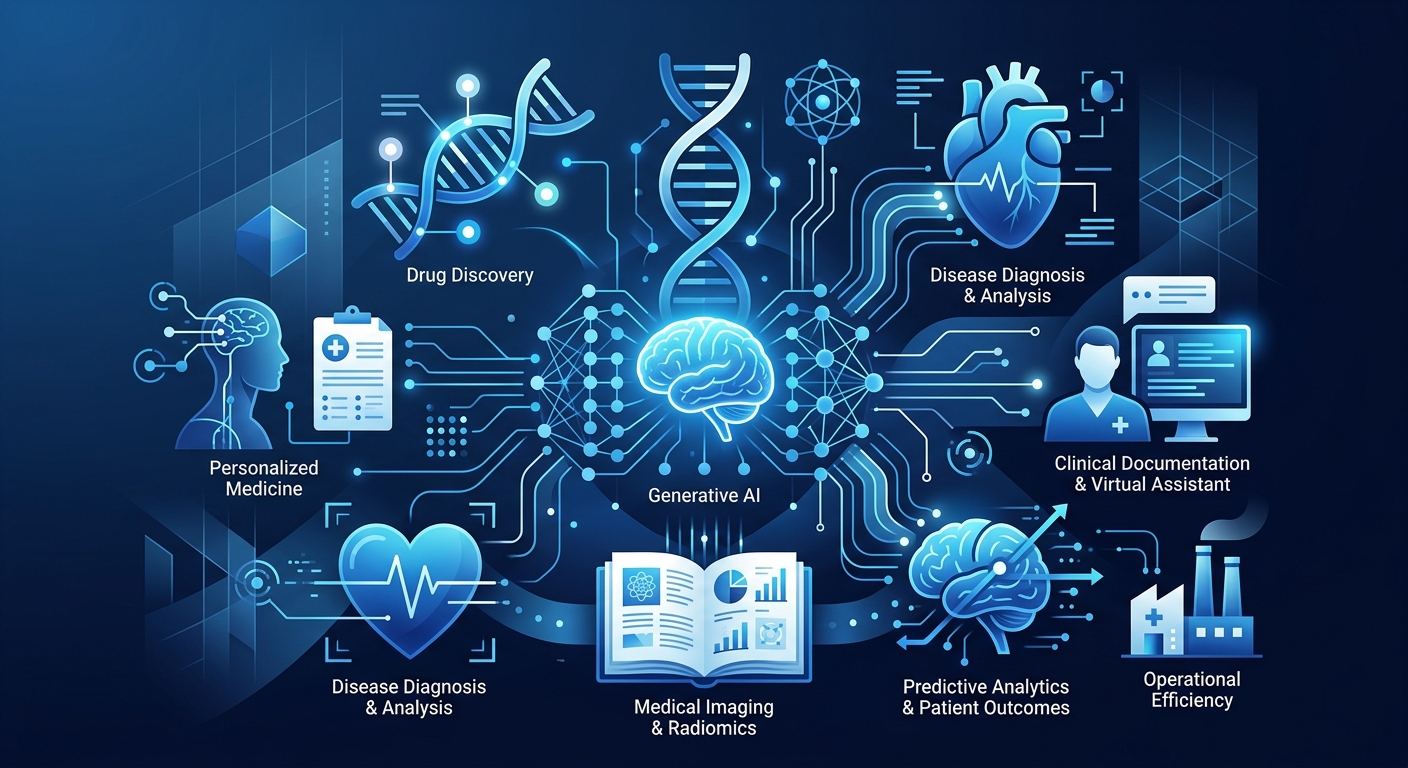
Generative AI is a category of artificial intelligence capable of creating new content—such as text, images, or synthetic data—from patterns learned during training. In the medical sector, generative AI in healthcare use cases are transitioning from experimental pilots to core operational pillars. Unlike traditional machine learning, which primarily classifies or predicts outcomes, generative AI (Gen AI) possesses advanced reasoning, summarization, and translation capabilities that address the industry's most pressing challenges.
According to a McKinsey analysis cited by Johns Hopkins University, generative AI alone could create $60–110 billion in annual value for the American healthcare industry. This value is driven by operational efficiency, reduced diagnostic errors, and optimized workforce allocation. As healthcare systems face a projected deficit of 11 to 18 million health workers by 2030, the adoption of these technologies is no longer optional for maintaining care standards PMC8285156.
Key Takeaways
- Efficiency Gains: Gen AI can generate $60–110B in annual value by streamlining workflows and reducing errors.
- Workforce Solutions: 75% to 85% of healthcare leaders are scaling Gen AI to mitigate the global labor shortage of 11M+ workers.
- Clinical Impact: Automated documentation and radiology report generation are significantly reducing clinician burnout.
- Data Innovation: Synthetic data generation allows for medical research and hypothesis testing without compromising patient privacy.
Introduction: The Shift from Predictive to Generative Intelligence
For decades, healthcare organizations have used predictive AI to identify high-risk patients or forecast hospital readmission rates. However, the emergence of Large Language Models (LLMs) has introduced a fundamental shift. Generative AI in healthcare use cases now encompass the management of unstructured, unlabeled data—which constitutes nearly 80% of all medical records. These models excel at natural language generation, summarization, and complex reasoning, allowing them to act as intelligent partners to clinicians rather than just data processors.
Deloitte research indicates that a significant majority of healthcare leaders, ranging from 75% to 85%, are currently adopting or planning to scale Generative AI to improve clinical productivity and patient engagement Deloitte US. This rapid adoption is driven by the technology's ability to interpret multi-modal data, including genomics, clinical notes, and phenotypic information.
Abstract: Scaling Innovation Amidst Crisis
The healthcare industry is at a crossroads where rising costs meet a critical labor shortage. Projections from the World Health Organization and other bodies indicate a global deficit of 11 to 18 million health workers by 2030 Johns Hopkins University. Generative AI offers a scalable solution to this crisis by automating the cognitive burdens that lead to physician burnout. By focusing on both clinical excellence and administrative efficiency, organizations can redirect human capital toward high-value patient interactions. This article explores the specific applications of Gen AI in medical documentation, imaging, research, and patient engagement, while addressing the integration challenges inherent in legacy systems.
Clinical Applications: Enhancing Patient Care and Diagnostics
Clinical applications of generative AI are primary drivers of improved patient outcomes. One of the most mature use cases is the generation of radiology reports from medical imaging. Gen AI models can analyze X-rays, MRIs, and CT scans to produce preliminary findings, highlighting anomalies for radiologist review. This does not replace the physician but accelerates the diagnostic cycle.
"Generative AI models demonstrate unprecedented capabilities in natural language generation, summarization, translation, and managing unstructured, unlabeled data." — Deloitte Insights
Beyond imaging, Gen AI is transforming personalized treatment plans. By synthesizing thousands of pages of medical history, current lab results, and the latest clinical guidelines, AI can suggest tailored interventions. This is particularly useful in oncology and chronic disease management, where the volume of data exceeds human processing capacity.
Key Insight: A study published in PubMed highlights that generative AI in medical imaging significantly enhances data augmentation and image-to-image translation, allowing for higher-quality diagnostics even with limited original datasets.
Non-Clinical Applications: Administrative Efficiency and Marketing
While clinical tools capture the headlines, non-clinical applications often provide the fastest return on investment (ROI). Generative AI can assist healthcare organizations with marketing and public relations by personalizing content and automating customer support through empathetic chatbots. According to research in PMC11739231, Gen AI can analyze large datasets to create customized health tips and articles, promoting deeper engagement between patients and providers.
Administrative workflows such as AI agents for medical claims reconciliation and prior authorization automation are also being transformed. These systems can autonomously review policy documents and patient records to ensure submissions are accurate, reducing the rate of denials and accelerating the revenue cycle.
Actions: Automating Clinical Documentation and Ambient Scribes
The most immediate actionable use case for Gen AI is the reduction of documentation burden. Clinicians spend an average of two hours on administrative tasks for every one hour of patient care. Ambient documentation technology uses Gen AI to listen to patient-clinician conversations and generate structured clinical notes in real time.
| Feature | Traditional Documentation | Gen AI Ambient Scribe |
|---|---|---|
| Time Commitment | 15-20 mins per patient | < 2 mins review time |
| Data Accuracy | Prone to recall bias | High-fidelity transcription |
| Patient Interaction | Clinician looks at screen | Clinician maintains eye contact |
| Burnout Risk | High (After-hours work) | Low (Real-time completion) |
Systems like those integrated with Epic or Cerner allow for seamless note-taking, which research from Yale School of Medicine shows can significantly reduce physician burnout and return focus to the patient.
Resources: Synthetic Data and Medical Research
Medical research often stalls due to the difficulty of obtaining high-quality patient data while maintaining HIPAA compliance. Synthetic data generation is a significant resource in this area. Gen AI can create artificial datasets that mimic the statistical properties of real patient populations without containing any identifiable information.
As noted in Nature, synthetic data can be used for hypothesis generation and preliminary testing before actual clinical data collection. This is particularly vital for research involving low- and middle-income countries where real-world data may be sparse or difficult to access. Furthermore, it allows for the training of other AI models without risking privacy breaches.
Catalyze Trust: The Future of Health Transformation
To build trust in the broader Future of Health™ transformation, organizations must move beyond the "black box" nature of AI. Transparency in how models are trained and the implementation of continuous AI agent monitoring protocols are essential. Trust is built when AI is seen as an augmentative tool that enhances the human element of medicine rather than replacing it.
Leaders must also address the ethical risks of synthetic data and the potential for bias. If a training dataset lacks diversity, the generative output will reflect those gaps. Ensuring representativeness in AI training is a critical step in achieving health equity.
Addressing Integration Challenges with Legacy Systems
A major gap in current literature is how to connect these advanced tools with legacy Electronic Health Record (EHR) systems like Epic or Cerner. The primary challenge is not just technical connectivity—which is often handled via SMART on FHIR applications—but workflow integration.
If a Gen AI tool requires a clinician to log into a separate portal, it adds to the cognitive load rather than reducing it. Success lies in embedding intelligent capabilities directly into the existing clinician environment. Furthermore, hospitals must manage the high computational costs of running these models. Many are turning to quantization (reducing the precision of the model to save memory) and model distillation to run LLMs locally or in private clouds to ensure data security and HIPAA compliance.
Liability and the 'Hallucination' Framework
What happens when a Generative AI tool produces a "hallucination" that leads to a clinical misdiagnosis? This is a significant concern for enterprise leaders. Currently, liability for AI-driven clinical misdiagnosis falls under the framework of medical malpractice. This occurs when a provider's negligence—such as failing to verify an incorrect AI-suggested diagnosis—leads to patient harm.
While the AI service provider may bear factual causation for the hallucination, legal frameworks are still evolving. Providers are encouraged to maintain "human-in-the-loop" systems where every AI-generated output is reviewed and validated by a licensed professional. This mitigates legal risk and ensures patient safety remains the top priority.
Frequently Asked Questions
What are the most common generative AI in healthcare use cases?
The most common use cases include ambient clinical documentation, radiology report generation, synthetic data for research, and administrative automation for claims and prior authorization.
How does Gen AI reduce physician burnout?
By using ambient listening to automate the creation of clinical notes, Gen AI removes the "pajama time" clinicians spend on administrative work, allowing them to focus on patients.
Is synthetic data safe for medical research?
Yes, synthetic data mimics the statistical patterns of real data without using actual patient identities, making it a privacy-compliant way to conduct preliminary research and train models.
How do hospitals integrate Gen AI with Epic or Cerner?
Integration is typically achieved through API-based middleware or SMART on FHIR applications that embed the AI tools directly into the clinician's existing EHR dashboard.
Who is liable for AI hallucinations in a clinical setting?
Currently, the licensed healthcare provider is generally liable under medical malpractice if they fail to verify AI outputs that lead to patient harm. Legal frameworks for algorithmic accountability are still developing.
Can Gen AI help with the healthcare labor shortage?
Yes, by automating routine tasks, AI allows the existing workforce to manage higher patient volumes more effectively, helping to bridge the gap caused by the projected 11-18 million worker deficit.
Conclusion: Navigating the Next Frontier
Generative AI in healthcare use cases represent a fundamental shift in how medical services are delivered and managed. From creating $110 billion in value to solving the administrative burdens that drive burnout, the potential is vast. However, success requires a strategic approach to Enterprise AI Agent Orchestration and a commitment to data integrity. As the industry moves forward, the focus must remain on the "quadruple aim": improving patient experience, improving population health, reducing costs, and improving the work life of healthcare providers.