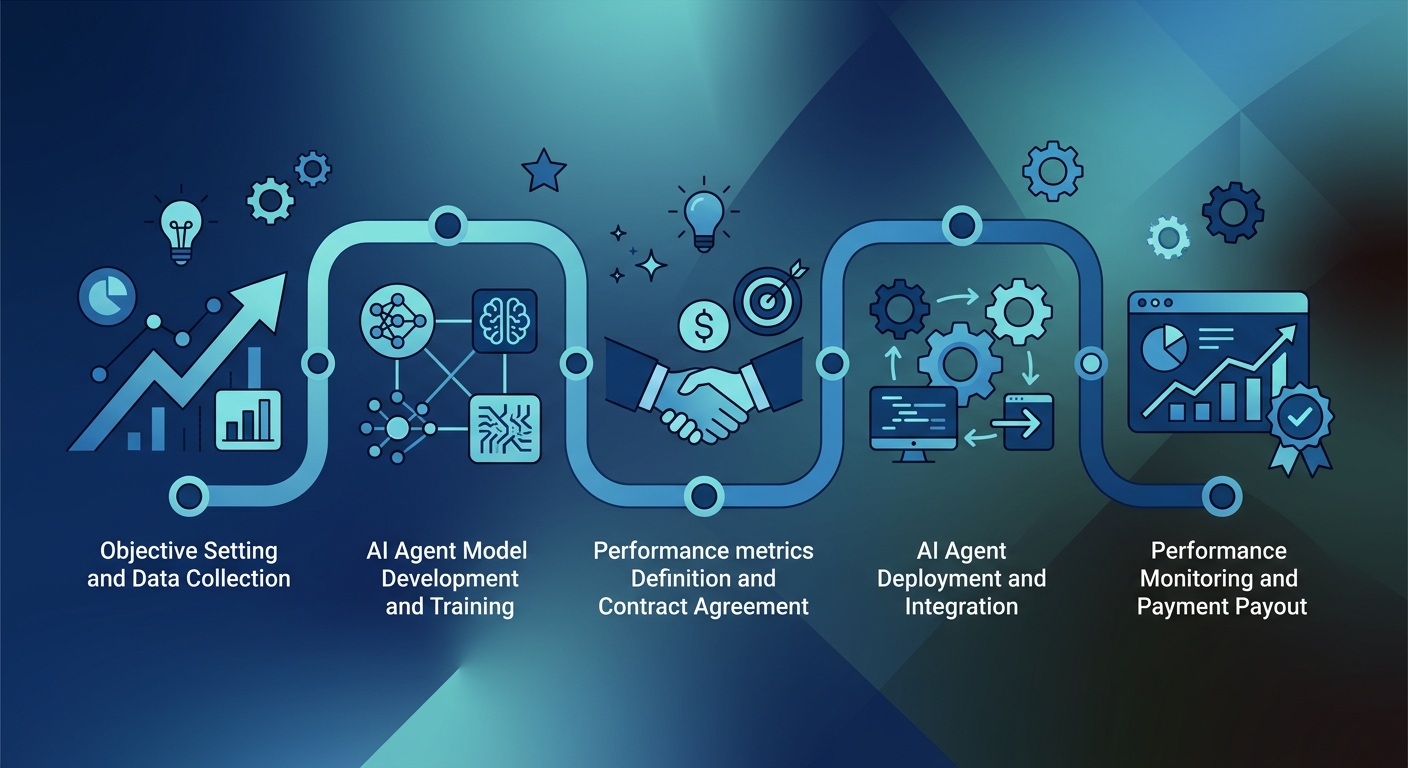
Traditional enterprises face a decisive inflection point in digital transformation. Generative AI delivers unprecedented efficiency, yet most organizations remain trapped in speculative procurement cycles—funding theoretical capabilities rather than verified business impact. This guide outlines a rigorous, executive-level roadmap for deploying autonomous AI agents as a scalable, accountable workforce. By replacing fixed IT overhead with strict performance accountability, organizations eliminate budget leakage, enforce measurable outcomes, and convert labor costs into predictable, ROI-driven operations.
The Strategic Shift: From Fixed Overhead to Accountable AI Workforce
Legacy IT deployments and traditional SaaS licensing rely on fixed overhead, generating consistent budget leakage through underutilized licenses, unpredictable compute costs, and open-ended consulting retainers. This conventional AI agent cost model decouples vendor compensation from actual business value. Executives absorb implementation risk while providers profit from access, not execution. The accountability gap is clear: organizations pay for the potential of automation, not for completed work. When pricing relies on seats or raw API consumption, vendors lack the incentive to optimize for real-world efficiency.
Forward-looking enterprises are closing this gap by reframing AI from a speculative capital expenditure into a measurable digital workforce. By adopting outcome-based AI pricing, leadership directly ties technology spend to verified operational lift and bottom-line impact. This strategic pivot eliminates speculative budgeting and enforces strict performance accountability. When investment hinges on delivered results, AI transforms from a cost center into a self-funding, value-driven extension of the enterprise.
Phase 1: Audit Operations & Define Verifiable Success Metrics
Successful performance-based AI services begin with rigorous operational auditing. Before deploying a single agent, executives must map high-friction, repetitive workflows governed by deterministic rules and clear success criteria. Prioritize processes with documented SOPs, structured inputs/outputs, and measurable error rates—such as invoice reconciliation, compliance documentation, or tier-one customer triage.
Next, establish baseline KPIs by isolating current cycle times, error rates, and fully loaded labor costs. These metrics serve as the control group against which AI performance will be measured. Crucially, define verifiable success thresholds that explicitly trigger compensation. Replace vague efficiency goals with binary or tiered validation criteria (e.g., “Agent resolves 95% of standard support tickets without human escalation” or “Reduces invoice processing from 48 hours to under 4 hours with <0.5% error rate”). This phase requires cross-functional alignment across operations, finance, and IT to ensure metrics are auditable and resistant to manipulation. Only with baselines locked can you architect a compensation model that rewards actual business impact.
Phase 2: Architect the Pay-for-Performance Pricing Structure
Designing an effective pay-for-performance AI pricing architecture requires moving beyond flat retainers or opaque per-token billing. Construct a tiered compensation structure that directly correlates to verified business outcomes. Begin by establishing clear Service Level Agreements (SLAs) that define acceptable accuracy rates, response windows, and escalation protocols.
Integrate risk-sharing mechanics: vendors assume upfront development and compute optimization costs, while clients pay only when predefined thresholds are consistently met. This alignment ensures every dollar scales linearly with operational lift, not infrastructure overhead. Transparency is enforced through real-time attribution dashboards that log every completed task, validated decision, and cost-saving event. Modern infrastructure now enables precise metering and independent auditing, making outcome-based models commercially viable at scale. By exposing the exact mechanics of value delivery, organizations eliminate hidden compute costs and prevent the budget creep historically associated with usage-based models. Hybrid pricing structures typically deliver the optimal balance—combining a minimal baseline for system maintenance and compliance with robust performance tiers that reward scale, speed, and accuracy. This guarantees every dollar invested corresponds to a tangible, auditable business result.
Phase 3: Deploy, Monitor, and Validate Agent Output in Production
Deployment requires controlled, iterative validation—not a simple system toggle. Execute phased rollouts starting with isolated workstreams, strictly governed by human-in-the-loop oversight protocols. During this phase, AI agents operate in a shadow or co-pilot capacity, allowing subject matter experts to verify outputs against established baselines before granting autonomous execution rights.
Implement real-time quality assurance frameworks that continuously score agent performance against accuracy, compliance, and resolution metrics. Automated tracking pipelines must feed directly into the attribution dashboard established in Phase 2, ensuring compensation triggers rely on immutable, auditable data rather than self-reported metrics. This rigorous validation period is critical for stress-testing edge cases, refining prompt architectures, and calibrating fallback escalation paths.
Conduct a formal ROI audit once the agent achieves steady-state operation. Compare verified output against the pre-deployment baseline, isolating direct cost avoidance, revenue acceleration, and labor reallocation. Authorize broader deployment only after the agent consistently exceeds predefined success thresholds and demonstrates positive unit economics. This disciplined gating mechanism ensures capital is deployed exclusively against validated, scalable workflows.
Phase 4: Scale the AI Workforce & Reinvest Proven Efficiency Gains
Once initial deployments validate unit economics, shift focus from isolated pilots to cross-functional scaling. Map adjacent workflows that share similar data schemas, process logic, or compliance requirements. Deploy additional agents across departments—finance, HR, procurement, and customer success—to create a networked digital workforce that compounds operational leverage.
The performance-based AI services model inherently funds its own expansion: efficiency gains from early deployments free up capital and bandwidth to onboard new agents without proportional headcount increases. Implement dynamic cost optimization protocols that continuously monitor token consumption, model latency, and routing efficiency. Leverage live production data to fine-tune underlying models, reducing error rates and accelerating task completion.
As the agent ecosystem matures, the organization transitions from pilot validation to enterprise-wide outcome-based AI pricing. This evolution requires standardized governance frameworks, centralized performance monitoring, and continuous workforce planning that treats digital labor as a core operational asset. By systematically reinvesting proven efficiency gains, traditional enterprises scale autonomous capabilities exponentially while maintaining strict financial discipline and structural agility.
The Executive Bottom Line: Future-Proofing with Outcome-Based AI
The era of speculative AI spending is over. Executives no longer need to choose between digital transformation and capital preservation. By adopting a pay-for-performance AI pricing framework, organizations achieve predictable, outcome-driven scaling without traditional headcount bloat or fixed-cost risk. This model builds a resilient, self-optimizing operations architecture aligned with market volatility and shifting customer demands.
When costs are strictly tied to verified business results, technology becomes a profit multiplier rather than an overhead burden. Outcome-based execution forces continuous model improvement, rigorous data governance, and relentless operational focus. As autonomous agents mature, performance-based compensation will transition from a competitive advantage to the industry standard for enterprise transformation. Organizations that embrace accountable AI today will secure structural cost advantages, accelerated decision cycles, and capital efficiency that legacy competitors cannot replicate. The mandate for modern leadership is clear: stop funding potential and start financing proven results.
Ready to Transform Labor Overhead into Verified ROI?
Stop paying for access. Start paying for outcomes. Partner with meo to deploy accountable, self-optimizing AI agents that integrate seamlessly into your existing workflows. Contact our enterprise team to schedule a zero-risk operational audit and discover how our performance-based AI services deliver measurable, auditable results within your first quarter.