Enterprises are no longer debating whether AI will transform operations; they are demanding verifiable proof of financial impact. Traditional software procurement models fail to align vendor incentives with actual business outcomes, leaving organizations overpaying for speculative capabilities. At Meo, we eliminate this friction through contractual accountability. By shifting to a pay-for-performance AI pricing structure, enterprises remove licensing overhead and only invest when verified results are delivered. This guide provides executives with a rigorous framework to measure, validate, and scale the ROI of autonomous AI agents.
The Shift From Seat-Based to Pay-for-Performance AI Pricing
Traditional AI licensing operates on seat-based or usage-cap structures, fundamentally misaligning vendor incentives with buyer success. Organizations pay regardless of whether the technology drives efficiency or remains underutilized, transferring deployment risk entirely to the enterprise. Industry analysis confirms that measuring AI agent ROI becomes inherently complex when tied to static contracts rather than dynamic, value-driven workflows. Outcome-based pricing inverts this paradigm. By tying compensation directly to verified deliverables, providers assume the deployment risk while clients achieve immediate financial predictability. Today’s executive mandate requires an accountable AI workforce, not another software license. Outcome-based AI pricing ensures capital is deployed strictly against measurable operational impact, transforming AI from a speculative cost center into a guaranteed profit lever.
Defining Contract-Ready Outcomes vs. Activity Metrics
Measuring AI success requires moving beyond vanity metrics such as prompt volume or system uptime. True accountability distinguishes between task completion and actual financial or operational impact. ROI cannot be proven through activity alone; contracts must anchor to resolution rates, revenue recovery, and strict compliance adherence. Establishing unambiguous KPIs is a prerequisite for performance-based AI services. Before deployment, enterprises must map workflow-specific success thresholds—such as a 95% first-contact resolution rate or a sub-24-hour invoice processing cycle—and define strict validation criteria. These contract-ready outcomes eliminate ambiguity, ensuring billing triggers exclusively when predefined business milestones are achieved.
Calculating the True Baseline for AI Agent Cost Modeling
Accurate ROI calculation begins with a comprehensive audit of current operational expenses. Most organizations underestimate legacy labor costs by tracking only base salaries while ignoring fully burdened expenses: recruitment, training, management overhead, benefits, and attrition. A robust AI agent cost model must also quantify hidden process friction, historical error rates, and the compounding opportunity cost of delayed workflows. Implementation best practices emphasize running a rigorous pre-deployment benchmark, tracking baseline task completion times against the fully loaded salary of the responsible personnel class. This establishes a defensible control variable for outcome comparison. Furthermore, enterprises must account for compliance risk exposure and manual reconciliation costs. By isolating the true fully burdened cost per transaction or case, organizations create a precise mathematical baseline. Only with this foundation can the incremental value generated by autonomous agents be accurately isolated, validated, and financially attributed.
The Executive ROI Framework for Performance-Based AI Services
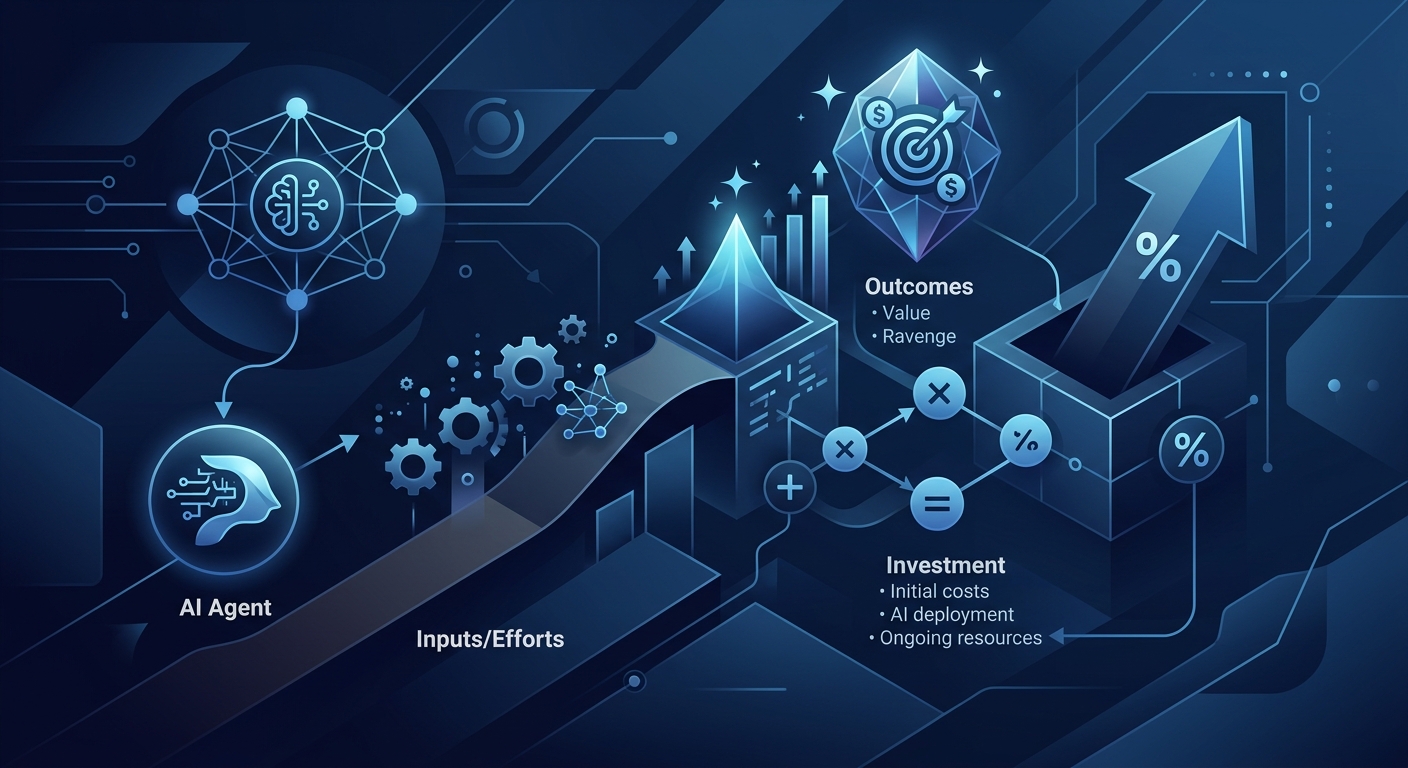
Executives require a transparent, repeatable formula to validate performance-based AI services before scaling. The foundation rests on calculating net value: (Verified Outcome Value - Baseline Operational Cost) / Deployment Investment. This must be paired with contribution margin analysis to ensure AI-driven outputs directly improve gross profitability, rather than merely reducing headcount. Hard savings, such as labor reallocation and reduced overtime, should be integrated with strategic gains, including accelerated time-to-market, infinite scalability, and enhanced regulatory compliance. Boards increasingly demand clear visibility into the measurable business value AI agents deliver, requiring disciplined attribution methodologies.
To isolate AI impact from legacy human variables, implement parallel-run testing and randomized control groups during the initial validation phase. Track incremental throughput against historical variance bands. When attributing financial value, apply a conservative multiplier to time-savings metrics, converting reclaimed hours into revenue-generating capacity. Industry data indicates that 74% of enterprises realize first-year returns from AI agents when measurement is structured proactively rather than retroactively. By focusing on contribution margin, payback period, and risk-adjusted net present value (NPV), leadership can transition from speculative pilot funding to institutionalized operational expenditure.
Real-Time Validation and Automated Billing Triggers
Contractual ROI requires transparent, tamper-proof verification. Modern outcome-based AI pricing relies on immutable audit trails that log every agent decision, data interaction, and workflow milestone in real time. These logs feed directly into cryptographic verification protocols, ensuring billing schedules are dynamically triggered only when predefined success criteria are mathematically confirmed. This architecture eliminates billing disputes and aligns seamlessly with pay-for-performance mandates.
Service Level Agreement (SLA) enforcement is embedded into the operational layer, featuring automated penalty and reward mechanics tied to precision, latency, and compliance thresholds. If an agent falls below a 90% accuracy benchmark, billing automatically scales down until performance is restored. Conversely, sustained excellence triggers volume bonuses, incentivizing continuous optimization. This transparent validation framework replaces subjective performance reviews with mathematical certainty, allowing finance and procurement teams to process invoices based on verified business impact rather than estimated usage.
Scaling Compounding Returns Across the Enterprise
Initial ROI validation is only the starting point. True enterprise transformation occurs when isolated departmental successes evolve into an integrated, autonomous workforce. Shared knowledge graphs and cross-agent learning architectures enable AI models to compound their intelligence over time, dramatically reducing per-unit processing costs and accelerating deployment cycles. As agents share successful resolution pathways, organizations experience exponential efficiency gains that outpace linear human training curves. Enterprises that transition from siloed pilots to enterprise-wide orchestration reinvest verified labor savings directly into high-impact, revenue-generating workflows. This capital reallocation fuels strategic growth initiatives, product innovation, and market expansion, transforming operational efficiency into a sustainable competitive advantage.
Next Steps: Aligning Procurement, IT, and Operations
Deploying a risk-mitigated, pay-for-results pilot requires cross-functional alignment. Procurement must structure outcome-linked contracts, IT must enforce secure data-sharing protocols, and Operations must define granular success thresholds. Begin by scheduling a comprehensive baseline assessment to map your current fully burdened costs and project precise AI agent ROI with mathematical accuracy.
Conclusion
The era of speculative AI spending is over. By adopting a rigorous, outcome-driven measurement framework, enterprises can replace unpredictable labor overhead with a scalable, accountable digital workforce. At Meo, we engineer AI agents to pay for themselves, aligning fees with your strategic objectives. Schedule your baseline assessment today and deploy an outcome-priced AI workforce.