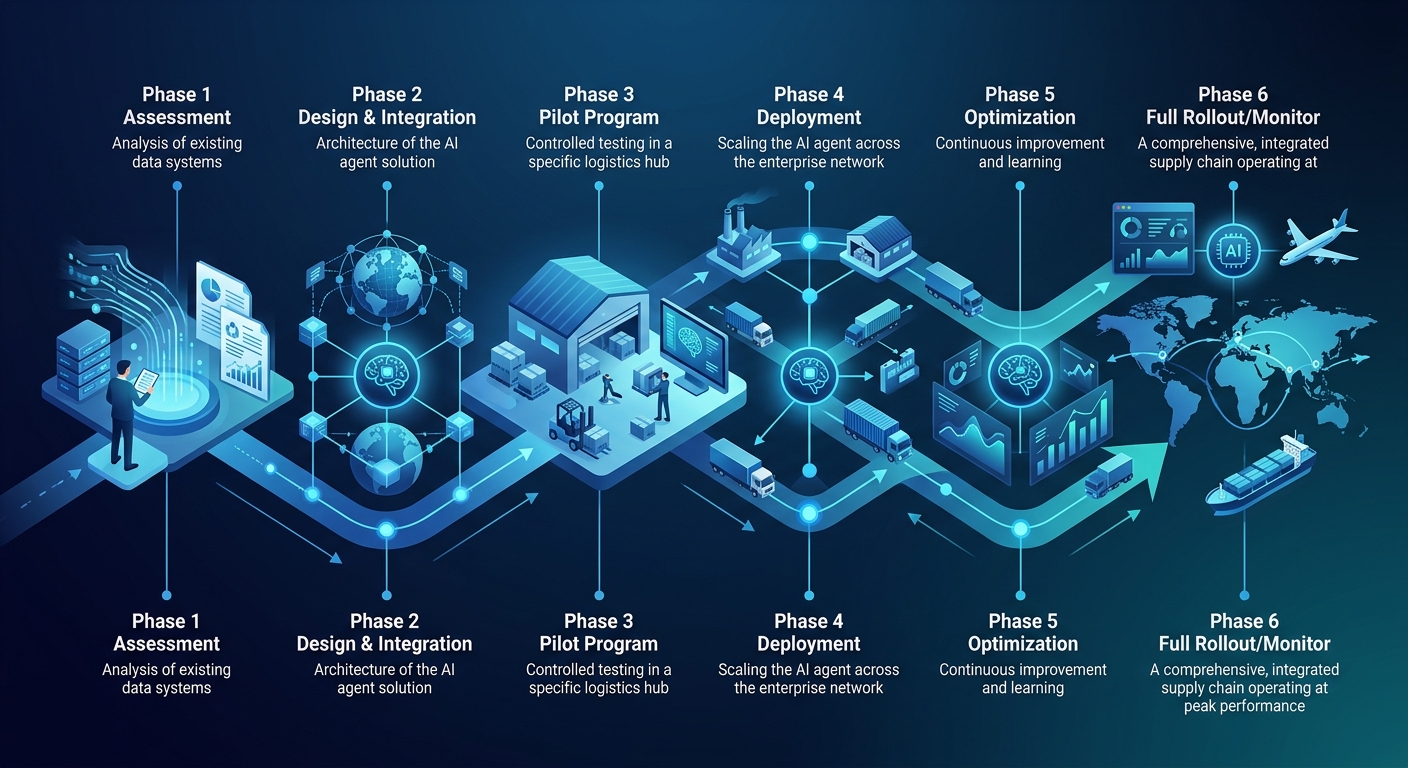
Enterprise supply chains are no longer optimized through incremental software patches. They require an autonomous, accountable workforce capable of executing complex logistics operations with precision. The modern AI agent implementation process is not an IT upgrade—it is a strategic workforce transition. At meo, we deploy AI agents as measurable, outcome-generating assets. Our agentic transformation methodology replaces fixed labor overhead with elastic capacity, governed by a strict pay-for-performance model. You pay only when predefined logistics KPIs are met. The following framework outlines our executive-level methodology for scaling AI agents across enterprise logistics networks.
Phase 1: Map Logistics Bottlenecks to Measurable KPIs
Successful AI workforce deployment begins with uncompromising operational clarity. Before evaluating technology, logistics leaders must isolate high-friction workflows that drain margin and delay throughput. Priority targets typically include dynamic freight booking, exception management, and cross-dock inventory reconciliation. These nodes generate the highest volume of repetitive decision loops, making them optimal candidates for agentic automation Aya Data.
Next, define strict, contract-ready success metrics. Generic efficiency goals fail under audit. Instead, anchor deployment to quantifiable logistics indicators: On-Time In-Full (OTIF) rates, yard dwell time reduction (measured in hours), and cost-per-shipment targets (including accessorials and detention fees). Industry data confirms that structured KPI alignment reduces deployment risk by over 60%, with leading enterprises treating these metrics as non-negotiable deployment gates Yadulink. Operations, IT, and finance leadership must jointly sign off on these targets before architecture is provisioned. At meo, we do not deploy until KPIs are contractually bound, ensuring every agent is engineered for verifiable financial impact, not just automated activity.
Phase 2: Design Secure AI Agent Architecture & System Integration
AI agents cannot operate in isolation. They require seamless, secure integration into your existing enterprise ecosystem. We architect API-first deployments that plug directly into legacy WMS, TMS, and ERP platforms, eliminating costly rip-and-replace cycles. This modular approach allows agents to read inventory states, execute carrier tenders, and update financial ledgers without disrupting core transaction flows.
Enterprise-grade data governance is non-negotiable. Agents operate under strict role-based access controls (RBAC) and maintain immutable audit trails for every decision, action, and data query. This architecture supports the evidence your SOC 2, ISO 27001, and customs compliance reviews ask for, while ensuring full operational transparency. Crucially, we define explicit decision boundaries and deterministic output standards. Agents autonomously manage routine routing, rate validation, and appointment scheduling, but any deviation beyond predefined risk thresholds triggers immediate human escalation. Moving AI from advisory support to a bounded, autonomous execution layer is the new standard for logistics resilience Kanerika. By codifying accountability into the architecture, we ensure agents execute with precision while preserving executive oversight.
Phase 3: Execute Controlled Pilots & Establish Performance Baselines
Full-scale automation without empirical validation introduces unacceptable operational risk. Phase 3 isolates agents within a single, high-volume logistics node to run parallel to legacy workflows. During this controlled pilot, the agent processes live freight data, executes bookings, and manages exceptions while human operators maintain a shadow posture.
We establish rigorous performance baselines to validate accuracy, throughput velocity, and error containment against historical human benchmarks. Structured pilots typically validate agent readiness within 4–6 weeks, significantly compressing time-to-value Aya Data. During this window, we iteratively refine agent logic, optimize workflow routing, and harden exception-handling rules. If dwell time reduction falls below the 15% threshold or booking error rates exceed tolerance, we recalibrate decision matrices before proceeding. This empirical gating mechanism ensures only validated agents advance to enterprise scaling. At meo, successful pilot validation is the strict trigger for performance-based compensation.
Phase 4: Scale Deployment & Reallocate Human Workforce
Once pilot baselines exceed contractual thresholds, we execute a standardized enterprise AI agent rollout across additional distribution centers and transport corridors. Scaling relies on repeatable deployment playbooks, pre-validated integration templates, and centralized orchestration layers that maintain operational consistency across geographies. This systematic expansion eliminates the fragmentation that typically derails logistics technology initiatives.
Simultaneously, we transition your workforce from repetitive execution to strategic oversight, complex exception resolution, and continuous process improvement. This is a capability elevation, not headcount reduction. Forward-looking enterprises deploy AI agents specifically to augment expertise and redirect talent toward high-value supply chain strategy, with 79% reporting improved human-AI collaboration NovaEdge. Fixed labor overhead is replaced with elastic, outcome-generating capacity that scales automatically with seasonal volume, carrier disruptions, or demand spikes. Teams shift from tracking status updates to optimizing network resilience, while autonomous agents absorb execution workloads 24/7.
Phase 5: Monitor Outcomes & Activate Pay-for-Performance Billing
The final phase institutionalizes accountability through real-time executive dashboards that track agent KPIs, SLA adherence, and direct financial impact. Automated auditing and milestone verification protocols continuously cross-reference agent outputs against baseline targets. Performance billing activates only after independent validation confirms deliverable completion.
This model inverts traditional enterprise software economics. Instead of paying upfront for seat licenses, implementation fees, or speculative ROI projections, logistics executives align vendor costs strictly to measurable operational improvements. If agents fail to hit contracted OTIF uplift, dwell time reduction, or freight cost savings, billing does not trigger. Enterprise-grade agentic AI now functions as autonomous decision intelligence, continuously optimizing routing, capacity allocation, and exception workflows Prolifics. Partnering with meo locks in sustainable ROI, eliminates deployment risk, and converts logistics overhead into a transparent, pay-for-performance workforce. The future of supply chain execution is not managed—it is automated, audited, and accountable.
Conclusion
Deploying AI agents across enterprise logistics requires more than technical integration; it demands a disciplined, outcome-focused methodology. By mapping bottlenecks to strict KPIs, engineering secure architectures, validating through controlled pilots, scaling with strategic workforce reallocation, and anchoring costs to verified results, organizations transform operational friction into measurable margin expansion. meo’s pay-for-performance model ensures you never pay for potential—only for proven logistics outcomes. Schedule an executive readiness assessment and deploy your first KPI-bound AI agent within 60 days.