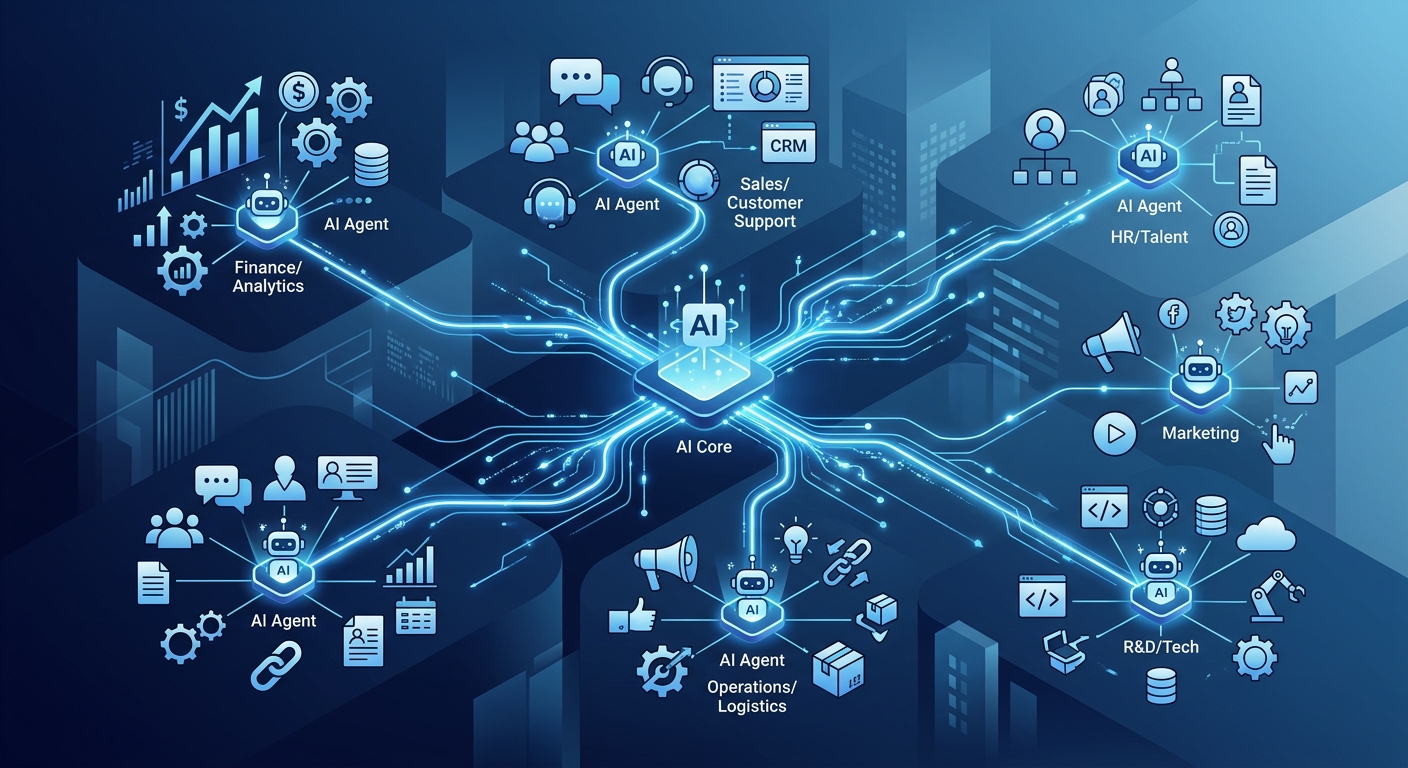
The enterprise AI landscape has shifted decisively from experimental pilots to mission-critical infrastructure. While 83% of organizations report widespread AI adoption, only 14% successfully transition isolated tests to production-scale operations. The bottleneck is rarely the technology; it is the absence of a disciplined, outcome-driven deployment framework. At Meo, we eliminate speculative IT spending. Instead, we deploy AI as a scalable, accountable workforce that replaces fixed labor overhead with measurable P&L impact. The following five-step framework provides an executive-ready blueprint for orchestrating an enterprise AI rollout that targets ROI while enforcing strict compliance and operational control.
1. Map Departmental Workflows to Measurable P&L Targets
Successful AI deployment begins with surgical precision, not blanket automation. Before evaluating vendors, conduct a rigorous labor audit to isolate repetitive, rule-based processes with clear success criteria—such as invoice reconciliation, ticket triage, compliance reporting, and data migration. Quantify the exact hours, error rates, and overhead costs of these workflows to establish a verifiable baseline for automation.
Tie baseline KPIs directly to departmental P&L targets. If a process costs $1.2M annually in FTE labor and contractors, the objective is not vague “efficiency gains” but a documented 60–75% reduction in those specific line items. Metrics such as “reduce average resolution time by 4.2 hours while maintaining a <1% error rate” secure executive alignment and funding. Research confirms that transformation initiatives stall when leaders decouple technical deployment from financial accountability.
Align your deployment roadmap with existing executive priorities: margin expansion, regulatory compliance, or customer retention. When department heads see direct P&L impact, resource allocation becomes frictionless. For a structured starting point, our Implementation Methodology provides the exact audit templates and KPI-mapping frameworks enterprise clients use to identify high-yield targets.
2. Architect Secure, Cross-System Integration
Fragmented AI deployments create compounding technical debt. Enterprises cannot afford isolated point solutions that operate in silos or require costly rip-and-replace overhauls. The foundation of scalable deployment is a centralized orchestration layer that connects AI agents directly to legacy CRMs, ERPs, HRIS platforms, and proprietary databases via secure APIs and middleware.
Security and data governance must be engineered into the architecture on day one. This requires zero-trust protocols, strict role-based access controls (RBAC), and granular PII handling. Agents must operate within predefined permission boundaries, executing tasks without exposing sensitive customer or financial data. Industry analysis consistently shows that enterprises fail to scale beyond pilot phases when security and integration are treated as retroactive fixes rather than core architectural requirements.
Standardizing on a unified orchestration framework eliminates version drift, reduces compliance exposure, and accelerates time-to-value. The layer functions as a central nervous system, routing agent actions through auditable channels while preserving legacy infrastructure compatibility. Explore our technical standards and compliance protocols in the Security, Compliance & Governance documentation to see how we architect enterprise-grade integrations without operational disruption.
3. Deploy with Embedded Accountability Guardrails
Autonomy without accountability is a compliance liability. As AI scales, every agent action must remain transparent, auditable, and bounded by deterministic fallback protocols. Implement human-in-the-loop escalation triggers that automatically route edge cases, ambiguous inputs, or high-stakes decisions to qualified personnel. The objective is not to bottleneck every task, but to ensure human oversight activates precisely when AI encounters uncertainty outside its operational parameters.
Immutable audit trails are non-negotiable. Log every data query, system update, and executed action with timestamps, source context, and decision rationale. This creates a compliance-ready record that satisfies SOC 2, HIPAA, GDPR, and SOX requirements. Furthermore, replace speculative ROI projections with live performance dashboards. Executives must monitor real-time throughput, accuracy rates, and SLA adherence, tying vendor compensation directly to contractual performance guarantees.
This accountability-first model transforms AI from an opaque utility into a transparent, auditable workforce asset. When leadership can trace every agent action to a verified outcome, trust scales with deployment velocity. Review our Agent Monitoring & Quality Assurance framework to understand how we maintain operational reliability in high-volume environments.
4. Scale Department-by-Department Using a Pay-for-Performance Model
Traditional software procurement locks enterprises into fixed seat licenses, compute-hour billing, and multi-year commitments regardless of utilization. The Meo model inverts this paradigm. We transition organizations from rigid IT overhead to variable, outcome-based investment structures. Clients pay exclusively for verified business results, eliminating financial risk and aligning vendor incentives directly with operational success.
Scaling is achieved by replicating validated deployment blueprints across adjacent functions with minimal reconfiguration. Once an agent successfully automates finance invoice processing, the underlying logic, integration patterns, and compliance guardrails adapt rapidly to procurement, accounts payable, or supply chain reconciliation. Market analysis indicates the average enterprise currently runs 12 AI agents—a baseline that is rapidly expanding as organizations leverage proven deployment templates to capture scalable efficiency.
By decoupling investment from speculative capacity planning, enterprises deploy aggressively without inflating OPEX. This pay-for-performance structure converts AI from a cost center into a self-funding operational lever. Model your financial impact using our Pay-for-Performance Model to see how outcome-based pricing eliminates risk while accelerating enterprise-wide adoption.
5. Govern, Optimize, and Expand the Autonomous Workforce
Initial deployment is only phase one. Long-term value requires continuous governance, optimization, and strategic expansion. Establish an executive AI oversight council spanning IT, compliance, operations, and finance to manage risk thresholds, approve model refinements, and maintain corporate alignment. This council does not impede deployment; it provides the structured oversight required for safe, accelerated scaling.
Real-time performance telemetry drives continuous improvement. By analyzing decision accuracy, processing latency, and exception rates, organizations systematically retrain agents, close process gaps, and progressively automate complex, multi-system workflows. Over time, isolated departmental deployments evolve into an integrated, self-optimizing enterprise AI workforce capable of adapting to shifting market and operational demands.
The transition from tactical automation to strategic autonomy is where competitive advantage compounds. Enterprises that manage AI as a disciplined, outcome-driven workforce are better positioned to outperform those treating it as an isolated IT initiative. Learn why Meo Advisors treats AI as an accountable workforce across finance, compliance, and operations. Execution readiness is the differentiator.
Conclusion
Scaling AI across enterprise departments is no longer a technological hurdle—it is an operational and financial discipline. By mapping workflows to measurable P&L targets, architecting secure cross-system integrations, embedding compliance guardrails, and enforcing a strict pay-for-performance model, organizations eliminate legacy overhead while tying fees to verifiable outcomes. This implementation framework removes speculation, mitigates deployment risk, and aligns AI investment directly with executive priorities.
Ready to replace fixed labor costs with a measurable, outcome-priced AI workforce? Start Your AI Agent ROI & Business Case today and deploy with confidence.