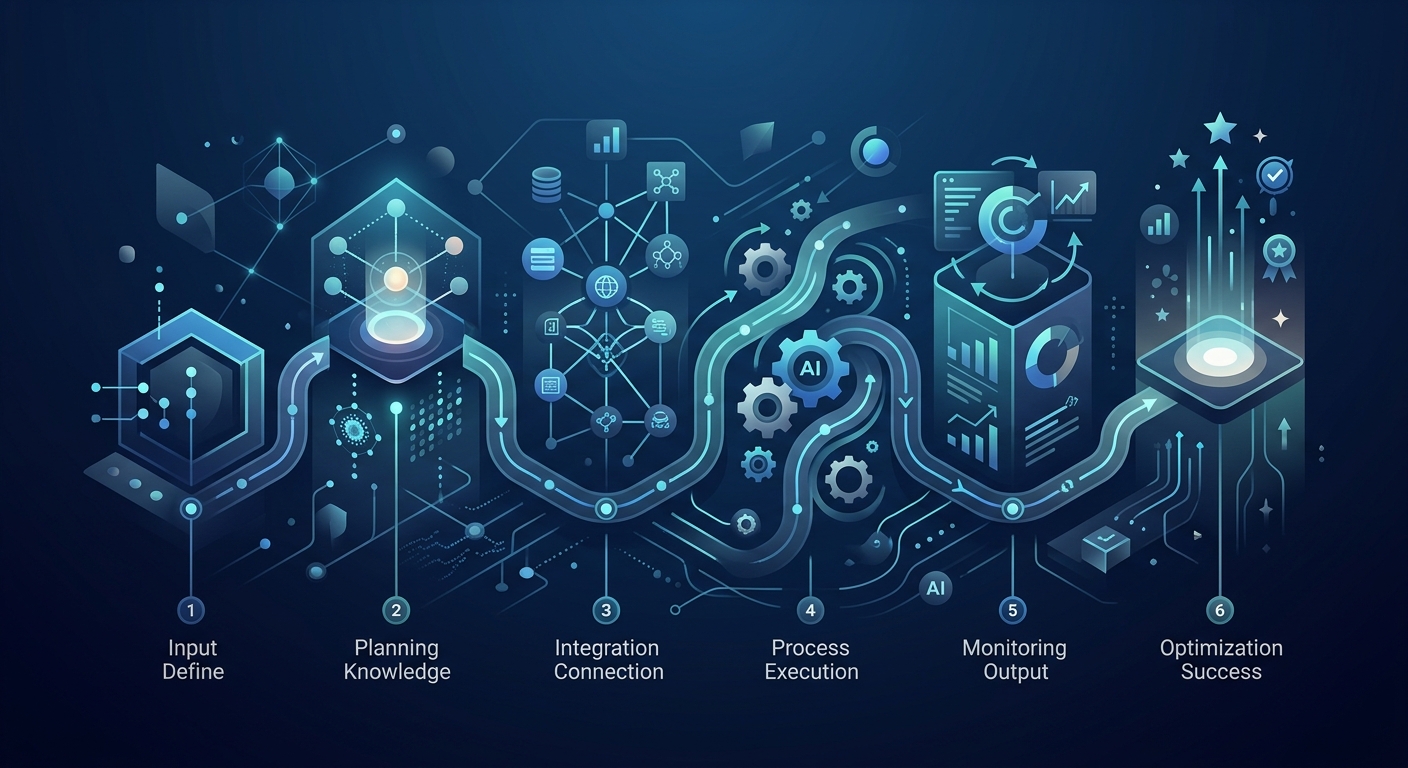
Scaling from experimental AI pilots to a production-grade autonomous workforce is rarely a matter of better prompts—it is a matter of rigorous engineering. Legacy organizations stall because they treat AI deployment as a software installation rather than an operational transformation. At meo, workflow mapping serves as the foundational architecture of the AI agent implementation process. By deconstructing legacy operations into measurable, accountable components, we eliminate guesswork so that every deployed agent is measured on labor overhead reduction and verified business outcomes. This is the blueprint for zero-risk scaling.
Why Workflow Mapping Must Precede Enterprise AI Deployment
The gap between isolated pilots and enterprise-grade systems stems from unstructured processes and ambiguous success criteria. Without precise mapping, organizations inevitably face deployment friction, unchecked scope creep, and unpredictable ROI. Mapping forces leaders to resolve process inefficiencies before automation, converting vague ambitions into executable blueprints. By breaking complex operations into discrete rule-based and judgment-based components, teams can align workflow complexity with exact autonomous decision thresholds. This disciplined approach ensures agentic systems are granted autonomy only where it mathematically drives value. As industry frameworks confirm, successful enterprise scaling requires structured orchestration rather than ad-hoc experimentation Moxo. When every step is mapped, measured, and bounded, the AI workforce deployment steps transition from theoretical risk to predictable, outcome-driven execution.
Phase 1: Process Audit & Opportunity Scoring
Scalable deployment begins with a rigorous process audit. Teams must systematically inventory workflows, prioritizing those that are high-volume, rule-driven, and directly tied to existing performance metrics. These processes represent optimal automation entry points. Next, quantify the current state: baseline full-time equivalent (FTE) labor overhead, end-to-end cycle times, and historical error rates. These metrics establish the immutable benchmark against which agent performance will be measured.
Not every process warrants AI adoption. Prioritization requires plotting initiatives on an ROI versus implementation complexity matrix, directing capital exclusively toward workflows where automation yields rapid, compounding returns. Research confirms that aligning AI initiatives with clear business objectives and responsible deployment frameworks significantly accelerates time-to-value OneReach.ai. By scoring opportunities against strict operational and financial criteria, leadership eliminates vanity projects and builds a pipeline of high-impact automation targets ready for architectural translation.
Phase 2: Define Accountability Metrics & Performance Boundaries
Autonomous systems require rigid accountability frameworks to operate safely at enterprise scale. This phase establishes hard Key Performance Indicators (KPIs), Service Level Agreements (SLAs), and acceptable variance thresholds tied directly to financial and operational outcomes. Ambiguity drives system underperformance. To counter this, design explicit escalation protocols and strategic human-in-the-loop (HITL) checkpoints. These boundaries ensure operational control is never relinquished; it is intelligently routed.
At meo, we map pay-for-performance triggers directly to these measurable outputs. Agent compensation and scaling activate only when predefined accuracy, throughput, and cost-saving benchmarks are consistently met. This outcome-driven architecture removes speculative spending and aligns technology investment with verified business results. Industry best practices emphasize that continuous monitoring and clear governance are non-negotiable for maintaining trust in autonomous systems AISera. By tethering every autonomous action to a financial metric and a predefined tolerance band, enterprises transform AI from an experimental cost center into an accountable, self-funding operational asset.
Phase 3: Decision Logic & Agent Architecture Mapping
With metrics defined, the focus shifts to translating legacy Standard Operating Procedures (SOPs) into machine-readable logic. This requires converting human workflows into deterministic routing paths for rule-based decisions and probabilistic reasoning chains for nuanced, context-dependent tasks. Architects must specify exact data inputs, permission scopes, API endpoints, and standardized output formats. Ambiguity at this stage guarantees hallucinations or operational failure downstream.
Crucially, the architecture must embed fail-safes, immutable audit trails, and regulatory compliance guardrails from the ground up. Every agent decision, data retrieval, and external action must be logged, traceable, and auditable to satisfy enterprise risk and compliance mandates. As agentic workflows scale, maintaining deterministic control over probabilistic models becomes a core architectural imperative Virtido. This blueprint ensures autonomous agents operate within strictly engineered boundaries, guaranteeing data integrity, regulatory adherence, and predictable execution across complex environments.
Phase 4: Integration, Sandbox Testing & Validation
Theoretical architectures must survive real-world conditions before live deployment. This phase securely connects agents to the existing technology stack—CRM platforms, ERP systems, helpdesk software, and document repositories—via sanctioned APIs and enterprise-grade authentication protocols. Once integrated, agents operate within a controlled sandbox, running against extensive historical datasets.
These simulations rigorously stress-test accuracy, decision latency, and resource consumption under peak-load scenarios. Security posture, data governance compliance, and error-handling routines undergo exhaustive validation. Edge cases, malformed inputs, and system timeouts are intentionally triggered to verify that fallback protocols and HITL escalations execute flawlessly. Validating adaptive systems under realistic conditions is mandatory before granting production access iApp Technologies. By benchmarking performance against historical data, organizations eliminate deployment risk. Only when agents consistently exceed baseline human performance metrics across all parameters do they receive clearance for live operational deployment.
Phase 5: Enterprise AI Agent Rollout & Continuous Optimization
A successful enterprise AI agent rollout requires controlled, phased deployment, not disruptive big-bang launches. Initial deployments target specific teams or departments, backed by real-time performance dashboards and automated reporting pipelines that track KPIs against Phase 2 benchmarks. As live production data flows, engineering teams iteratively refine system prompts, optimize tool integrations, and adjust escalation thresholds based on actual operational metrics. This feedback loop transforms static automation into continuously improving digital workers.
Once validated at the departmental level, proven workflows scale organization-wide. Throughout expansion, strict cost and outcome accountability remain paramount. meo’s agentic transformation methodology ensures scaling is dictated exclusively by verified performance data, not speculative forecasts. Phased deployment strategies, combined with lifecycle management protocols, enable enterprises to scale autonomous systems safely while maintaining financial discipline AISera. The result is predictable, compounding ROI where each additional agent directly reduces overhead and accelerates cycle times.
Conclusion: Transform Mapped Workflows Into a Scalable AI Workforce
Transitioning from experimental pilots to accountable, outcome-driven operations demands a disciplined, engineering-first approach. Workflow mapping is not theoretical documentation; it is the rigorous foundation of a pay-for-performance operational model. At meo, this methodology is designed so that capital is deployed only when agents deliver verified, measurable business results—eliminating upfront risk and aligning technology investment directly with labor savings. The future of enterprise operations belongs to organizations that systematically replace overhead with autonomous, accountable workforces. Initiate a risk-free, metrics-backed transformation by partnering with meo to map, deploy, and scale an AI workforce that pays for itself from day one.