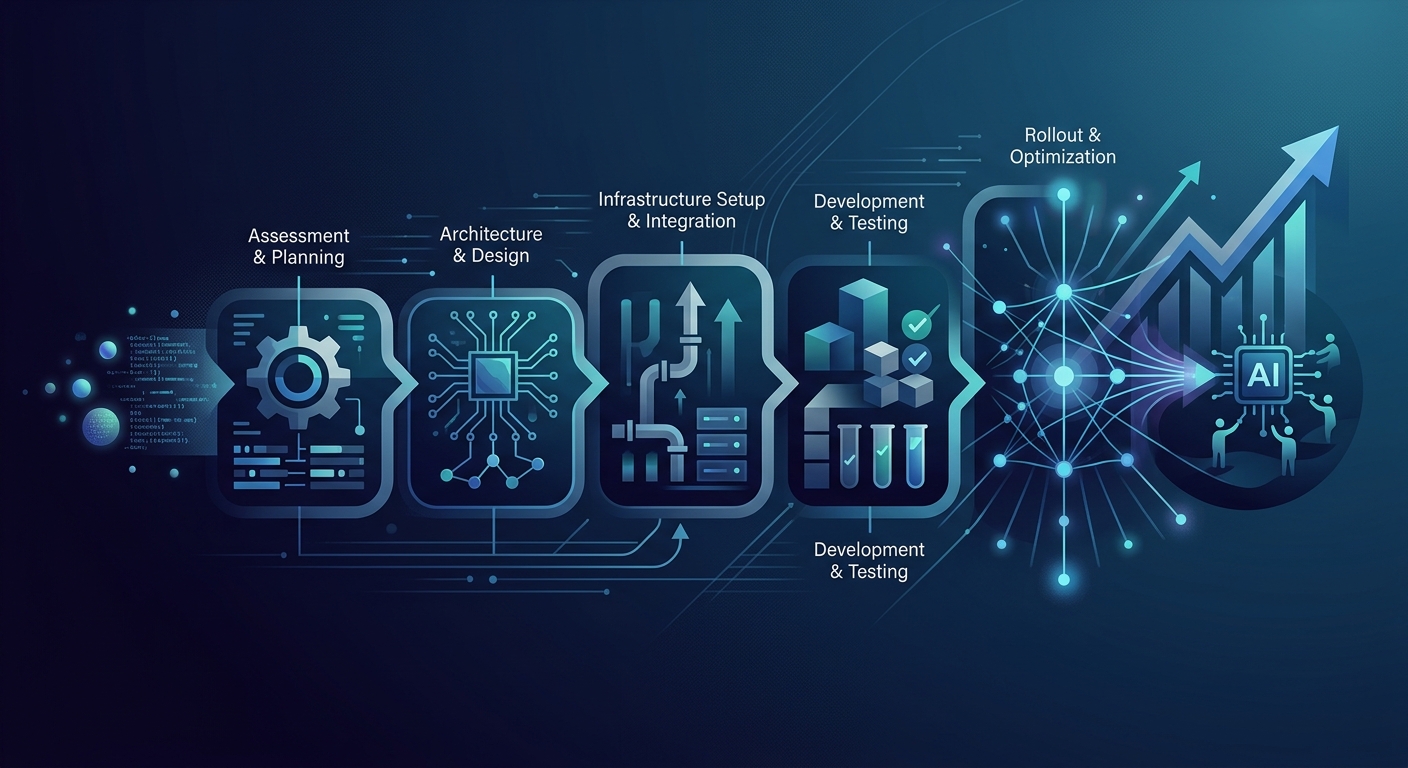
The transition from speculative AI experimentation to operational workforce deployment demands a disciplined, metric-driven framework. AI is no longer a peripheral IT initiative; it is a scalable, accountable digital workforce that systematically replaces administrative overhead with predictable, measurable outcomes. At Meo, we anchor every engagement to a strict pay-for-performance model: enterprises invest only when agents deliver verified, bottom-line results. This guide reframes AI adoption from a technology gamble into a structured operational upgrade. By following this sequence, leadership teams de-risk deployment, maintain business continuity, and guarantee that every automated workflow drives enterprise profitability.
Phase 1: Process Audit & Workforce Mapping
Successful deployment begins with surgical precision. Identify where human labor is consumed by repetitive, rule-bound execution. Conduct a rigorous process audit to isolate high-friction workflows—such as invoice reconciliation, compliance reporting, or tier-one customer triage—that are structurally primed for automation. Quantify existing labor overhead by capturing fully loaded personnel costs, historical cycle times, and baseline error rates. These metrics establish the performance floor for all future agent deployments.
Next, map decision boundaries to distinguish fully autonomous tasks from those requiring human-in-the-loop oversight. Explicitly defining agent authority versus mandatory human escalation eliminates ambiguity and preempts compliance risk. If a workflow cannot be rigorously measured, it cannot be reliably optimized. Anchoring Phase 1 in auditable baselines ensures every deployed agent replaces quantifiable overhead rather than adding technological complexity.
Phase 2: Architecture Design & Secure Integration
Enabling autonomous functionality while securing the enterprise IT perimeter requires a zero-trust architecture. Engineering and security leaders must establish strict data governance frameworks, embedding compliance guardrails and role-based access controls directly into agent parameters. Legacy ERP, CRM, and communication systems cannot be replaced overnight. Instead, orchestration layers must integrate seamlessly via secure APIs and middleware, preserving core operations while expanding capability. This strategy confines AI agents to sanctioned data environments, preventing unauthorized data egress and mitigating hallucination risks.
Crucially, every agent interaction must generate an immutable audit trail. Unlike static software, AI agents navigate dynamic decision trees that require transparent logging for regulatory compliance and internal review. By capturing input parameters, reasoning pathways, and execution outcomes in tamper-proof ledgers, organizations establish clear accountability. This architectural rigor transforms AI from an experimental tool into a compliant, enterprise-grade workforce component.
Phase 3: Controlled Pilot & Performance Benchmarking
Controlled validation bridges theoretical capability and operational reality. Deploy isolated AI agents against a single, well-scoped workflow to test technical feasibility, contextual accuracy, and systemic resilience. Operate this sandbox under strict containment so edge-case failures are captured without triggering cascading disruptions. During the pilot, measure throughput, error rates, processing latency, and direct labor cost displacement against Phase 1 baselines.
These metrics are not diagnostic—they are commercial triggers. Formalize explicit performance thresholds that dictate whether an agent scales or undergoes recalibration. If the agent misses predefined accuracy or efficiency targets, it is optimized, not subsidized. This gating mechanism eliminates sunk-cost exposure and ties capital allocation strictly to verified output. Treat the pilot as a binding proof-of-concept, not an open-ended experiment, to validate economic viability before broader commitment.
Phase 4: Enterprise Rollout & Change Management
Scaling from isolated validation to organization-wide deployment requires meticulous orchestration to preserve business continuity. Execute parallel deployment strategies, running AI agents alongside legacy human processes until performance consistency is mathematically proven. This phased cutover neutralizes operational risk while allowing teams to adapt incrementally.
Simultaneously, retrain leadership and staff to manage AI-augmented workflows, shifting focus from task supervision to exception handling, strategic oversight, and cross-functional alignment. Reallocate human capital from administrative execution to revenue generation and complex problem-solving. Govern the expanded ecosystem through SLA-driven frameworks that monitor multi-agent coordination, resource allocation, and cross-departmental impact. These SLAs function as operational scorecards, ensuring systemic bottlenecks are identified and resolved proactively. Structured change management and parallel run strategies reduce transition friction by over 60% compared to abrupt replacements. Embedding accountability into the rollout architecture transforms AI adoption into a predictable operational upgrade.
Phase 5: Continuous Optimization & Outcome Alignment
Initial deployment is a starting point, not an endpoint. Sustainable value generation demands relentless optimization and strict commercial alignment. Deploy automated feedback loops that monitor agent outputs in real time, feeding performance data back into prompt engineering and behavioral calibration models. This self-correcting architecture enables agents to adapt to shifting business rules, seasonal demand, and evolving customer expectations without manual intervention.
Once an agent consistently exceeds benchmarks, scale it across the enterprise using a standardized methodology that guarantees repeatable, de-risked replication. Crucially, this phase cements the commercial model: ongoing vendor compensation is tied exclusively to verified efficiency gains and measurable ROI, not licensing fees or billable hours. If outputs fail to translate into auditable bottom-line results, financial exposure remains capped. This structure forces technology partners to operate as performance-driven stakeholders. By institutionalizing continuous optimization and binding financial incentives to operational impact, enterprises future-proof AI investments, creating a perpetually improving digital workforce.
Conclusion
Deploying AI agents at scale is no longer a question of technological feasibility, but of operational discipline and financial accountability. By adhering to this phased framework, enterprises systematically dismantle labor overhead, eliminate implementation risk, and guarantee that technology investments correlate directly with verified business outcomes. The future of work belongs to organizations that treat AI agents as accountable, performance-driven workforce assets. If your leadership team is ready to replace speculative overhead with measurable results, operationalize a pay-for-performance AI strategy. Partner with Meo to audit your highest-friction workflows, deploy compliant autonomous agents, and scale only when your bottom line verifies the investment.