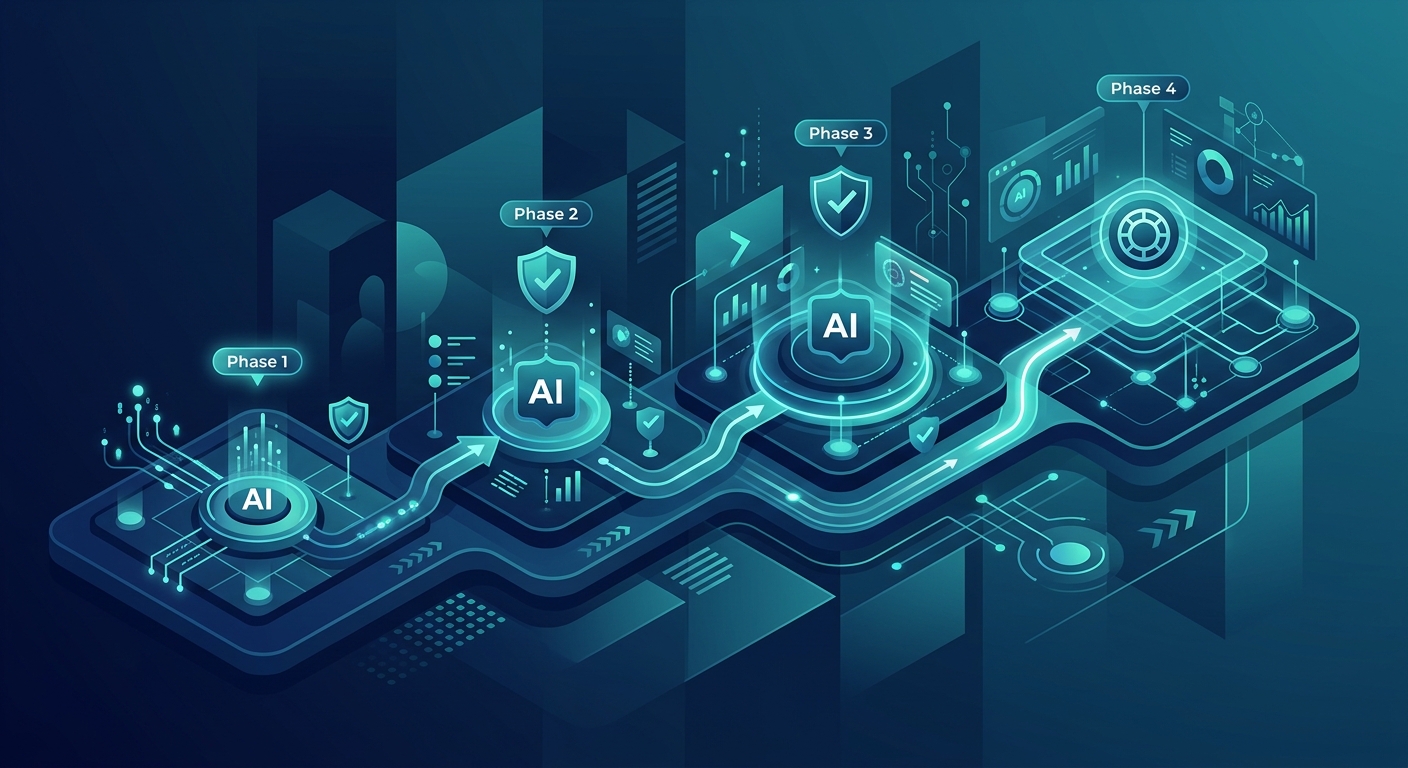
Traditional enterprises are increasingly burdened by speculative AI expenditure. Early adopters chased the theoretical promise of generative models. The operational reality is stark: monolithic deployments routinely exceed budgets, disrupt critical workflows, and fail to deliver auditable returns. At meo, we eliminate the risk of unstructured experimentation. We treat AI not as an experimental novelty, but as mission-critical infrastructure. Our AI agent implementation process is engineered around a phased, risk-first methodology that systematically replaces manual labor overhead with a measurable, accountable digital workforce. By isolating operational variables, enforcing strict governance boundaries, and tying every financial commitment to verified performance, we transform technological uncertainty into operational certainty. This guide outlines our four-phase enterprise AI agent rollout protocol—a pragmatic blueprint for executives who require financial de-risking, strict compliance, and measurable ROI from day one.
The Strategic Imperative: Why Phased AI Deployment Beats Monolithic Rollouts
Big-bang AI implementations carry disproportionately high failure rates, typically driven by uncontrolled capital expenditure, misaligned operational expectations, and inadequate change management. Industry analyses indicate that organizations attempting simultaneous, enterprise-wide deployments routinely face 40–60% project attrition before reaching stable production environments Enterprise AI Agents Go Mainstream: 2026 Report Highlights. Phased deployment neutralizes this exposure by compartmentalizing operational, financial, and compliance risk into discrete, manageable increments. Rather than funding speculative infrastructure, leadership validates tangible value before committing additional capital. This incremental structure aligns directly with pay-for-performance economics. Enterprises transition from capital-intensive gambling to an operational variable model, where investment scales exclusively when autonomous agents demonstrate verifiable impact on throughput, cost reduction, or service quality. In an era of market volatility, treating AI integration as a gated, outcome-driven process is a strategic imperative that protects balance sheets while accelerating transformation Agentic AI in 2026: What Enterprise Leaders Must Prepare for.
Phase One: Risk Baseline Mapping & High-Yield Use Case Selection
Successful deployment begins with rigorous risk baseline mapping. Before autonomous agents interact with live systems, we conduct granular audits of legacy workflows to pinpoint high-friction processes and identify labor overhead for automated substitution. This diagnostic phase separates high-yield, repeatable use cases from operational noise. Concurrently, we establish immutable security boundaries, compliance checkpoints, and cross-functional governance guardrails aligned with industry-specific mandates. Security and compliance are never retrofitted; they are architecturally embedded from day one AI Agents in 2026: What Enterprise Leaders Must Know ... - WWEMD. Crucially, this phase defines quantifiable KPIs that govern financial engagement. We map exact performance thresholds—such as resolution time reductions, error rate declines, or cost-per-transaction benchmarks—that trigger payment. This ensures capital deployment remains strictly conditional. The agentic transformation methodology begins with financial and operational precision—not technology procurement—ensuring every subsequent step anchors to auditable outcomes and clear accountability metrics.
Phase Two: Controlled Validation & Performance-Gated Testing
Once high-value use cases and guardrails are established, agents enter controlled validation environments. We deploy autonomous workflows in isolated sandbox networks, systematically stress-testing decision accuracy, contextual reasoning, and edge-case handling under simulated production loads. This environment mirrors real-world complexity without exposing live customer data or core enterprise systems to unproven behavior. We enforce rigorous human-in-the-loop oversight, maintain comprehensive audit trails, and deploy automated kill-switch protocols that instantly halt operations upon breaching anomaly thresholds. Validation is strictly measured against enterprise Service Level Agreements (SLAs) and compliance mandates before any production release is authorized. Industry research confirms that explainability, rigorous testing, and transparent audit mechanisms are non-negotiable for enterprise adoption, particularly as agents manage complex, multi-step decision trees The Enterprise AI Transformation Journey. By treating validation as a performance-gated checkpoint rather than a procedural formality, organizations eliminate deployment friction and ensure only rigorously vetted agents graduate to live operations.
Phase Three: Live Deployment & Outcome-Triggered Scaling
Live activation transitions operations from validation to value realization. Agents deploy into production environments equipped with real-time telemetry, strict performance thresholds, and continuous monitoring dashboards. Here, the pay-for-performance model fully activates: enterprise investment scales exclusively in direct proportion to verified business outcomes. If an agent reduces invoice processing costs by 35%, capital deployment aligns precisely with that efficiency gain. If performance metrics dip below agreed benchmarks, scaling pauses automatically until remediation protocols execute. We systematically expand agent scope to adjacent workflows only after initial deployments consistently clear risk, accuracy, and compliance thresholds. Modern agentic frameworks integrate seamlessly with legacy ERP, CRM, SCM, and ITSM ecosystems, enabling cross-functional automation without disruptive rip-and-replace strategies Agentic AI in 2026: Turning Promise into Practice and Measurable .... By tying financial commitments directly to live operational data, organizations eliminate speculative AI spend and build a self-funding, outcome-driven automation architecture.
Phase Four: Enterprise Governance & Continuous Workforce Optimization
Enterprise AI is not a static deployment. It is a continuously optimizing digital workforce requiring active lifecycle management. Phase four institutionalizes governance through automated compliance reporting, real-time model drift detection, and dynamic policy enforcement. As market conditions, regulatory landscapes, and internal processes evolve, autonomous agents adapt without compromising accuracy or data security. We align AI accountability directly with executive dashboards, delivering board-ready ROI tracking that translates technical performance metrics into clear financial outcomes. This visibility bridges IT operations and C-suite strategy, ensuring automation investments remain tightly coupled with overarching corporate objectives. Transitioning from isolated pilots to a permanent, scalable workforce requires shifting from ad-hoc experimentation to systemic orchestration. Human teams and autonomous agents operate within a structured division of cognitive labor The Enterprise AI Transformation Journey. At meo, this phase represents the culmination of our AI workforce deployment steps: a fully accountable, self-optimizing automation layer that continuously reduces overhead, enhances operational precision, and delivers compounding enterprise value.
Conclusion
The future of enterprise automation belongs to organizations that prioritize financial accountability over technological experimentation. By adopting a phased, risk-managed approach to AI integration, executives eliminate speculative capital expenditure, enforce strict regulatory boundaries, and guarantee that every dollar invested translates into measurable, auditable operational gains. meo’s performance-gated methodology transforms AI from an unpredictable expense into a scalable, outcome-driven workforce that pays for itself. Ready to deploy autonomous agents with financial certainty, operational precision, and zero speculative risk? Partner with meo today to architect your next-generation enterprise AI agent rollout and turn automation into a permanent competitive advantage.