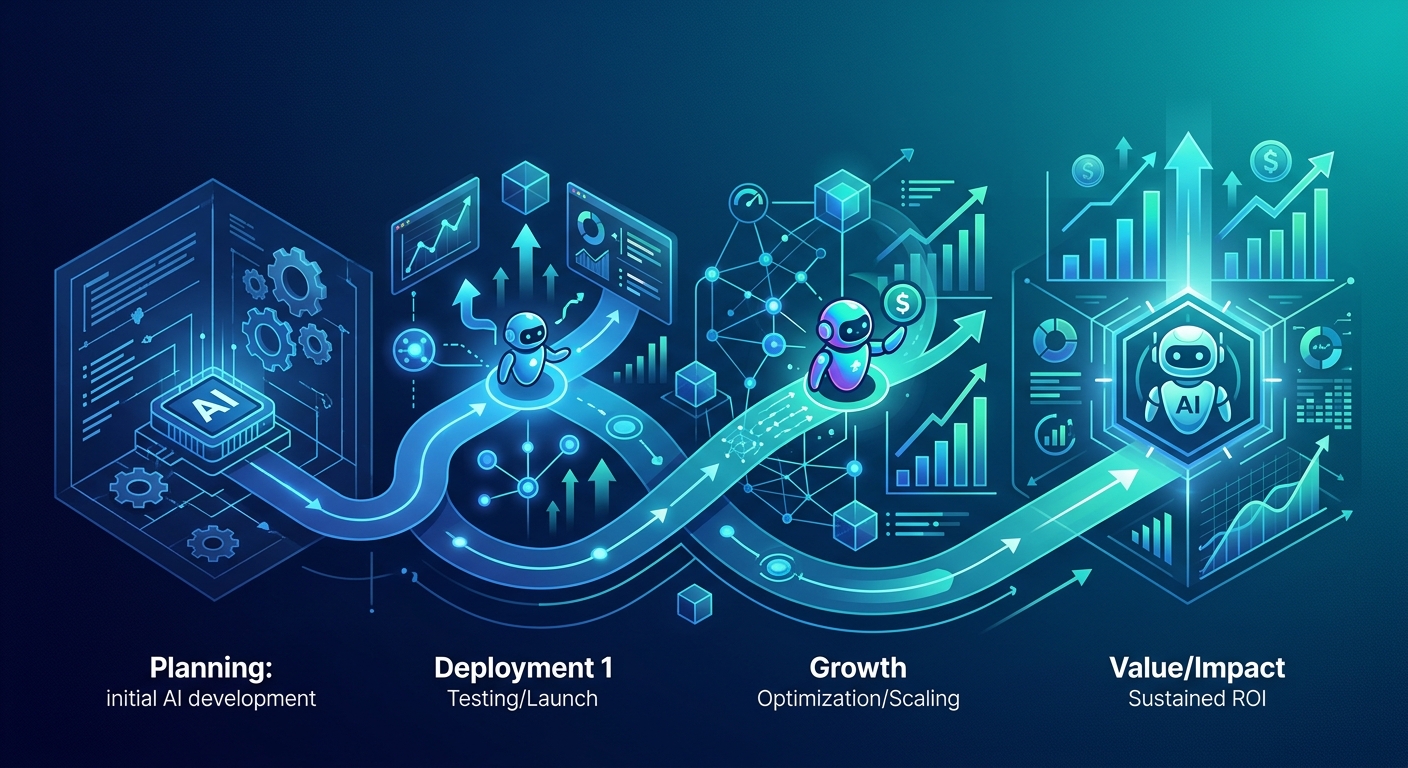
The era of treating AI as a speculative IT project is over. Autonomous agents are not static software licenses; they are dynamic, measurable workforces. For traditional enterprises, the critical challenge is no longer whether to adopt AI, but how to audit its financial and operational impact with precision. At meo, our deployment frameworks replace speculative overhead with auditable outcomes. This guide outlines how to track, scale, and capitalize on AI agent performance across every implementation cycle.
Redefining ROI for Autonomous Workforces
Traditional software ROI models fail to capture agent value because they treat technology as a fixed cost center rather than a dynamic labor multiplier. Calculating ROI based on subscription fees or infrastructure spend ignores the core economic shift: agents replace human labor hours, compress decision cycles, and operate continuously without fatigue MindStudio. To capture true value, executives must map agent capabilities directly to labor displacement and output acceleration.
This requires a shift from activity tracking to outcome accountability. Instead of monitoring "users logged in" or "API calls," leaders must track resolved workflows, compliance adherence rates, and fully loaded labor cost savings. Establishing executive accountability demands outcome-based KPIs tied directly to departmental P&L statements. Evaluated with the same financial rigor as human teams, agents become transparent, predictable, and auditable assets. This foundational shift transforms AI from an experimental expense into an accountable workforce multiplier.
Cycle 1: Baseline & Pilot
Before deployment, organizations must conduct rigorous operational baseline audits. Documenting the current state of workflows—including fully loaded labor costs, average handling times, error rates, and seasonal volume fluctuations—creates the financial benchmark against which all future performance is measured GetMonetizely. Without empirical data, ROI calculations remain speculative.
Once baselines are established, design controlled pilot environments with strict, non-negotiable success thresholds. Pilots should run in parallel with legacy operations, allowing agents to process real workloads without exposing customer-facing outcomes to risk. Track three critical early-cycle metrics: task completion rates, error reduction percentages, and human oversight hours. These indicators reveal operational readiness and highlight edge cases requiring immediate tuning. For instance, quantifying the manual research and reporting hours eliminated during high-value financial transactions provides immediate visibility into efficiency gains StackAI. Anchoring Cycle 1 to verified data rather than vendor projections establishes a defensible foundation for scaling.
Cycle 2: Scaling Through Agentic Transformation
Transitioning validated agents from sandbox environments to production workflows requires a structured transformation methodology. Scaling AI is not merely about increasing compute capacity; it is about expanding decision autonomy while maintaining strict governance. Organizations must systematically integrate agents into core enterprise systems—CRMs, ERPs, and data pipelines—to compound efficiency gains across interconnected workflows Aequi Labs.
At this stage, measurement must evolve from task-level metrics to systemic performance indicators. Monitor throughput scalability to ensure agents maintain accuracy and speed during 5x–10x volume spikes. Calculate cost-per-output by dividing total agent operational expenses by successfully completed workflows, revealing the true marginal cost of autonomous labor. Equally critical is measuring cross-departmental handoff latency. Traditional organizational silos create friction that delays revenue recognition and customer resolution; agents eliminate these bottlenecks by routing data, approvals, and actions in real time. Aggregating these departmental metrics into an enterprise-wide ROI model captures the full automation cost structure, preventing localized efficiency gains from masking systemic friction Blue Prism. Cycle 2 transforms isolated automations into a synchronized, high-velocity operational layer.
Cycle 3: Full-Scale Enterprise Rollout & Cross-Functional Impact
A successful enterprise rollout must follow a phased deployment strategy to protect legacy infrastructure and manage organizational change. Parallel shadow runs, gradual traffic routing, and automated rollback safeguards ensure business continuity as agents assume operational responsibility. As scale increases, financial measurement must bifurcate into two distinct value streams: hard cost displacement and soft revenue enablement.
Hard cost displacement quantifies direct financial impact: FTE reallocation, third-party vendor consolidation, reduced overtime spend, and infrastructure optimization. Soft revenue enablement captures strategic upside: faster time-to-market, 24/7 customer coverage, increased upsell conversion rates through persistent engagement, and accelerated audit readiness. To maintain executive alignment, integrate agent performance telemetry directly into financial dashboards. Real-time visibility into cost-per-transaction, resolution velocity, and compliance adherence replaces retrospective quarterly reporting with continuous financial oversight. When agent outputs map directly to revenue generation and expense reduction, AI transitions from an IT initiative to a core profit center.
The Pay-for-Performance Standard for Sustainable Deployment
Sustainable AI adoption requires aligning procurement with pay-for-performance contracting. Traditional procurement models force organizations to front-load capital on speculative technology with unproven returns. The pay-for-performance standard eliminates this exposure by tying financial commitment directly to verified business outcomes. Organizations invest only when agents deliver measurable results, ensuring capital flows strictly toward value creation.
This model embeds rigorous accountability into every deployment phase. If agents fail to meet baseline thresholds, organizations do not absorb the cost of experimentation. When they surpass targets, ROI compounds as agents optimize, learn, and expand across additional functions. By structuring long-term financial models around self-sustaining, outcome-verified AI teams, enterprises convert uncertain technology investments into predictable, compounding workforce assets. This is how traditional organizations future-proof operations without gambling on unproven innovation.
Conclusion
Measuring AI agent ROI is no longer a technical exercise—it is a financial imperative. Enterprises that anchor deployments to auditable baselines, scale through structured methodologies, and align procurement with verified outcomes will outperform competitors trapped in speculative adoption cycles. At meo, we deploy AI workforces engineered to replace overhead with measurable results, ensuring every dollar invested correlates directly to operational acceleration and cost displacement. To transition from experimental AI to accountable, outcome-driven workforce scaling, partner with meo. Deploy autonomous agents that quantify their own ROI.