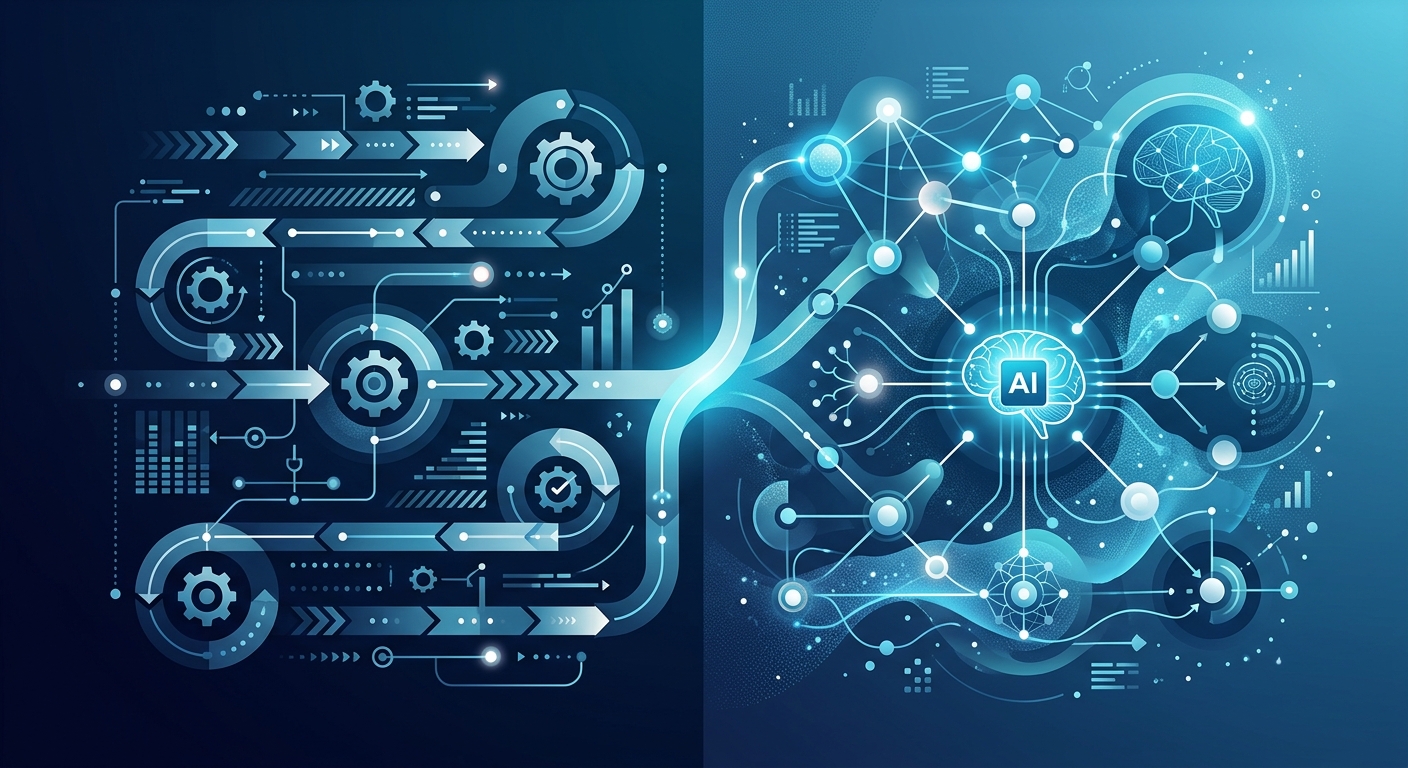
In the current landscape of digital transformation, the distinction between Intelligent Automation vs RPA has become the defining line between businesses that merely digitize tasks and those that fundamentally re-engineer their operations for the AI era. While Robotic Process Automation (RPA) was the catalyst for the first wave of back-office efficiency, its inherent limitations have paved the way for Intelligent Automation (IA)—a more resilient, cognitive approach to enterprise workflows.
Key Takeaways
- RPA is rule-based: It excels at repetitive, high-volume tasks with structured data but breaks when process variations occur.
- IA is cognitive: It integrates Artificial Intelligence (AI) and Machine Learning (ML) to handle unstructured data and complex decision-making.
- Resilience is the differentiator: IA can adapt to changes in UI or data formats that typically cause traditional RPA bots to fail.
- End-to-End Orchestration: Successful enterprises use IA to bridge the gap between siloed tasks, creating autonomous, self-healing workflows.
Defining Robotic Process Automation (RPA) and Intelligent Automation (IA)
Robotic Process Automation (RPA) is a software technology that makes it easy to build, deploy, and manage software robots that emulate human actions when interacting with digital systems and software. These "bots" follow strict, predefined rules to perform tasks such as data entry, invoice processing, or simple system migrations. However, as noted by Deloitte Netherlands, RPA solutions no longer work at their best when variations are introduced, because software bots that only follow rules cannot adapt to change.
Intelligent Automation (IA), often referred to as Intelligent Process Automation (IPA), is the combination of RPA with advanced technologies like AI, machine learning, and natural language processing (NLP). If RPA represents the "hands" of a digital worker—capable of doing—IA represents the "brain," capable of thinking, learning, and making context-aware decisions.
According to research published in IEEE Xplore, IA is superior to RPA for end-to-end process management because it mimics human decision-making patterns, allowing it to process unstructured information like emails, handwritten documents, and conversational intent.
The Key Differences Between RPA and IA
The fundamental difference between Intelligent Automation and RPA lies in the nature of the data they process and the complexity of the logic they apply.
- Logic and Decision Making: RPA is deterministic. It follows an "If X, then Y" logic. If a process encounters a "Z" that wasn't programmed, the bot stops and triggers an exception. IA is probabilistic. It uses machine learning to evaluate the best course of action based on historical data and confidence scores.
- Data Handling: RPA requires structured data (e.g., specific fields in a spreadsheet). IA can ingest unstructured data, such as the body of an email or a PDF of a contract, using Optical Character Recognition (OCR) and NLP to extract meaning.
- Maintenance Requirements: Traditional RPA is notoriously "brittle." A slight change in a website's UI or a software update can break the script. IA models are more resilient, often capable of identifying that a button has moved or a field has been renamed without requiring a manual code update.
Key Insight: Deloitte research highlights that RPA breakage occurs immediately upon process variation in standard rule-based environments, whereas IA creates a layer of resilience by adapting to these variations dynamically.
RPA and IA in Action: Real-World Applications
To understand the practical impact of these technologies, we must look at how they function within a live enterprise environment.
In a standard RPA scenario, a bot might be programmed to log into a portal, download a CSV file, and copy the data into an ERP system. This works perfectly as long as the portal's layout never changes and the CSV format remains identical every day.
In an IA scenario, the automation might involve AI Agents For Invoice Exception Handling. Instead of failing when an invoice is missing a PO number, the IA system can search previous communications, identify the correct PO number through context, or autonomously email the vendor to request the missing information. It doesn't just execute a task; it completes a goal.
How RPA Provided an 88% ROI for This Insurance Firm
While IA is the future, RPA remains a powerful tool for specific use cases. An insurance firm recently reported an 88% ROI by deploying RPA to handle high-volume claims processing. By automating the extraction of data from standardized claim forms and cross-referencing them with policy databases, the firm reduced processing time from days to minutes.
However, the firm soon hit a plateau. While the 88% ROI was impressive for structured claims, nearly 40% of their claims involved "unstructured" evidence—photos of accidents, scanned medical notes, and long-form descriptions. To capture the remaining value, they had to transition to an IA framework, layering AI agents over their existing RPA bots to interpret the visual and textual data that the rule-based bots could not read.
How Siemens Uses IA to Accelerate Key AP Processes
Siemens provides a benchmark for Enterprise AI Agent Orchestration. In their Accounts Payable (AP) department, they moved beyond simple RPA to a cognitive IA model. By using IA to accelerate key AP processes, they achieved a level of touchless processing that traditional scripts could not reach.
The IA system at Siemens doesn't just move data; it validates it. If a vendor sends an invoice with a price discrepancy, the IA system analyzes historical pricing, contract terms, and current market rates to determine if the discrepancy is an error or a negotiated change. This reduces the manual workload for human accountants, allowing them to focus on strategic financial planning rather than data reconciliation.
End-to-End Automation with RPA and IA
The most successful digital transformations do not choose between RPA and IA; they integrate both into a unified Agentic Enterprise strategy. In this model, RPA acts as the connective tissue between legacy systems that lack APIs, while IA provides the intelligence to navigate those systems effectively.
| Feature | RPA (Task Automation) | IA (Process Orchestration) |
|---|---|---|
| Primary Goal | Efficiency of repetitive tasks | Effectiveness of end-to-end processes |
| Data Input | Structured (Excel, SQL) | Unstructured (Email, Voice, PDF) |
| Learning | None (Static) | Continuous (ML-driven) |
| Resilience | Low (Brittle) | High (Adaptive) |
| Integration | Surface-level (UI automation) | Deep-level (API + Cognitive) |
Technical Prerequisites for Transitioning to IA
Transitioning from a legacy RPA environment to an IA framework is not a simple software upgrade; it requires a strategic shift in infrastructure. According to insights from Handling Workflow Exceptions With AI Agents, enterprises must address several gap areas:
- Data Orchestration Layers: IA requires a centralized data lake or robust API layer to feed machine learning models. Unlike RPA, which "scrapes" the UI, IA performs best when it has direct access to high-quality data.
- Compute Infrastructure: Running LLMs or complex ML models requires significant GPU resources or specialized cloud environments that standard RPA orchestrators do not provide.
- Governance Frameworks: As IEEE Xplore notes, IA introduces complexities around data privacy and ethical bias. A solid governance framework is required to monitor AI decision-making for "hallucinations" or discriminatory patterns.
Total Cost of Ownership: RPA vs IA
When evaluating the Total Cost of Ownership (TCO), enterprises often find a paradox. RPA has lower upfront development costs but higher long-term maintenance costs due to its fragility. IA requires a higher initial investment in model training and infrastructure but offers lower maintenance costs because the system can self-correct and handle variations without human intervention.
Moreover, IA introduces new operational costs such as LLM token usage and API fees. However, when measured against the cost of human employees handling exceptions that break RPA bots, the business case for IA typically shows a superior long-term ROI.
Frequently Asked Questions
Can IA exist without RPA?
Yes, IA can function entirely through APIs and direct database integrations without ever using RPA-style UI automation. However, in enterprises with legacy systems that lack modern interfaces, RPA is often used as the "vehicle" for IA to interact with those systems.
Is Intelligent Automation the same as Hyperautomation?
Hyperautomation is a broader strategic umbrella that includes IA, RPA, low-code platforms, and process mining. IA is the cognitive component that makes hyperautomation possible by providing the decision-making power.
How does IA handle data privacy differently than RPA?
RPA typically handles data in a "pass-through" manner. IA often requires data for training or fine-tuning models, which necessitates stricter AI Agent Data Privacy Compliance to ensure PII (Personally Identifiable Information) is not leaked or misused by the AI.
What happens when an IA model makes a mistake?
Unlike an RPA bot that simply stops, an IA model might proceed with a low-confidence decision. This is why "Human-in-the-Loop" (HITL) protocols are essential for IA, where the system flags low-confidence outputs for human review.
Which industries benefit most from IA over RPA?
Industries with high volumes of unstructured data and strict regulatory requirements—such as healthcare, legal services, and finance—see the most significant gains from IA. For instance, Best Practices For Automated Regulatory Change Tracking Agents shows how IA can monitor global law changes in ways RPA never could.
Ready to Take the Next Step?
Moving from task-based automation to end-to-end intelligent orchestration is the primary challenge for the modern CIO. To avoid common hurdles, consult our Enterprise RPA to AI Migration Guide for a detailed roadmap on infrastructure requirements and change management.
By layering cognitive capabilities onto your existing automation stack, you can transform your operations from a series of rigid scripts into a resilient, autonomous ecosystem capable of driving sustained competitive advantage.