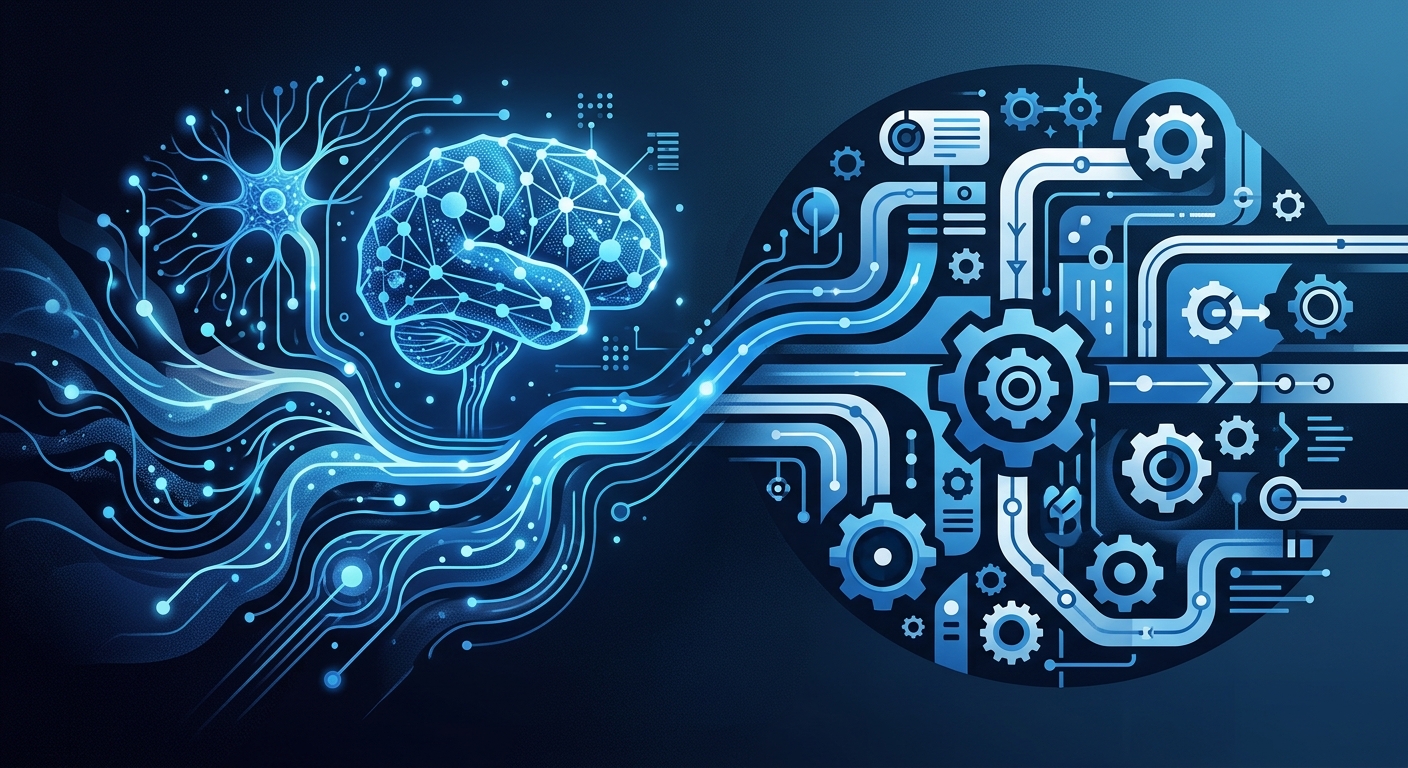
In today's digital transformation landscape, the distinction between Artificial Intelligence (AI) and Robotic Process Automation (RPA) has become a focal point for organizations seeking to optimize their operations. While both technologies aim to enhance efficiency, they occupy different ends of the automation spectrum. Robotic Process Automation (RPA) is a software technology that makes it easy to build, deploy, and manage software robots that emulate human actions when interacting with digital systems and software. Artificial Intelligence (AI), by contrast, is the simulation of human intelligence processes by machines, especially computer systems, enabling them to learn, reason, and self-correct.
Key Takeaways
- Definition: RPA acts as the 'digital worker' mimicking human actions, while AI acts as the 'digital brain' mimicking human intelligence.
- Logic: RPA operates on 100% rule-based logic for structured data tasks, whereas AI handles unstructured data and probabilistic reasoning.
- Combination: The combination of both technologies produces 'Intelligent Automation' (IA), enabling end-to-end process handling.
- Compliance: Deterministic RPA is easier to audit, while AI requires advanced governance frameworks to manage 'model drift' and probabilistic outcomes.
What is RPA? (Robotic Process Automation)
Robotic Process Automation (RPA) is a process-driven technology designed to automate manual, repetitive, and rule-based tasks. It works by recording a sequence of human interactions with a user interface (UI) and replicating those actions across multiple applications. According to UTI's Robotics and Automation Guide, RPA is designed for structured, rule-based tasks that follow a clear sequence, such as copying data between systems or processing high-volume transactions.
Because RPA relies on a predefined set of instructions, it is highly deterministic. If a process changes—even slightly—the RPA bot will typically fail unless its script is updated. This makes it ideal for back-office functions where inputs are consistent and rules are unchanging. Common examples include payroll processing, data entry, and simple form completion.
What is AI? (Artificial Intelligence)
Artificial Intelligence (AI) is a data-driven technology that enables machines to perform tasks that typically require human cognition. Unlike RPA, which follows a script, AI uses algorithms to identify patterns in large datasets, allowing it to make predictions or decisions. AI can handle unstructured data—such as natural language, images, and video—that does not fit neatly into the rows and columns of a traditional database.
AI encompasses various subfields, including Machine Learning (ML), Natural Language Processing (NLP), and Computer Vision. As noted by UTI, AI handles more complex tasks that require interpretation, analysis, or problem-solving. This cognitive ability allows AI to improve over time as it is exposed to more data, a process known as "learning."
Key Differences Between RPA and AI
The fundamental difference between RPA and AI lies in their approach to task execution: RPA is "doing," while AI is "thinking." Understanding this distinction is critical for selecting the right tool for a specific business challenge.
| Feature | Robotic Process Automation (RPA) | Artificial Intelligence (AI) |
|---|---|---|
| Primary Focus | Process-driven; mimics human actions. | Data-driven; mimics human intelligence. |
| Data Type | Structured data (spreadsheets, databases). | Unstructured data (text, images, voice). |
| Decision Logic | Deterministic (If/Then rules). | Probabilistic (patterns and predictions). |
| Flexibility | Rigid; breaks if the UI or process changes. | Adaptive; learns from new data patterns. |
| Goal | Efficiency and accuracy in repetition. | Insights and complex decision-making. |
Key Insight: RPA operates on 100% rule-based logic for structured data tasks, whereas AI models provide probabilistic outputs that require different validation frameworks. UTI
Is RPA a Form of AI?
A common misconception is that RPA is a subset of AI. In technical terms, traditional RPA is not AI. RPA is essentially a sophisticated macro that operates on an "if this, then that" basis. It does not possess the ability to "understand" the data it processes; it merely moves data according to instructions.
However, the lines are blurring with the advent of "Cognitive RPA" or "AI-enhanced RPA." In these scenarios, AI components are embedded within an RPA workflow to handle specific cognitive tasks—such as using OCR (Optical Character Recognition) to read a handwritten document—before passing the structured data back to the RPA bot for processing. Despite this overlap, the core engines remain distinct in their logic and architecture.
How RPA and AI Work Together: Intelligent Automation
When organizations combine the execution power of RPA with the analytical power of AI, they achieve Intelligent Automation (IA). In an IA framework, RPA acts as the hands and feet, moving data between legacy systems that lack APIs, while AI acts as the brain, making decisions on complex variables.
For example, in a customer service environment, an AI-powered chatbot can use NLP to understand a customer's intent and sentiment. Once the AI determines that the customer wants to change their billing address, it triggers an RPA bot to log into the legacy CRM system and update the record. This combination enables the automation of end-to-end processes that were previously too complex for simple scripts but too repetitive for human experts to handle manually.
Common Applications of RPA and AI in Industry
The impact of these technologies is perhaps most visible in the healthcare and finance sectors, where the volume of data and the need for precision are both exceptionally high.
Healthcare Utilization
In the medical field, the integration of these tools is transforming patient care. According to a narrative review in PMC, healthcare professionals are using RPA to enhance patient satisfaction by automating processes such as scheduling appointments, handling medical billing, and processing insurance claims. Simultaneously, AI is used to provide tailored treatments and quick access to medical information through advanced diagnostics and predictive modeling.
Finance and Accounting
In finance, RPA is widely used for invoice exception handling. While traditional RPA can match a standard invoice to a purchase order, AI is required to handle "exceptions"—invoices with missing data or non-standard formats. By combining the two, firms can achieve touchless processing rates exceeding 90%.
Transitioning from RPA to AI Agents
As enterprises mature, many are looking to move beyond simple bots toward AI agents. Transitioning to AI-enhanced agents requires moving integrations to APIs where possible and investing in scalable, cloud-based architectures to handle increased computational demands. Unlike RPA scripts, which are static, AI agents require infrastructure that supports continuous learning and real-time data processing.
"The integration of RPA and AI is often referred to as Intelligent Automation (IA), where RPA handles the administrative workflow and AI provides the analytical depth." — Synthesis from Increasing Trends of Artificial Intelligence With Robotic Process Automation in Health Care
Managing Maintenance: Script Debugging vs. Model Drift
A significant operational difference between AI and RPA is the nature of maintenance. Standard RPA maintenance involves script-based debugging. If a website changes its button layout, the developer must re-map the bot's selectors.
In contrast, AI maintenance involves managing "model drift." Model drift occurs when the statistical properties of the target variables change over time, leading to a decline in the model's predictive accuracy. Managing this requires automated monitoring tools and retraining pipelines that pull validated data to redeploy models when performance thresholds are crossed. RPA maintenance is reactive to UI changes; AI maintenance is proactive regarding data quality and environmental shifts.
Compliance and Auditability Risks in Regulated Industries
For industries like healthcare and finance, the shift from deterministic RPA to probabilistic AI introduces unique risks. RPA is highly auditable because every step is logged and follows a hard-coded rule. AI, however, can sometimes act as a "black box," making it difficult to explain exactly why a specific decision was reached.
To mitigate these risks, organizations must implement AI governance and audit trails. This includes source verification, mandatory human-in-the-loop review for high-stakes outputs (such as loan approvals or medical diagnoses), and compliance with standards like HIPAA or SR 11-7 model risk management. The goal is to ensure that while the technology is probabilistic, the outcomes remain safe and compliant.
A New Career Path Starts Here
The rise of AI and RPA is creating a new category of professional roles. Organizations are moving from traditional software developers toward "Automation Architects" and "AI Orchestrators." These roles require a blend of process mapping skills (traditionally associated with RPA) and data science literacy (traditionally associated with AI).
Educational programs, such as UTI's Robotics & Automation Program, are increasingly focusing on this hybrid skill set. Students learn not only how to build the physical and digital "arms" of automation but also how to integrate the "brains" that allow these systems to function autonomously in dynamic environments. Training for the future means understanding how to bridge the gap between code and cognition.
Frequently Asked Questions
Can RPA work without AI?
Yes, RPA can work independently for any task that is 100% rule-based and involves structured data. It does not require AI to perform repetitive tasks like data entry or file migration.
Is AI more expensive than RPA?
Generally, yes. AI requires greater investment in data preparation, specialized hardware (like GPUs), and high-level talent for model training and maintenance. RPA has a lower barrier to entry for most enterprises.
What is 'Model Drift' in AI automation?
Model drift refers to the degradation of an AI model's performance over time due to changes in the underlying data or environment. Unlike an RPA script that works until a UI changes, an AI model may gradually become less accurate without any obvious technical failure.
How do I choose between AI and RPA for a new project?
Choose RPA if the process is stable, rule-based, and uses structured data. Choose AI if the process involves unstructured data (like emails or images), requires judgment, or needs to adapt to changing patterns.
Can RPA bots learn from their mistakes?
Standard RPA bots cannot learn. They will repeat the same error until a human developer changes the underlying script. AI-enhanced bots, however, can use feedback loops to improve their performance over time.
Summary: The Future of Intelligent Process Automation
The debate of AI vs. RPA is not about which technology is superior, but about how they can be orchestrated to drive end-to-end intelligent process automation. RPA provides the necessary bridge to legacy systems and ensures high-speed execution of routine tasks. AI provides the cognitive layer needed to navigate complexity and unstructured data. By understanding the technical prerequisites, maintenance needs, and compliance risks of each, enterprise leaders can build a robust automation strategy that scales with their business needs.