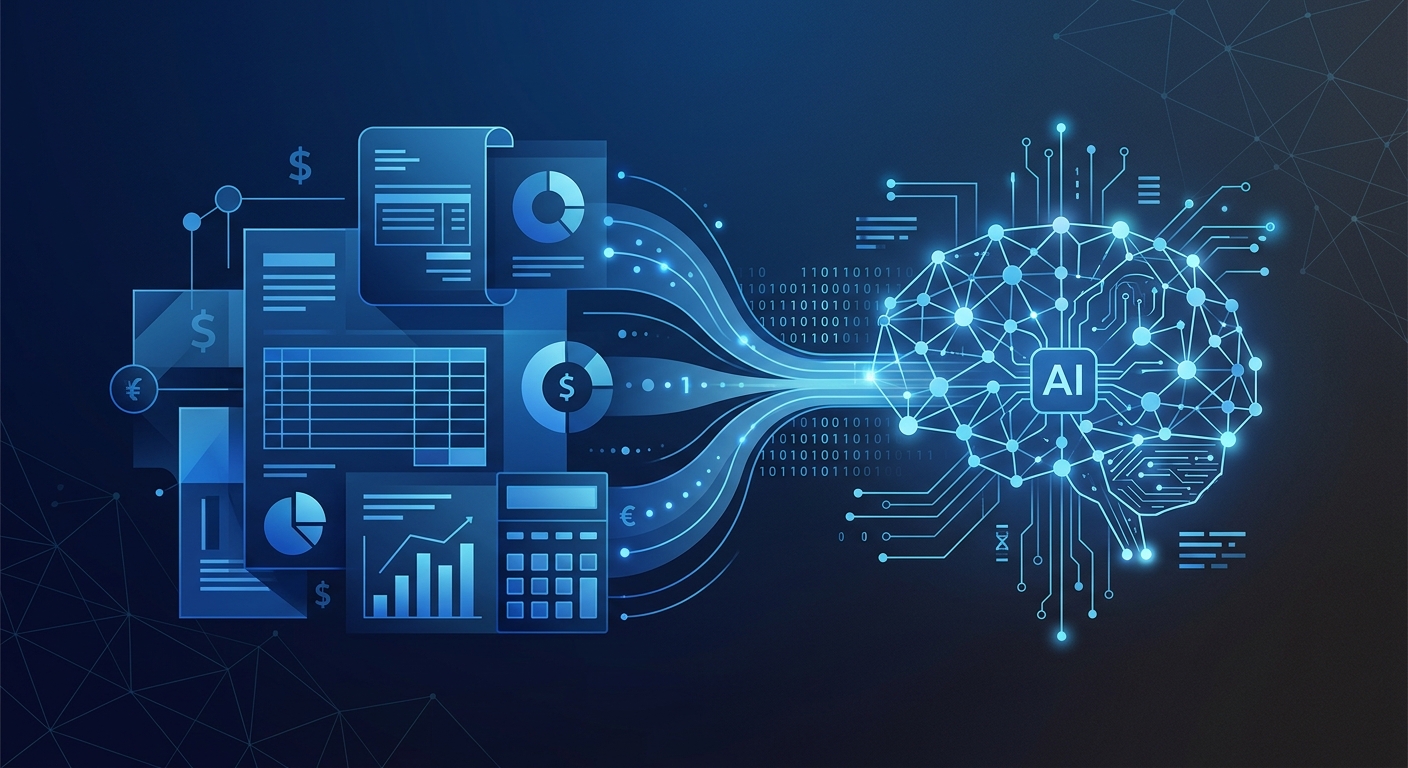
The accounting profession is currently undergoing its most significant evolution since the introduction of the spreadsheet. Generative AI in accounting is a specialized application of Large Language Models (LLMs) and transformer architectures designed to process, interpret, and generate financial narratives, complex tax research, and audit documentation. Unlike traditional automation, which relies on rigid, rule-based logic to process structured data, Generative AI (GenAI) possesses the semantic understanding required to engage with unstructured data—the contracts, emails, and legal memos that comprise a significant portion of a modern firm's knowledge base.
As enterprise decision-makers look to scale their financial operations, understanding the distinction between "calculating" and "reasoning" becomes essential. GenAI does not just sum columns; it explains why the numbers have shifted. According to the Stanford Institute for Human-Centered AI (HAI), approximately 40% of accounting tasks could be automated by AI, signaling a massive shift in labor productivity and the definition of professional value.
Key Takeaways
- Shift to Semantic Processing: GenAI moves beyond numerical calculation to interpret unstructured data like contracts and regulatory filings.
- Efficiency Gains: Research suggests up to 40% of accounting tasks are eligible for AI-driven automation, focusing on narrative and research-heavy workflows.
- Adoption Trends: 75% of accounting firms are currently exploring or implementing GenAI solutions as of 2024.
- Human-in-the-Loop: Effective implementation requires a "Co-pilot" model where human CPAs verify AI-generated drafts to mitigate hallucination risks.
What is Generative AI in Accounting?
Generative AI in accounting is the use of artificial intelligence models to create new content—such as financial reports, tax summaries, or audit notes—based on patterns learned from existing financial data. While traditional AI excels at predictive analytics (e.g., forecasting next month's cash flow based on historical trends), Generative AI focuses on synthesis and creation.
For a CPA, this means the AI can act as a highly sophisticated research assistant. For instance, instead of manually searching through thousands of pages of tax code, an accountant can query a GenAI model to summarize the implications of a new regulatory change on a specific client's portfolio. This capability is rooted in the model's ability to handle unstructured data. Traditionally, accounting software struggled with anything that wasn't in a neat CSV or Excel format. GenAI, however, can read a 50-page commercial lease agreement and extract the specific financial obligations, commencement dates, and escalation clauses required for GAAP compliance.
Key Insight: Generative AI represents a shift from "Calculative AI" to "Cognitive AI," where the system understands the context behind the numbers, not just the values themselves.
Key Benefits of AI in Accounting for Enterprise Firms
For enterprise-level firms, the benefits of Generative AI extend far beyond simple time savings. The primary value lies in improved accuracy and broader access to high-level insights across the organization.
- Narrative Financial Reporting: One of the most time-consuming tasks for controllers is drafting the Management Discussion and Analysis (MD&A) sections of financial reports. GenAI can ingest the raw trial balance and previous reports to draft a high-quality first version of these narratives, highlighting key variances and their likely causes.
- Real-Time Fraud Detection: Traditional fraud detection looks for numerical outliers. GenAI goes further by analyzing narrative data—such as employee expense descriptions or vendor communication patterns—to identify subtle anomalies that suggest collusive fraud or circumvented controls.
- Complex Tax Research: As noted by the AICPA, GenAI is becoming the "next frontier" for the profession by enabling accountants to perform deep-dive research across global tax jurisdictions in seconds rather than hours.
- Enhanced Audit Quality: In digital auditing, GenAI can analyze 100% of a company's transactions rather than relying on statistical sampling. This provides a higher level of assurance and reduces the risk of undetected material misstatements.
Implementation Challenges and Risk Management
Despite the clear advantages, integrating Generative AI into financial workflows carries significant risks. Enterprise leaders must navigate AI "hallucinations" and data sovereignty concerns.
The Hallucination Problem AI models are probabilistic, not deterministic. This means they can occasionally generate facts or citations that appear plausible but are entirely fabricated. In a field as precise as accounting, a hallucinated tax rule or an incorrect interest rate can lead to serious financial and legal consequences. This makes a robust AI agent audit trail essential to ensure every AI-generated claim is traceable back to a source document.
Data Privacy and Security Uploading sensitive client data to public LLMs violates professional ethics and data protection laws such as GDPR and CCPA. Firms must use private, containerized instances of AI models where data is not used to train the underlying public model. For more on this, see our guide on AI agent data privacy compliance.
| Risk Factor | Impact Level | Mitigation Strategy |
|---|---|---|
| Hallucination | High | Mandatory human-in-the-loop verification for all external deliverables |
| Data Leakage | Critical | Use of enterprise-grade, private LLM environments and strict API governance |
| Bias in Models | Medium | Regular testing of AI outputs against standardized datasets |
| Regulatory Non-compliance | High | Deployment of autonomous regulatory change monitoring |
Future Outlook: The Evolving Role of the Strategic Accountant
The widespread adoption of GenAI is fundamentally altering the career trajectory of accountants. According to the AICPA 2024 report, 75% of accounting firms are already exploring GenAI usage. This adoption is moving the profession away from transactional data entry and toward a role focused on strategic advisory.
In this new model, the accountant acts as a "reviewer-in-chief." Instead of spending 80% of their time gathering and cleaning data, they spend 80% of their time interpreting the AI's findings and advising clients on capital allocation, risk mitigation, and business growth. This shift is particularly evident in computer and mathematical occupations, where the focus has moved from coding and calculation to system orchestration.
Key Insight: Accountants will increasingly be judged by how well they question AI and interpret the strategic implications of its answers, not by how well they reconcile accounts.
Technical Integration: From RPA to Agentic AI
Many firms are transitioning from traditional Robotic Process Automation (RPA) to more sophisticated agentic workflows. While RPA is well-suited for invoice exception handling using fixed rules, GenAI agents can handle exceptions that require judgment.
For example, if an invoice doesn't match a purchase order because of a complex discount structure or a change in shipping terms described in an email thread, a GenAI agent can read the email, understand the context, and suggest the correct reconciliation path. This level of enterprise AI agent orchestration represents the next phase of the "Agentic Enterprise."
Best Practices for Deploying GenAI in Accounting
To successfully implement Generative AI, enterprise firms should follow a structured deployment framework:
- Identify Low-Risk, High-Value Use Cases: Start with internal-facing tasks such as drafting memos, summarizing meeting notes, or initial tax research before moving to client-facing deliverables.
- Establish an AI Governance Board: This group should include IT, legal, and senior accounting partners to oversee the ethical and operational risks of AI deployment.
- Invest in Prompt Engineering Training: Accountants must learn how to interact with LLMs effectively to get the most accurate and relevant results.
- Implement Continuous Monitoring: AI models can "drift" over time. Establishing continuous AI agent monitoring protocols ensures that the system's performance stays within acceptable accuracy bounds.
The Impact on Audit and Assurance
Audit is perhaps the area most ready for disruption. The Journal of Accountancy notes that GenAI can significantly affect how auditors approach risk assessment. By using AI to analyze large volumes of unstructured data—such as board meeting minutes, news articles about the client, and industry reports—auditors can identify risks that traditional financial analysis might miss.
Furthermore, the concept of a "continuous audit" becomes feasible. Instead of a year-end scramble, AI agents can monitor transactions in real time, flagging potential issues as they occur. This not only improves audit quality but also gives management more timely information to correct errors or address fraud risks.
Frequently Asked Questions
Can Generative AI replace human accountants?
While AI can automate up to 40% of specific tasks, it is unlikely to replace the need for human CPAs. Instead, it handles the repetitive work of data entry and basic synthesis, allowing humans to focus on high-level judgment, ethics, and strategic advisory. For a deeper look at this trend, see our analysis of jobs replaced by AI.
How does GenAI handle complex tax laws?
GenAI uses Large Language Models trained on large datasets, including tax codes and legal precedents. It can summarize these laws and apply them to specific scenarios, but its output must always be verified by a qualified tax professional to ensure accuracy and compliance with the latest updates.
What are the main risks of using ChatGPT in accounting?
The primary risks include data privacy (uploading sensitive information to public servers), hallucinations (AI generating false facts), and the absence of a clear audit trail. Enterprise firms should use specialized, secure versions of these models rather than the public ChatGPT interface.
Is GenAI better than traditional Excel automation?
They serve different purposes. Excel is best for structured numerical calculations. GenAI is best for unstructured data, narrative generation, and complex research. A modern accounting workflow uses both in tandem.
How should a firm start its AI journey?
Start by identifying a single, non-critical workflow—such as drafting internal emails or summarizing research papers—to test the technology. Focus on building a culture of AI literacy before scaling to core financial processes.
Does GenAI improve fraud detection?
Yes. By analyzing narrative data and communication patterns alongside numerical data, GenAI can identify the subtle signals of fraud that traditional rule-based systems often miss.