From Cost Center to Accountability Engine
Traditional enterprise support functions as a perpetual cost center. High-volume ticket queues consume thousands of labor hours monthly, while legacy chatbots deflect rather than resolve. This linear model ties scalability to headcount, locking organizations into unpredictable operational overhead, continuous training cycles, and seasonal staffing volatility. Achieving autonomous customer resolution requires a fundamental operational shift: moving beyond conversational routing to transactional execution.
Modern AI ticket resolution agents do not simply triage inquiries. They authenticate users, query backend systems, execute policy-bound actions, and definitively close tickets without manual intervention. As generative AI assumes full interaction ownership—executing transactions, coaching human agents in real time, and auditing 100% of interactions for compliance—the strategic focus has shifted from software selection to operational layer architecture (FitGap, 2026). At meo, we hardcode accountability into the workflow architecture. By replacing experimental routing tools with a measurable, pay-for-performance AI workforce, organizations convert support overhead into predictable, outcome-driven capacity.
Architecting the AI Ticket Resolution Workflow
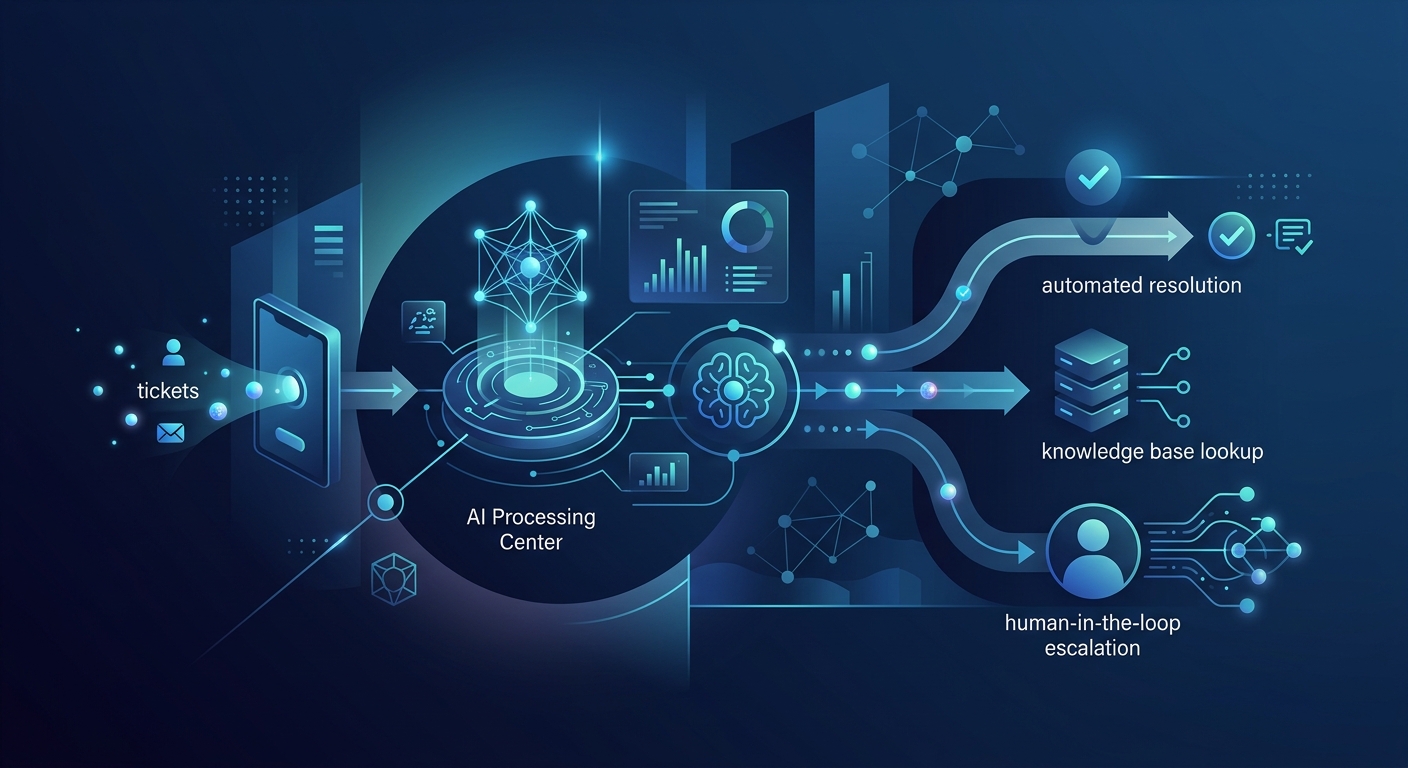
Successful enterprise ticket automation requires precision workflow mapping. Organizations must isolate high-volume, low-complexity resolution paths—password resets, order status verification, return authorizations, and Tier-1 IT provisioning—and engineer deterministic execution paths around them. The architecture operates across three integrated layers: intent classification, tool orchestration, and strict policy enforcement. Rather than relying on open-ended generative prompts, effective agents function within constrained decision trees augmented by real-time API calls. Each node contains explicit access permissions, ensuring the agent can only retrieve data or execute actions authorized by enterprise governance frameworks.
Human-in-the-loop (HITL) fail-safes remain mandatory during initial deployment and for complex edge cases. Workflows are engineered with dynamic confidence thresholds. When resolution certainty drops below a predefined benchmark, or when sensitive data modifications require manual approval, the agent escalates to a human specialist with complete context preservation. This structured progression enables continuous validation and eliminates hallucination-driven errors in production (SlideShare, 2026).
System prompts are explicitly designed for first-contact resolution (FCR), embedding retrieval-augmented generation (RAG) pipelines that pull directly from verified knowledge bases, live inventory systems, and CRM records. Directives replace vague assistance models with exact operational boundaries: retrieve data via secure endpoints, validate policy matrices, draft resolution summaries, and execute authorized transactions. By decoupling conversational generation from transactional execution, the architecture guarantees that every action is auditable, traceable, and aligned with operational SLAs. For organizations ready to deploy this architecture, our Ticket Resolution Agents are engineered for enterprise-grade FCR.
Enterprise Integration & Data Readiness
AI resolution agents are constrained by the data they access and the systems they integrate with. Enterprise deployment requires secure, bidirectional connectivity to CRM platforms, ITSM suites, and centralized knowledge repositories. Data readiness begins with rigorous hygiene protocols: deduplicating legacy records, standardizing ticket taxonomy, and archiving obsolete documentation. Fragmented data degrades agent accuracy; establishing strict permission boundaries is a prerequisite to deployment. Role-based access control (RBAC) ensures AI agents operate exclusively within authorized data silos, preventing unauthorized exposure of PII or financial records.
API orchestration serves as the central nervous system for real-time ticket lifecycle management. Modern deployments utilize event-driven architectures that trigger agent workflows the moment a ticket is created, updated, or escalated. This enables dynamic context injection, allowing the agent to pull live system states, cross-reference historical interactions, and execute resolutions without manual intervention. As organizations integrate AI coworkers into established workflows, the architecture must support seamless data synchronization, version control, and audit logging across all touchpoints (Antier Solutions, 2026). Our Data Integration & Setup framework transforms your existing tech stack into an active, automated resolution engine.
Measuring Outcomes: The Pay-for-Performance Framework
Traditional support models optimize for activity—calls handled, tickets closed per hour, average handle time. These metrics prioritize speed over resolution quality and frequently incentivize premature ticket closure. Measuring an AI support workforce requires a shift to outcome-based KPIs: true resolution rate, mean time to resolution (MTTR), and post-interaction CSAT/NPS. These baselines must be contractually locked during onboarding, establishing clear performance thresholds that dictate operational success.
Transitioning from seat-based licensing to outcome-based AI pricing aligns vendor accountability directly with business impact. Under a pay-for-performance model, organizations only invest when agents deliver verifiable results: resolved tickets, reduced backlog, and maintained SLA compliance. This eliminates the financial risk of underutilized software licenses and transfers the economic burden of experimentation to the provider. Auditing AI performance against SLAs requires continuous telemetry and transparent reporting. Every agent action is logged, creating an immutable audit trail that tracks resolution accuracy, escalation frequency, and policy adherence. When resolution rates fall below contracted thresholds, performance credits trigger automatically, protecting enterprise budgets from service degradation. While most enterprises have initiated AI adoption, fewer than half have implemented rigorous, outcome-aligned pricing structures to prevent cost leakage (IAIUSE, 2025). By adopting Pay-for-Performance Model contracts, organizations convert unpredictable labor overhead into fixed, measurable operational costs. Detailed tracking methodologies are available in our ROI & Performance Metrics framework.
Phased Rollout & Operational Governance
Deploying autonomous customer resolution at enterprise scale demands disciplined, phased execution—not wholesale system replacement. Pilot scoping begins with a narrow, well-defined ticket taxonomy, typically billing inquiries, account updates, or standard IT service requests. This controlled environment validates agent accuracy, refines prompt engineering, and stress-tests API integrations before expanding to high-risk workflows. Clear escalation protocols are equally critical. Governance frameworks must define exact confidence thresholds, compliance checklists, and human takeover triggers. When agents encounter ambiguous intent, regulatory constraints, or multi-system conflicts, tickets route with full contextual handoff, preserving audit continuity and customer experience.
Compliance guardrails are hardcoded into the agent’s decision matrix. Every resolution path is validated against industry regulations, internal data policies, and communication standards, ensuring autonomous operations never bypass legal or security requirements. Continuous optimization is driven by resolution telemetry. Post-deployment analytics capture interaction success rates, failure modes, and sentiment shifts. These insights fuel iterative prompt refinement, knowledge base updates, and workflow recalibration. Leading enterprise solutions prioritize production reliability over isolated demo performance, requiring ongoing monitoring to maintain operational excellence (Lexogrine, 2026). Our Agent Monitoring & Quality Assurance protocols ensure deployments evolve alongside shifting customer demands.
Scaling an Autonomous AI Support Workforce
Once baseline resolution metrics are validated, scaling shifts from headcount recruitment to capacity orchestration. Agents expand across omnichannel touchpoints—email, web chat, voice, and mobile—maintaining consistent resolution logic and compliance guardrails. Capacity forecasting integrates historical ticket volume with predictive demand modeling. AI agents scale elastically during seasonal peaks, product launches, or system outages, eliminating the lag, training costs, and quality variance of traditional temporary staffing.
Long-term ROI crystallizes as organizations systematically replace fixed labor overhead with predictable, outcome-driven operations. Instead of managing escalating payroll and turnover, enterprises lock in fixed resolution costs that scale inversely with operational friction.