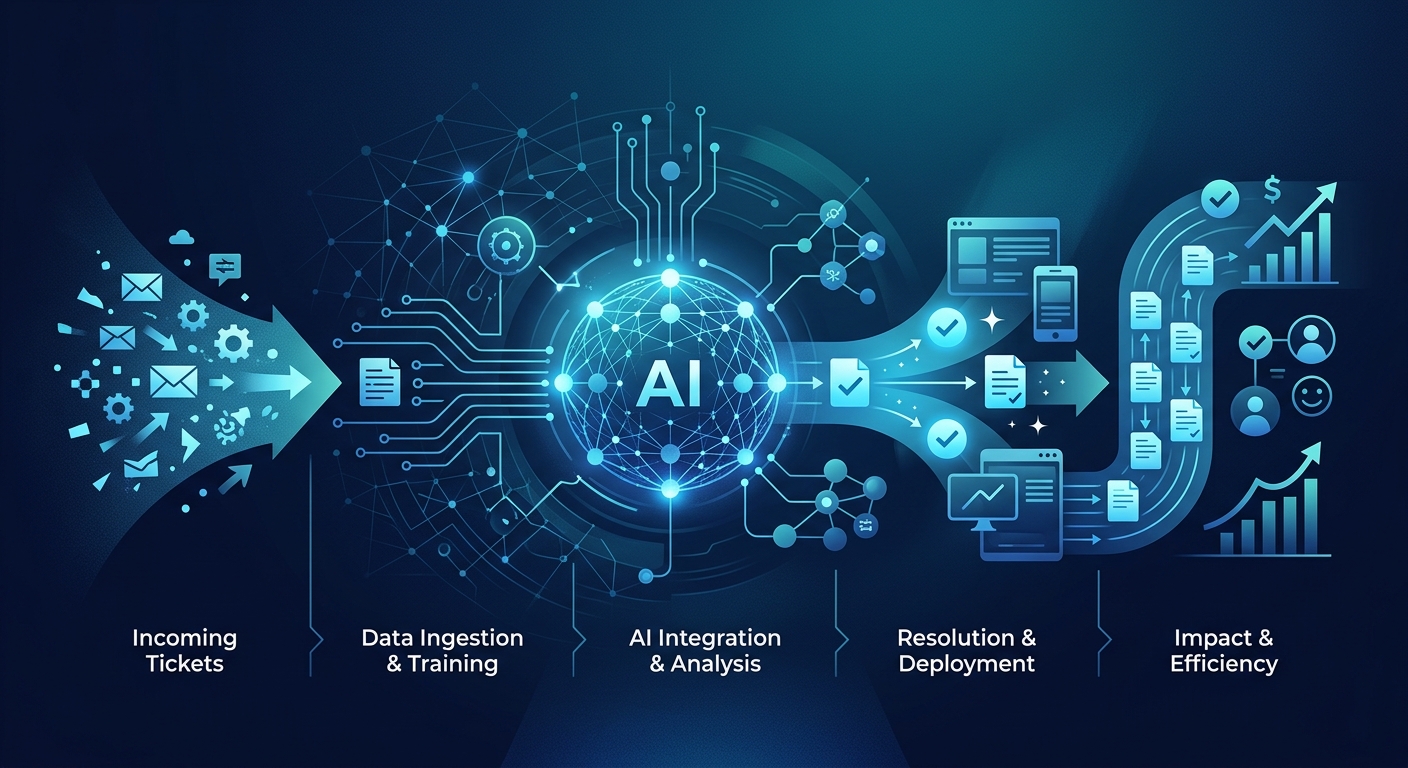
Executive Overview: Shifting from Cost Center to Outcome-Driven Support
Traditional support operates as a linear cost center. Scaling human headcount to match ticket volume inflates labor overhead, extends resolution times, and compounds attrition costs. Enterprises are replacing the headcount-to-growth model with an outcome-driven AI workforce. By deploying autonomous agents across the ticket lifecycle, organizations transform support from a reactive expense into a measurable, scalable function.
Implementation risk remains the primary adoption barrier—paying upfront for technology with unproven ROI. This guide addresses that gap through a pay-for-performance framework, where investment occurs only upon verified ticket resolution. This aligns vendor accountability with operational outcomes and de-risks enterprise-scale deployment.
Phase 1: Audit, Baseline Metrics & Use Case Mapping
Deployment begins with a comprehensive operational audit. Before introducing AI, leadership must quantify baseline resolution rates, first-contact resolution (FCR) percentages, average handle time (AHT), and fully loaded labor costs per ticket. Use this data to isolate high-volume, deterministic workflows—password resets, billing inquiries, order tracking, and standard troubleshooting—that typically represent 60–80% of inbound volume. These tasks require minimal contextual judgment and are optimal for immediate automation.
Define explicit KPIs and ROI thresholds prior to launch. Target specific deflection rates, resolution accuracy, and cost-per-resolution. Without rigorous use-case mapping and predetermined success criteria, AI initiatives devolve into experimental pilots. This framework mandates measurable baselines, ensuring every deployed agent is contractually tied to verifiable business outcomes rather than vague efficiency projections.
Phase 2: Secure Integration & Workflow Architecture
AI agents require secure, bi-directional integration with existing CRM, ERP, and helpdesk platforms (e.g., Salesforce, ServiceNow, Zendesk). Architecture must prioritize API-driven data exchange with strict role-based access controls, enabling agents to read and update tickets without exposing sensitive customer PII. Enterprise adoption demands robust data governance, compliance guardrails (SOC 2, GDPR, HIPAA as applicable), and immutable audit trails. Log every agent action with timestamps and traceable decision pathways.
Engineer deterministic escalation protocols for edge cases. When confidence thresholds fall below parameters, or when multi-system authorization is required, workflows must route seamlessly to human specialists with full context preservation. This hybrid model ensures autonomous handling of routine volume while reserving human expertise for complex, high-value interactions. By designing fail-safe routing and strict data isolation, organizations eliminate compliance exposure while maintaining seamless service continuity.
Phase 3: Knowledge Onboarding & Agent Configuration
Agent efficacy depends entirely on the quality and structure of the operational knowledge base. Ingest historical resolutions, internal SOPs, product documentation, and compliance playbooks into dynamic knowledge graphs. Unlike static FAQ repositories, knowledge graphs enable semantic reasoning, allowing agents to cross-reference policies with real-time system states. Configure decision logic to prioritize deterministic, rule-bound pathways over generative speculation.
Prior to production deployment, execute parallel shadow-mode testing. Route live ticket traffic to agents without granting execution permissions, then benchmark AI-generated resolutions against historical human outcomes. Rigorously measure accuracy, policy adherence, and escalation timing. Authorize autonomous action only when agents consistently meet or exceed human performance thresholds. This validation phase eliminates hallucination risks and enforces strict operational boundaries.
Phase 4: Phased Rollout & Pay-for-Performance Activation
Enterprise transformation requires controlled, iterative deployment. Activate AI capabilities across a single product line or geographic cohort, limiting initial scope to pre-validated deterministic workflows. As agents demonstrate consistent accuracy and SLA compliance, expand scope incrementally.
At this stage, meo’s pay-for-performance model activates. Traditional SaaS licensing charges for capacity; this model charges exclusively for successfully resolved tickets. Outcome-based billing aligns vendor accountability with client ROI, eliminating upfront capital expenditure and transferring financial risk to the provider. Monitor real-time dashboards tracking resolution velocity, deflection rates, CSAT, and cost-per-resolution. Maintain transparent SLA reporting. When performance meets targets, billing scales proportionally. If metrics decline, costs contract automatically. This converts AI implementation from a speculative capital project into a self-funding operational upgrade, ensuring leadership maintains strict financial control while support capacity scales elastically.
Continuous Optimization & Workforce Scaling
Post-deployment, continuous optimization converts temporary efficiency into permanent structural advantage. Implement closed-loop feedback systems that capture escalation triggers, customer corrections, and agent reasoning paths to refine decision trees and systematically reduce error rates. As confidence scores improve, scale agents into adjacent functions—billing, logistics, vendor management, and internal IT support.
Long-term success requires tracking capacity metrics and strategically reallocating human talent from repetitive ticket handling to proactive customer success, retention, and revenue initiatives. By treating AI as an accountable, scalable workforce rather than a static software tool, enterprises permanently decouple support growth from linear labor costs. Continuous model refinement compounds operational leverage while maintaining strict outcome-based accountability.