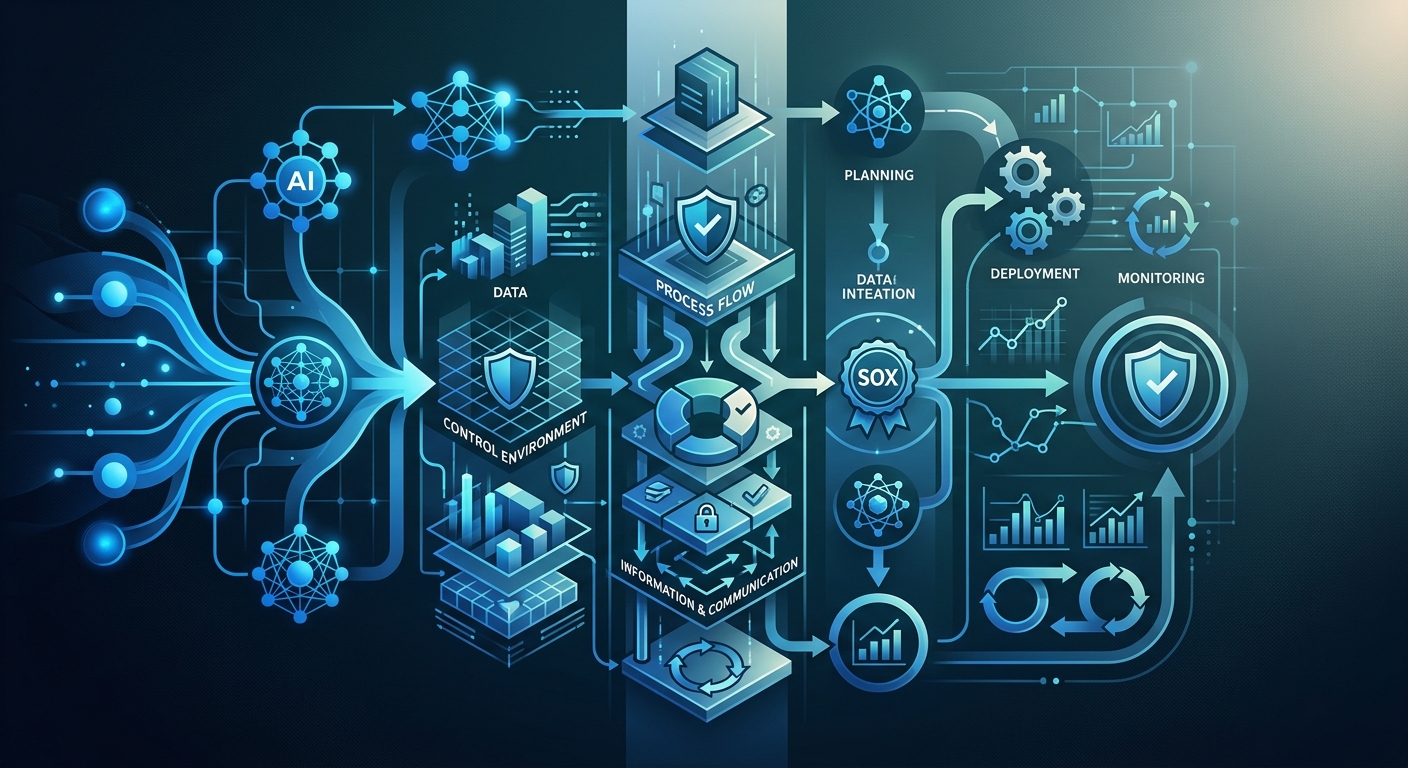
Traditional SOX compliance operates as a reactive, labor-intensive cost center. Finance and internal audit teams expend countless hours extracting data, testing controls, and preparing for external reviews—only to identify exceptions post-quarter. This paradigm has fundamentally shifted. At meo, we treat SOX compliance not as a software purchase, but as the deployment of a scalable, accountable AI compliance agent workforce. Under a strict pay-for-performance model, enterprises invest only when autonomous systems deliver verified control improvements, accelerate audit cycles, and eliminate fixed labor overhead.
The SOX Compliance Bottleneck and the AI Workforce Shift
The financial toll of manual compliance is unsustainable. Chief Audit Executives report that traditional audit preparation consumes up to 30% of annual departmental budgets, driven primarily by manual data reconciliation and sample-based testing Intone CCM. Legacy approaches rely on historical sampling, leaving control gaps undetected until regulators or external auditors intervene. This reactive posture exposes organizations to material weakness findings and inflated consulting fees.
Forward-looking enterprises are transitioning from periodic reviews to regulatory monitoring AI that executes continuous, 100% transaction testing. This shift eliminates the latency between control execution and exception detection. Executive accountability is no longer measured by hours logged, but by outcome metrics: exception reduction rates, control coverage percentages, and accelerated financial close cycles. By redefining compliance as a measurable workforce output, CFOs and Chief Audit Executives can directly align compliance spend with verifiable risk mitigation.
Architecting Autonomous Audit Agents for Financial Controls
Rule-based automation and autonomous audit agents operate on fundamentally different principles. Traditional scripts follow static if/then logic; AI compliance agents learn baseline transaction patterns, adapt to evolving business processes, and dynamically identify anomalies that fall outside predefined thresholds. These agents map directly to SOX Sections 302 and 404 requirements, automating high-friction domains such as segregation of duties (SoD) validation, privileged access reviews, and automated journal entry testing.
To ensure regulatory defensibility, the architecture must incorporate strict human-in-the-loop escalation paths. Agents autonomously flag deviations; final exception classification and remediation require auditor validation before external submission. This design preserves professional skepticism while eliminating manual processing overhead. Because these systems automate tasks that historically bottlenecked audit teams, they are rapidly evolving from experimental tools to mission-critical assets Intone CCM. By embedding governance guardrails and transparent decision logs, enterprises deploy systems that continuously monitor controls, validate effectiveness, and document findings without compromising audit integrity QueryNow.
Phased Implementation Roadmap: From Pilot to Enterprise Scale
Successful deployment requires a structured, de-risked rollout. meo’s methodology aligns compliance automation with enterprise change management across three disciplined phases:
Phase 1: Baseline Mapping & Historical Ingestion Organizations catalog high-risk financial controls and ingest 24 months of historical exception data. Agents process ERP logs, GRC platform records, and audit workpapers to establish behavioral baselines. This phase isolates control fatigue areas, redundant manual checks, and historical failure patterns. A comprehensive governance framework ensures systems operate transparently and align with internal audit standards from day one BeyondScale.
Phase 2: Deploy Risk Assessment AI Workforce Once validated, the risk assessment AI workforce automates transaction sampling, control validation, and exception triage. Agents execute parallel processing across business units, comparing real-time activity against mapped SOX 404 objectives. Internal audit teams transition from data collectors to exception managers, focusing exclusively on escalated anomalies requiring investigative judgment.
Phase 3: Continuous Regulatory Monitoring AI Activation The final phase transitions compliance from periodic testing to continuous oversight. Regulatory monitoring AI enforces real-time policy validation, automatically generating variance reports, updating control documentation, and triggering remediation workflows. Cross-functional alignment between IT, Finance, and Internal Audit is maintained through structured governance councils that review agent performance dashboards, validate escalation accuracy, and adjust control thresholds as business models evolve. This approach ensures zero disruption to financial close while systematically replacing fixed compliance labor with scalable, outcome-driven automation.
Enterprise Integration, Data Security, and Audit Readiness
Deploying autonomous systems requires enterprise-grade architecture. Secure, zero-trust connectors establish encrypted data pipelines between legacy ERPs, cloud infrastructure, and existing GRC platforms. Agents operate within isolated, read-only execution environments to prevent unauthorized data modification. All system actions generate immutable, cryptographically timestamped audit trails that satisfy external auditor documentation standards and SEC reporting expectations.
Data governance frameworks strictly enforce role-based access controls (RBAC) aligned with SOX IT General Controls (ITGC). Only authorized personnel can modify agent parameters, approve exception overrides, or access raw financial datasets. As autonomous systems integrate into core workflows, organizations must govern them as distinct operational entities to maintain strict SEC and SOX compliance Safepaas. By implementing transparent logging, model version control, and automated drift detection, enterprises ensure AI outputs remain defensible during regulatory examinations. This architecture guarantees compliance outputs meet the evidentiary rigor required by PCAOB standards.
Pay-for-Performance: De-Risking Deployment and Proving ROI
The traditional compliance software model charges upfront licensing fees regardless of control effectiveness. meo’s pay-for-performance model eliminates this structural misalignment. Commercial agreements are structured exclusively around verified outcomes: measurable reductions in control exceptions, accelerated quarter-end close timelines, and documented decreases in external audit preparation fees. Enterprises scale investment only when autonomous systems deliver auditable results.
This commercial framework transforms compliance from a fixed-cost labor burden into a variable, performance-driven investment. Organizations track KPIs such as exception detection latency, first-pass control pass rates, and manual testing hour reduction. Industry benchmarks confirm that automated control testing, including AI-driven three-way matching, can eliminate manual reconciliation overhead without inflating compliance costs Safebooks AI. By tying expenditure directly to verified control improvements, CFOs secure predictable compliance spend, transparent ROI attribution, and contractual accountability for every deployed system.
Executive Next Steps: Compliance Readiness Assessment
Transitioning to an AI-powered compliance workforce begins with a targeted readiness assessment. Executives should prioritize control domains characterized by high manual overhead, clear historical exception patterns, and well-documented testing procedures. Establish baseline metrics—including current exception rates, testing cycle times, and external audit preparation costs—before deployment. These baselines serve as contractual success thresholds for performance-based scaling.
Schedule an architecture review with internal audit leadership to map existing SOX 302/404 controls against AI capabilities. Align IT security requirements with zero-trust integration standards and define human-in-the-loop escalation protocols upfront. By validating data accessibility, governance frameworks, and KPI tracking mechanisms early, enterprises deploy a de-risked, outcome-priced compliance workforce that delivers immediate audit readiness.
Conclusion
SOX compliance is transitioning from a labor-heavy obligation to a measurable, outcome-driven function. By deploying AI compliance agents under a strict pay-for-performance model, enterprises eliminate operational guesswork, reduce external audit exposure, and replace reactive sampling with continuous oversight. meo provides the architecture, governance, and commercial structure required to scale autonomous compliance safely and profitably. Schedule a compliance readiness assessment today and transition from fixed overhead to verified results.