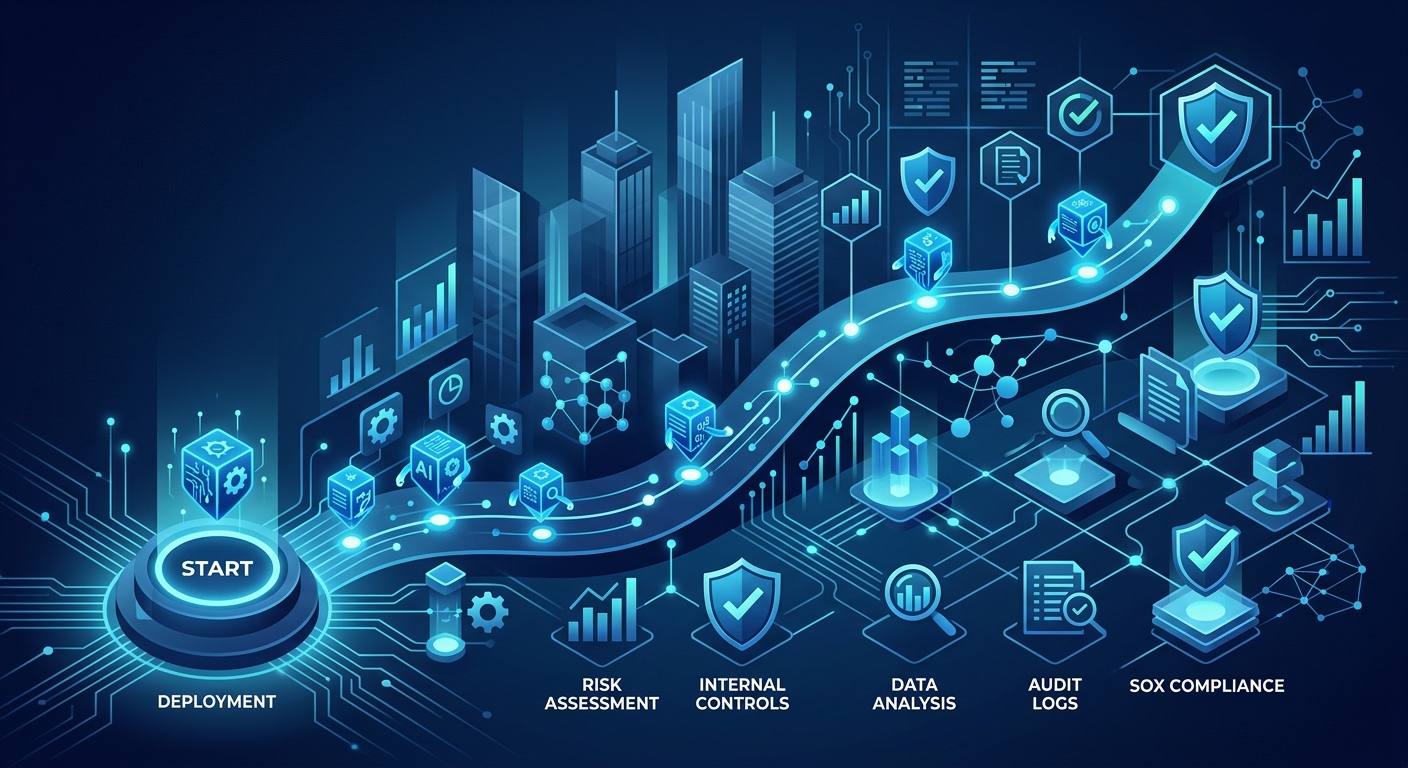
Sarbanes-Oxley (SOX) compliance has evolved from an administrative function into a strategic operational imperative that directly influences capital market trust and enterprise valuation. Yet, traditional audit frameworks remain constrained by manual processes, extended consulting retainers, and static control testing that cannot adapt to dynamic financial ecosystems. At meo, we transform compliance from a fixed cost center into an outcome-driven capability powered by scalable AI workforces. By deploying AI compliance agents under a strict pay-for-performance model, enterprises eliminate labor inefficiencies, guarantee measurable risk mitigation, and align audit expenditures with verified business outcomes.
The SOX Compliance Bottleneck: Why Traditional Audits Fail Today
Manual audit processes create unsustainable overhead and introduce compounding risk across control documentation, evidence collection, and regulatory interpretation. Frameworks such as SOX Sections 302 and 404 demand rigorous, repeatable validation, yet legacy approaches still rely on subjective sampling, manual tracking, and retrospective reviews. Static compliance architectures fail to adapt to real-time regulatory shifts or evolving SEC disclosure mandates, leaving organizations exposed to undiscovered control gaps AI Agents in Regulatory Compliance: 7 Ways They Cut Risk (2026).
Additionally, traditional advisory models operate on billable-hour structures that inherently prioritize consultation time over verified risk mitigation. This structural misalignment drains executive bandwidth, inflates compliance costs, and creates incentives that reward prolonged audit preparation. The market requires a decisive shift from labor-intensive, episodic auditing to continuous, deterministic verification.
How AI Compliance Agents Transform Regulatory Monitoring
Modern regulatory monitoring AI fundamentally restructures how financial controls are validated. Autonomous agents continuously map transactional data against SOX Sections 302 and 404 requirements, replacing quarterly checklists with persistent, context-aware surveillance. Rather than waiting for end-of-period reconciliations, these systems flag transactional anomalies, segregation-of-duty conflicts, and configuration drifts in real time, eliminating retrospective discovery gaps. This capability compresses preparation timelines; documented deployments have reduced SOX audit preparation from months to weeks How AI Agents Cut SOX Audit Prep from Months to Weeks in Financial Services.
Crucially, AI-driven platforms transition organizations from statistical sampling to 100% transaction coverage. Every journal entry, access request, and system change is automatically logged, cross-referenced against control objectives, and compiled into regulator-ready documentation. This eliminates manual evidence gathering and provides external auditors with immutable, traceable records from day one Benefits of AI for Regulatory Compliance in Banking | BizTech Magazine. The result is a continuous audit posture that surfaces control deficiencies before they escalate into material weaknesses.
Building a Scalable Risk Assessment AI Workforce
Deploying a risk assessment AI workforce requires architectural discipline and operational precision. Agents are provisioned as specialized, auditable roles: automated control testers, continuous evidence collectors, and intelligent exception handlers. Machine learning models analyze historical control failures, transactional volumes, and entity risk profiles to dynamically prioritize high-risk areas. This ensures audit scoping and computational resources target the highest probability of material misstatement.
Integration remains seamless; agents connect via secure APIs to legacy ERPs, GRC platforms, and financial subsystems without requiring costly infrastructure overhauls Data Integration & Setup. By decoupling control testing from human bandwidth constraints, enterprises scale compliance capabilities elastically across global subsidiaries and complex organizational structures. The system continuously refines exception thresholds and adapts to new control designs while maintaining strict role-based access and operational transparency.
Implementing Autonomous Audit Agents with Zero Disruption
Enterprise-grade deployment follows a rigorously controlled, phased methodology to eliminate operational friction and preserve audit continuity. Initial sandbox validation ensures agents accurately interpret control matrices and interact safely with production data replicas. Deployment then progresses to parallel execution alongside human audit teams, validating output accuracy, control mapping logic, and exception handling protocols before transitioning to full autonomous operation.
Throughout this lifecycle, strict governance protocols and cryptographic, immutable audit logs ensure compliance with PCAOB standards and satisfy external auditor scrutiny Making AI Agents SOX-Compliant: What I Learned Building an AI-First SDLC in Banking. Executive command centers provide real-time visibility into agent accuracy, exception resolution rates, and overall compliance posture. Security, compliance, and governance frameworks are embedded at the architecture level, ensuring every automated action is traceable, explainable, and aligned with enterprise risk tolerances Security, Compliance & Governance. The result is a seamless operational transition that elevates control assurance without disrupting financial close cycles.
The Pay-for-Performance Model: Aligning Cost with Audit Outcomes
meo’s commercial structure replaces traditional consulting retainers by tying investment directly to verified SOX milestones. Under our Pay-for-Performance Model, organizations transition from unpredictable hourly billing to outcome-based pricing. AI compliance agents are compensated strictly upon delivering measurable, audit-ready outputs—such as successfully executed control tests, validated exception reports, and complete documentation packages prepared for external review. This performance guarantee shifts execution risk from the enterprise to the vendor.
During peak audit cycles, regulatory investigations, or M&A activity, the agent network scales elastically to absorb increased transactional volume without triggering permanent FTE hiring or overhead expansion. Organizations pay only for verified compliance outcomes, not idle hours or exploratory phases. This model transforms compliance from a fixed liability into a variable, results-driven operational expense that scales precisely with regulatory complexity and business growth. By aligning vendor compensation with actual audit readiness, enterprises eliminate financial waste while guaranteeing accountability across the compliance lifecycle.
Executive Roadmap: Measuring ROI and Future-Proofing Compliance
Measuring success requires rigorous, auditable KPIs: audit cycle time reduction, control failure rates, and external audit pass percentages. Establishing continuous optimization loops enables risk and compliance leaders to refine decision thresholds, integrate new regulatory frameworks, and expand automated coverage across emerging business units. Leadership must treat compliance infrastructure as a dynamic capability rather than a static, annual checkbox exercise.
By architecting systems that accommodate evolving SEC climate disclosures, cybersecurity reporting mandates, and emerging AI governance standards, organizations future-proof their risk posture AI Agents for Compliance. Track measurable impact through transparent reporting dashboards and align every compliance investment with strategic business outcomes ROI & Performance Metrics. Organizations that deploy accountable, autonomous agents today will establish a durable competitive advantage in tomorrow’s capital markets.
Conclusion
SOX compliance has evolved from a periodic obligation to a continuous operational mandate. Manual processes and traditional consulting models cannot sustain the velocity or precision modern financial controls require. By deploying autonomous audit agents under a pay-for-performance framework, enterprises eliminate labor inefficiencies, guarantee real-time monitoring, and secure regulator-ready documentation at scale. At meo, we deliver accountable AI workforces that succeed only when your compliance posture does. Schedule a strategic deployment assessment to transition from retrospective auditing to predictive, outcome-driven control assurance.