Introduction
Traditional Anti-Money Laundering (AML) screening is misaligned with the velocity of modern financial crime. Financial institutions no longer face an alert shortage; they face an operational efficiency crisis. Deploying autonomous AI compliance agents transforms screening from a fixed-cost liability into a scalable, outcome-driven function. By adopting a performance-based pricing model, executives eliminate rigid licensing fees and linear headcount growth, funding only verified compliance results. This guide details the architecture, deployment protocol, and economic shift required to operationalize autonomous compliance infrastructure.
The AML Screening Bottleneck in Traditional Compliance
Legacy rule-based engines routinely generate false-positive rates exceeding 90%, overwhelming manual review teams and inflating operational costs. This inefficiency delays investigations, increases regulatory exposure, and diverts analyst hours from actual threat detection. As FinCEN, FATF, and the EU’s Anti-Money Laundering Authority (AMLA) intensify oversight, static workflows and rigid logic matrices can no longer meet modern compliance demands. Regulatory change management alone consumes thousands of analyst hours annually, pulling resources away from strategic threat detection. Organizations must transition from capacity-constrained screening to a scalable infrastructure that directly ties compliance expenditure to measurable risk reduction.
Architecting the Regulatory Monitoring AI Framework
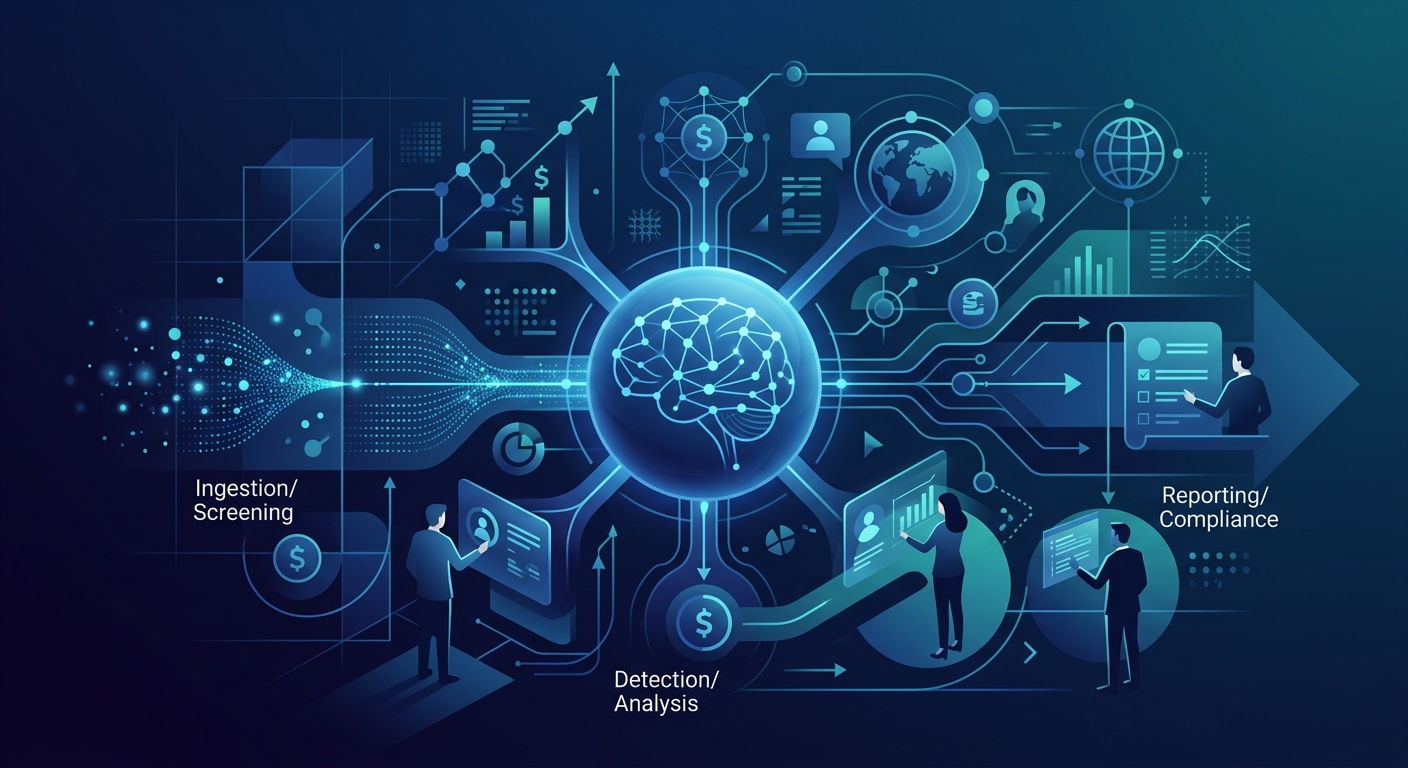
Effective regulatory monitoring requires shifting from passive software to autonomous agents operating within deterministic guardrails. Unlike assistive tools that merely recommend actions, enterprise-grade AI agents execute defensible screening decisions at scale. The architecture must embed immutable, regulator-grade audit trails and integrate seamlessly with core banking systems via secure, non-disruptive APIs. This design preserves existing data governance while delivering real-time, audit-ready documentation. Institutions that embed AI compliance into their foundational architecture achieve higher operational trust, reduced systemic risk, and streamlined regulatory reporting without fragmenting existing workflows.
Step-by-Step Enterprise Deployment Protocol
Successful deployment follows a phased protocol engineered to mitigate integration risk and validate performance against historical baselines.
- Phase 1: Data & Integration Readiness. Audit entity resolution quality, transaction metadata lineage, and global watchlist alignment. Establish secure API pathways and verify infrastructure integrity before live deployment.
- Phase 2: Controlled Rollout & Human-in-the-Loop. Deploy agents in jurisdiction-specific tiers, validating precision, recall, and latency against analyst benchmarks. Configure automated escalation thresholds to route complex SAR/STR candidates to senior investigators while autonomously clearing routine false positives.
- Phase 3: Continuous Validation & SLA Enforcement. Implement adversarial testing, synthetic stress scenarios, and back-testing against known typologies. Activate real-time dashboards tracking precision metrics, suppression rates, and case velocity. This methodology ensures AI integration remains predictable, auditable, and fully aligned with enterprise risk tolerances.
Operationalizing the Risk Assessment AI Workforce
A risk assessment AI workforce requires continuous adaptation to evolving financial crime tactics. Static models degrade rapidly as criminals deploy novel obfuscation techniques and cross-jurisdictional laundering networks. Modern AI agents counter this through automated drift detection and dynamic behavior modeling, recalibrating risk parameters as new patterns emerge. Regulatory updates—including sanctions lists, PEP classifications, and jurisdictional directives—are synchronized across all screening nodes within minutes of publication. To guarantee accountability, enterprises must enforce strict performance SLAs contractually tied to screening velocity, precision thresholds, and false-positive suppression. Treating AI as a measurable workforce extension transforms compliance from a reactive cost center into a proactive risk function.
Shift to Pay-for-Performance Compliance Economics
Traditional procurement—characterized by fixed licensing, perpetual maintenance fees, and linear headcount scaling—is economically unsustainable. Meo’s pay-for-performance model replaces sunk costs with strictly outcome-based investments. Autonomous audit agents are compensated exclusively upon delivering verified results: cleared alerts, audit-ready documentation packages, and accelerated SAR/STR filing. ROI is calculated through transparent, contractually binding metrics tracking labor cost reduction, investigation throughput acceleration, and direct penalty mitigation. Aligning vendor compensation with verified outcomes eliminates capital waste on underperforming technology and ensures strict alignment with executive risk tolerance and board-level accountability mandates.
Executive Readiness & 90-Day Implementation Roadmap
Enterprise-scale AI compliance requires disciplined executive alignment and structured governance.
- Days 1–30: Unify the C-suite (CCO, CRO, CIO) around shared accountability metrics, data sovereignty boundaries, and baseline performance targets. Establish foundational governance protocols to guarantee model transparency, secure data routing, and automated regulatory reporting.
- Days 31–60: Transition from isolated pilots to controlled, cross-functional scaling. Risk teams stress-test agent performance under production-level alert volumes and adversarial scenarios.
- Days 61–90: Activate Meo’s performance-based pricing model, shifting financial accountability entirely to measurable compliance outcomes and verified case resolutions. This structured pathway ensures deployment remains tightly coupled with institutional risk governance and transparent ROI targets.
Conclusion
The era of treating AML screening as an unpredictable, fixed-cost liability is over. Meo transforms compliance into an accountable, scalable workforce that delivers measurable risk reduction, audit readiness, and executive-level ROI transparency. Deploy AI compliance agents that operate exclusively on verified outcomes. Schedule your enterprise readiness assessment today to transition from compliance overhead to performance-driven risk management.