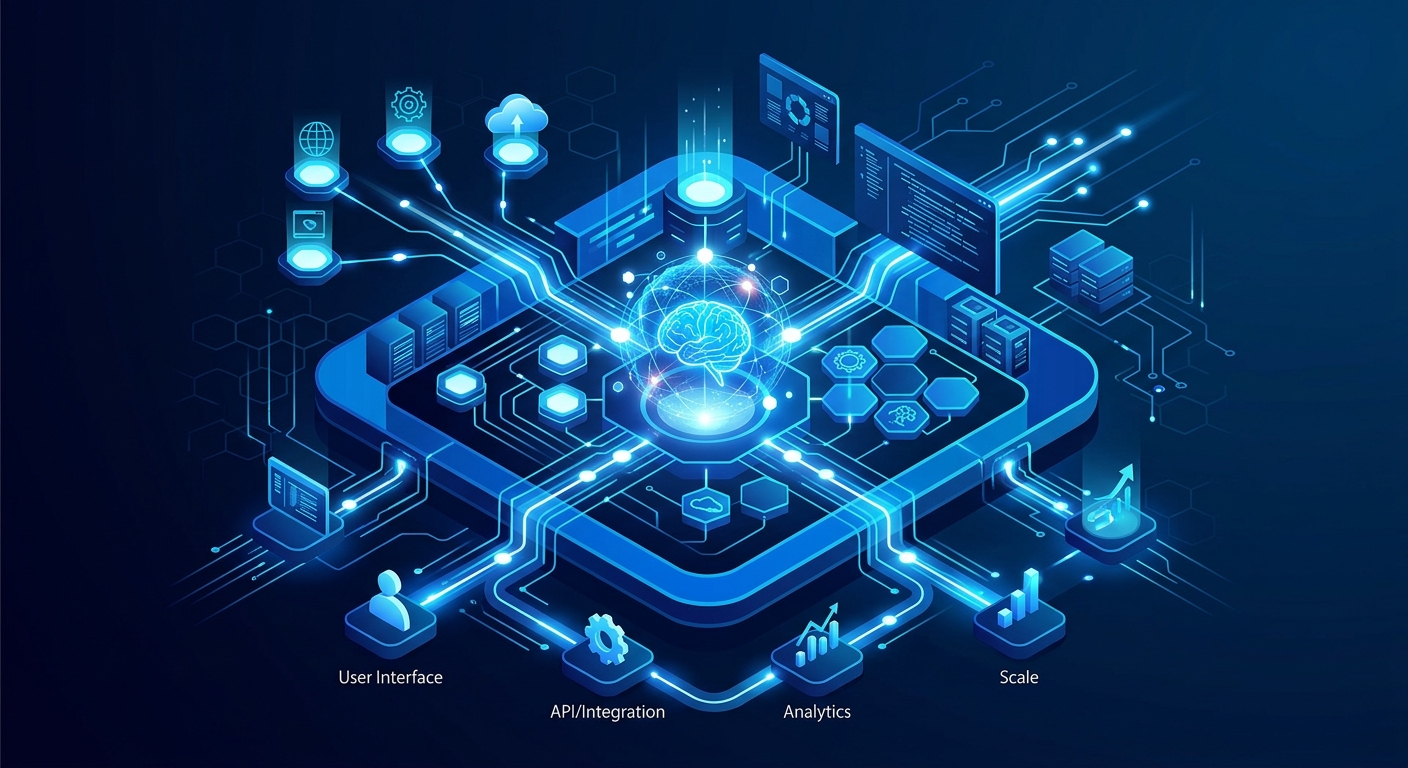
Artificial Intelligence as a Service (AIaaS) is a third-party offering of artificial intelligence (AI) outsourcing that allows individuals and companies to experiment with AI for various purposes without a large initial investment and with lower risk. This model has transformed how modern organizations approach digital transformation, shifting the focus from building proprietary hardware stacks to consuming high-level intelligence through cloud-based interfaces.
Key Takeaways
- Democratization: AIaaS allows small businesses to access advanced technology without massive upfront infrastructure investment.
- Efficiency: NLP-driven chatbots provide instant responses for customer service, significantly reducing response times.
- Scalability: AI solutions help businesses compensate for skilled labor shortages by automating complex analytical tasks.
- Competitive Edge: Real-time market research tools powered by AI analyze competitor strategies to inform product decisions.
What Is AI as a Service (AIaaS)?
Artificial Intelligence as a Service (AIaaS) is a specialized cloud computing delivery model where AI capabilities are provided to users over the internet by a service provider. In this framework, the provider manages the underlying infrastructure, software, and computational power required to run complex machine learning (ML) models, while the client pays for access to these capabilities, often on a subscription or pay-per-use basis.
According to research published in Business & Information Systems Engineering, the field of AIaaS is currently characterized by fragmented terminology across multiple disciplines, but its core value remains the same: the commodification of intelligence. It functions similarly to Software as a Service (SaaS), where the technical complexity of maintaining neural networks is abstracted away from the end user.
For many organizations, especially those navigating Jobs Replaced by AI, AIaaS provides a transition path. Instead of replacing human capital entirely, it augments existing workflows by providing tools that would otherwise be cost-prohibitive to develop in-house.
How Does AIaaS Work?
AIaaS works by using cloud infrastructure to host pre-trained models or training environments. When a business integrates an AIaaS solution, it typically connects via an Application Programming Interface (API). This API acts as a bridge, sending data from the business's local systems to the provider's cloud environment, where the AI model processes the information and returns a result.
"AI can improve efficiency, which can help business owners save time. It can also save on costs and help your business stay competitive in times of mounting inflation." — U.S. Small Business Administration (SBA)
The workflow generally follows these steps:
- Data Ingestion: The client sends raw data (text, images, or structured numbers) to the provider.
- Processing: The provider's high-performance computing clusters run the data through optimized algorithms.
- Output: The system returns a prediction, classification, or generated content back to the client application.
- Refinement: Many platforms allow for "fine-tuning," where the client provides specific feedback to improve the model's accuracy for their particular industry niche.
Types of AI as a Service (AIaaS)
Understanding the AIaaS landscape requires categorizing the different ways these services are delivered. Not all AIaaS is built the same; some offerings are "black box" APIs while others are flexible development platforms.
1. Bots and Digital Assistants
This is perhaps the most visible form of AIaaS. It includes NLP-driven chatbots and virtual assistants that handle customer service inquiries. The University of Cincinnati notes that these tools provide instant responses, allowing customers to resolve queries without waiting for human intervention.
2. Cognitive Computing APIs
These are specialized services that allow developers to add specific AI features—such as computer vision, speech-to-text, or sentiment analysis—into their existing software without needing to understand the underlying math. They are often used in AI Agent Solutions to give bots the ability to "see" or "hear."
3. Machine Learning Frameworks
For organizations with data scientists, these platforms provide the foundational infrastructure for building custom models. They offer pre-built environments with libraries like TensorFlow or PyTorch, allowing teams to train models on the provider's high-performance GPUs rather than purchasing their own.
4. Fully Managed AI Platforms
These offer an end-to-end workflow, from data labeling to model deployment. They are designed for enterprises that want custom AI solutions but lack the specialized DevOps expertise to manage the lifecycle of a model in production.
Core Features of AIaaS Platforms
When evaluating an AIaaS provider, enterprise leaders should look for specific core features that ensure the platform is robust enough for professional use.
| Feature | Description | Business Value |
|---|---|---|
| Pre-trained Models | Ready-to-use models for common tasks like translation or image recognition. | Faster time-to-market. |
| AutoML Capabilities | Automated tools that select the best algorithm for your data. | Reduces the need for PhD-level data scientists. |
| API Access | Standardized connectors for integrating AI into existing ERP/CRM systems. | Seamless workflow integration. |
| Scalability | The ability to handle 100 or 1,000,000 requests without manual intervention. | Ensures performance during peak demand. |
| Data Governance | Tools for tracking data lineage and ensuring compliance. | Vital for AI Agent Data Privacy Compliance. |
Benefits of Adopting AI as a Service
The advantages of AIaaS extend beyond simple cost savings. According to the Crunchbase Blog, small businesses can gain a significant competitive edge by using AI tools to enhance their products and services.
- Reduced Upfront Costs: Traditional AI development requires massive capital expenditure (CapEx) for hardware. AIaaS converts this into an operational expense (OpEx).
- Access to Specialized Talent: By using AIaaS, companies effectively "rent" the expertise of the world's leading AI researchers who work for the providers.
- Compensating for Labor Shortages: In a tight job market, AIaaS can automate routine analytical tasks, as highlighted by the SBA.
- Continuous Improvement: Providers constantly update their models. When a provider like OpenAI or Google improves their underlying engine, every AIaaS subscriber benefits immediately without needing to rewrite code.
Common Applications of AIaaS in Enterprise
AIaaS is no longer a futuristic concept; it currently powers critical business functions across industries.
- Customer Service Excellence: NLP enables chatbots to provide instant responses to customer service queries, improving satisfaction scores and lowering churn University of Cincinnati.
- Market Research: AI-powered tools analyze competitor strategies and customer behavior in real time, offering insights into market trends Crunchbase Blog.
- Predictive Maintenance: In industrial settings, AIaaS platforms process IoT data to predict equipment failure before it happens, as detailed in our guide on Predictive Maintenance.
- Sales Automation: Using Enterprise AI Sdr Deployment Strategy, companies can scale outreach using AIaaS-driven personalization.
Strategic Challenges: Data Residency and Sovereignty
A significant gap in most AIaaS discussions is the issue of data residency. When using a global AIaaS provider, your data may cross international borders. This has profound implications for businesses operating in highly regulated regions like the EU or Singapore.
Key Insight: Using AIaaS across international jurisdictions subjects data to the specific laws of the country where it is processed. Achieving true data sovereignty requires that cloud content and technical support data are locked to the home country or region.
Organizations must ensure their provider offers "region-locking" to prevent data from being processed in jurisdictions with weaker privacy protections. This is a critical component of AI Agent Data Privacy Compliance.
Calculating the Break-Even Point: AIaaS vs. Self-Hosting
While AIaaS is cost-effective initially, there is a "break-even point" where the volume of requests makes self-hosting more economical. Organizations calculate this by comparing API token pricing against the Total Cost of Ownership (TCO) for self-hosting (including hardware, power, and engineering salaries).
Research indicates that for premium models, the economic threshold for switching to self-hosted open-source models typically occurs at a volume of 5 to 10 million tokens per month. Below this volume, the overhead of managing local infrastructure usually outweighs the savings on API fees.
Best Practices for Adopting AIaaS
To maximize ROI, enterprises should follow a structured adoption framework:
- Start with a Pilot: Choose a high-impact, low-risk use case like Invoice Exception Handling.
- Audit for Bias: Regularly review the outputs of AIaaS models to ensure they align with corporate ethics and do not introduce algorithmic bias.
- Implement Monitoring: Use Continuous AI Agent Monitoring Protocols to track performance and cost in real time.
- Avoid Vendor Lock-in: Design your architecture with an abstraction layer so you can switch AIaaS providers if pricing or model quality changes.
Frequently Asked Questions
What is the difference between AIaaS and SaaS?
SaaS (Software as a Service) provides a finished software application for a specific task. AIaaS (AI as a Service) provides the underlying intelligence or machine learning capabilities that can be integrated into many different applications.
Is AIaaS secure for sensitive financial data?
Security depends on the provider's compliance certifications (SOC2, HIPAA, etc.). Most enterprise-grade AIaaS providers offer private instances where data is not used to train their public models, ensuring higher security.
How much does AIaaS cost?
Costs vary widely. Most providers use a "pay-as-you-go" model based on tokens (units of text), images processed, or compute hours. Small businesses can often start for under $100/month, while enterprises may spend thousands.
Do I need a data scientist to use AIaaS?
Not necessarily. Many AIaaS offerings are "low-code" or "no-code," allowing business analysts or software developers to implement AI features via simple APIs or drag-and-drop interfaces.
Can AIaaS help with regulatory compliance?
Yes, there are specialized AIaaS agents designed for Automated Regulatory Change Tracking that monitor legal updates and flag risks automatically.
What are the main risks of AIaaS?
The primary risks include vendor lock-in, where it becomes difficult to move your data or models to another provider, and "black box" risk, where you cannot see exactly how the AI reached a specific conclusion.