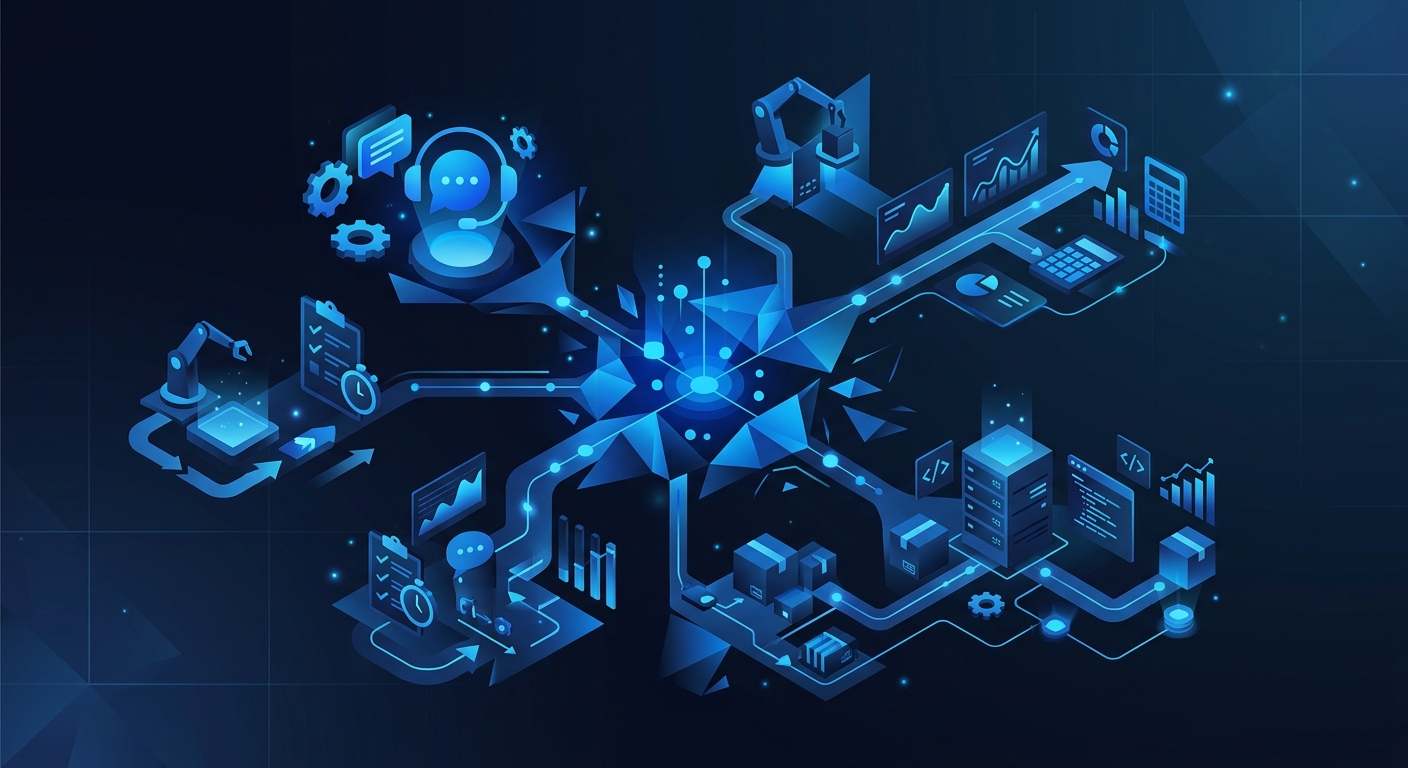
Introduction to AI Agents in the Enterprise
An AI agent is an autonomous software system that perceives its environment, reasons through complex problems, and takes direct action to achieve specific goals. Unlike traditional software that requires step-by-step instructions, an AI agent operates on a goal-oriented basis. For example, instead of a user manually filtering a spreadsheet, an AI agent can be told to "find and resolve all billing discrepancies for January," and it will independently access the necessary databases, compare records, and issue corrections.
The shift from generative AI to agentic AI represents a transition from 'chat' to 'do.' While generative AI focuses on creating content, agentic AI focuses on task execution through AI Agent Solutions. This evolution is critical for enterprises looking to scale operations without linear increases in headcount. Recent data suggests that 82% of enterprises are already exploring or deploying AI automation, including agents, to maintain competitive advantage in a rapidly digitizing market IBM Topics.
Key Takeaways
- Autonomy is the Differentiator: Unlike chatbots, AI agents can execute multi-step workflows across different software platforms without human intervention.
- Significant Time Savings: AI agents can save users up to 10 hours per week on routine tasks and manual job application processes V7 Labs.
- Diverse Frameworks: Building these agents requires specialized stacks like LangGraph for multi-agent orchestration or CrewAI for rapid prototyping.
- Five Logical Types: Intelligent agents range from simple reflex agents to complex learning agents that improve over time through environmental feedback.
What are Intelligent Agents? Core Capabilities and Logic
An intelligent agent is a system that uses sensors to perceive its environment and actuators to act upon that environment. In the context of enterprise software, 'sensors' are often APIs or data streams, while 'actuators' are the functions that allow the agent to write data, send emails, or trigger code deployments.
The core logic of an intelligent agent follows a perception-action cycle. The agent receives an input, processes it using a 'brain'—typically a Large Language Model (LLM)—determines the best course of action based on its available tools, and executes that action. This makes them significantly more capable than traditional robotic process automation (RPA), which relies on rigid, rule-based scripts.
"AI agents are distinguished from standard AI by their ability to perceive their environment, reason, and take autonomous actions to achieve goals." — IBM Research on Intelligent Agents
How AI Agents Work: The Architecture of Autonomy
To understand how these agents function in a business setting, we must look at their internal architecture. Most modern agents use a four-pillar structure:
- Perception: The agent monitors specific triggers, such as an incoming customer email or a drop in server performance.
- Reasoning: Using LLMs, the agent breaks a high-level goal into a series of sub-tasks. This is often referred to as 'chain-of-thought' reasoning.
- Memory: Agents use short-term memory (context windows) and long-term memory (vector databases) to maintain state across complex, multi-day tasks.
- Action: The agent uses 'tools'—pre-defined functions or API calls—to interact with the world.
This architecture allows for AI Agent Data Privacy Compliance while ensuring that the agent remains grounded in real-world data rather than just generating text.
AI Agents vs. Chatbots and Virtual Assistants
While the terms are often used interchangeably, there is a fundamental technical divide between a chatbot and an AI agent.
| Feature | Chatbot / Virtual Assistant | AI Agent |
|---|---|---|
| Core Purpose | Provide information and answer questions | Execute tasks and achieve objectives |
| Interaction | Reactive (waits for user prompt) | Proactive (can initiate actions based on goals) |
| Tool Use | Limited (mostly text-based) | Extensive (can use APIs, browse the web, write code) |
| Reasoning | Pattern matching and retrieval | Multi-step planning and self-correction |
| Outcome | A text-based response | A completed task (e.g., a booked flight or paid invoice) |
For enterprise leaders, understanding this distinction is vital for calculating ROI & Performance Metrics. A chatbot might reduce call volume by providing FAQs, but an AI agent reduces operational costs by resolving the tickets itself.
7 Types of AI Agents and Their Logic
Intelligent agents are classified based on their level of intelligence and the complexity of the environments they operate in.
1. Simple Reflex Agents
Simple reflex agents act only on the basis of the current perception, ignoring the rest of the percept history. They follow an 'if-then' logic. For example, a basic email filter that moves any message containing the word "Invoice" to a specific folder is a simple reflex agent.
2. Model-Based Reflex Agents
These agents maintain an internal state that depends on the percept history and reflects at least some of the unobserved aspects of the current state. They are useful in environments where the agent cannot see everything at once, like a warehouse robot navigating around obstacles it previously encountered.
3. Goal-Based Agents
Goal-based agents expand on model-based agents by having a specific objective. They don't just react to the current situation; they choose actions that lead toward a desired goal. In business, an Enterprise AI Sdr Deployment Strategy often uses goal-based agents to move a lead through the sales funnel.
4. Utility-Based Agents
These agents go a step further by not just reaching a goal, but reaching it in the most efficient way. They use a utility function to rank different paths to a goal based on cost, time, or risk.
5. Learning Agents
Learning agents can operate in initially unknown environments and become more capable than their initial knowledge might allow. They use a 'learning element' to improve their performance over time based on feedback from a 'critic.'
6. Multi-Agent Systems (MAS)
In a multi-agent system, several agents work together to solve a task. One agent might be responsible for data retrieval, while another focuses on analysis, and a third on reporting. This is the foundation of Enterprise AI Agent Orchestration.
7. Hierarchical Agents
These agents use a 'manager' agent to oversee several 'worker' agents. The manager breaks down the high-level goal and assigns specific sub-tasks to the workers, ensuring a structured approach to large enterprise projects.
Real-World AI Agent Examples by Industry
Finance: Autonomous Trading and Fraud Detection
In finance, AI agents execute high-frequency trades based on sentiment analysis of news feeds. Beyond trading, they act as AI Agents for Invoice Exception Handling, identifying and resolving discrepancies in thousands of transactions without human oversight.
Healthcare: Patient Monitoring and Diagnostics
Healthcare agents monitor real-time vitals from wearable devices. If an agent detects an anomaly, it doesn't just alert a doctor; it can cross-reference the patient's medical history, check for drug interactions, and prepare a preliminary diagnostic report for the physician to review.
Cybersecurity: Autonomous Red-Teaming
As noted by NIST, AI models face unique threats. Cybersecurity agents proactively defend networks by running autonomous red-teaming exercises—simulating attacks to find vulnerabilities before malicious actors do. They also manage autonomous patch deployment, applying fixes across global infrastructure in minutes.
Intelligent Agent Examples in Customer Experience
Customer service is the most mature field for AI agent deployment. Modern agents can now handle complex, multi-modal interactions.
- Refund Processing: An agent can verify a customer's purchase, check the return policy, confirm the item has been received at the warehouse, and initiate the bank transfer.
- Technical Support: Agents can access a user's log files, identify the error code, and walk the user through a resolution—or apply a remote software fix directly.
- Proactive Retention: Agents can analyze usage patterns to identify customers at risk of churning and autonomously offer a personalized discount or schedule a success call.
Measuring the success of these deployments requires specific frameworks, such as Measuring AI Agent ROI For Enterprise Customer Support Automation.
Building AI Agents: Frameworks and Technical Requirements
Building these systems from scratch requires more than just an LLM API. Developers must choose an 'agentic framework' that provides the scaffolding for autonomy.
Key Insight: To build production-grade agents, developers are moving away from simple prompt chains toward stateful orchestration frameworks like LangGraph, which allow for cycles and self-correction loops in the agent's logic.
Common Frameworks Include:
- LangGraph: Ideal for stateful, multi-agent orchestration where agents need to hand off tasks to one another.
- CrewAI: A popular choice for rapid prototyping of collaborative agent 'crews' that work together on a single objective.
- AutoGen (AG2): Microsoft's framework for creating multi-agent conversation loops that can solve complex coding and reasoning tasks.
- LlamaIndex: Essential for agents that require heavy RAG (Retrieval-Augmented Generation) capabilities to navigate large internal knowledge bases.
Managing Risk: Hallucinations and Security Protocols
A significant concern for enterprise leaders is the risk of 'hallucinations'—where an AI agent confidently performs an incorrect action. While zero-hallucination models are theoretically impossible, developers use strategies like 'Human-in-the-Loop' (HITL) for high-stakes tasks and 'Agentic Risk Standards' to manage liability.
For security, granting an agent 'write access' to enterprise databases requires rigorous protocols. Organizations should implement OAuth with short-lived access tokens and use 'Agent Action Governance' frameworks. This ensures that every action taken by an agent is logged, auditable, and reversible. For further reading on maintaining these systems, see Continuous AI Agent Monitoring Protocols.
Frequently Asked Questions
What is a real-world example of an AI agent?
A common example is an autonomous SDR (Sales Development Representative) that researches prospects on LinkedIn, writes personalized emails, handles objections, and schedules meetings directly on a salesperson's calendar.
How do AI agents save 10 hours a week?
They automate the manual work between apps. For instance, an agent can automatically extract data from a PDF, update a CRM, and notify a Slack channel, saving the hours a human would spend on data entry and context switching Wrike.
Can AI agents replace human jobs?
While AI agents automate tasks, they typically reshape roles rather than eliminate them. For a detailed breakdown, see our guide on Jobs Replaced by AI.
What software is needed to build an AI agent?
You need an LLM (like GPT-4o or Claude 3.5), an orchestration framework (like LangGraph or CrewAI), and a way to connect to external tools (APIs or SDKs).
Are AI agents secure for business use?
Yes, provided they are implemented with 'Least Privilege' access and robust AI Agent Data Privacy protocols. Enterprise-grade agents operate within secure sandboxes and require human approval for financial transactions.