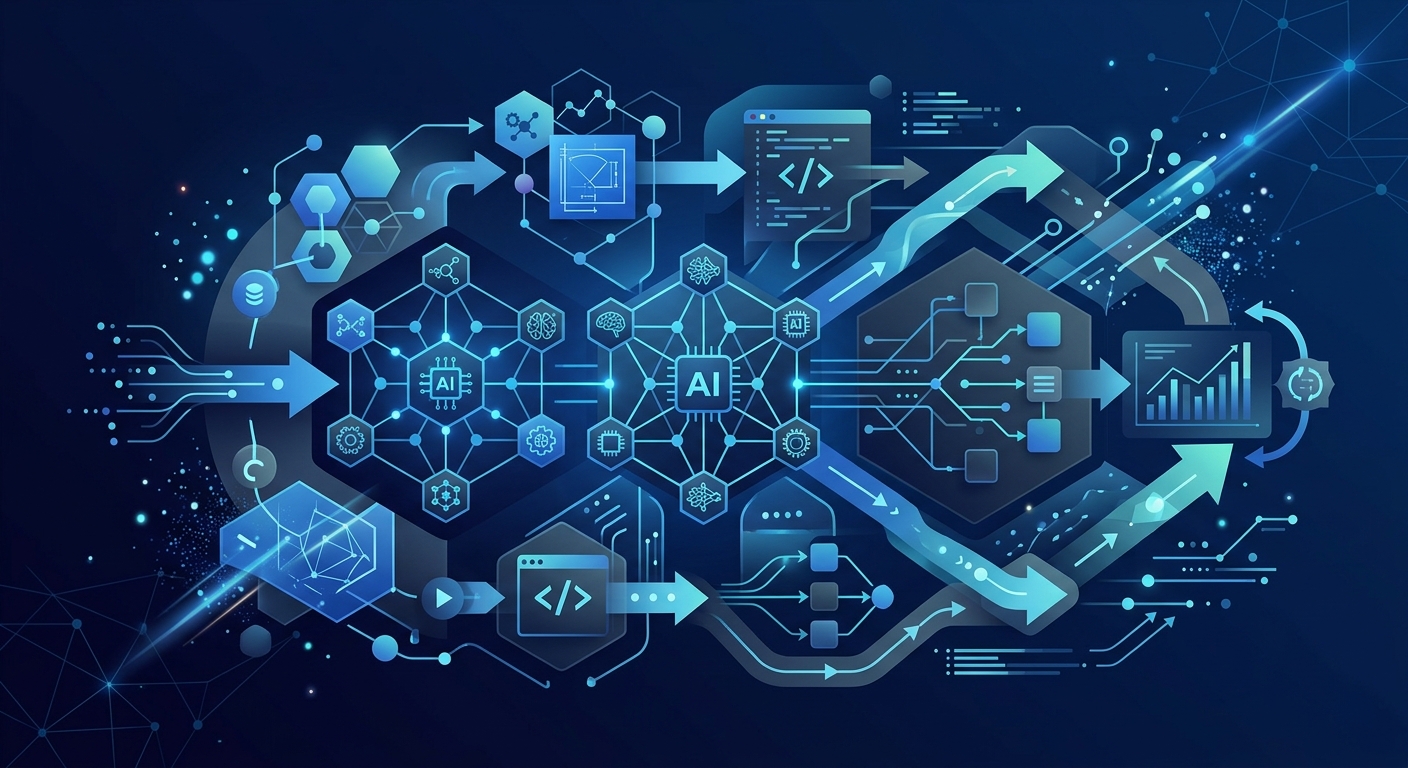
Enterprise AI investments routinely stall between pilot and production due to a lack of operational discipline. Executives no longer require experimental proofs-of-concept; they require a scalable, accountable digital workforce that directly reduces legacy labor costs. At meo, we treat AI agents not as experimental software, but as measurable operational assets governed by strict performance contracts. Transitioning to an agentic operating model requires shifting from technical experimentation to outcome-driven deployment. This playbook outlines how traditional enterprises can architect, deploy, and scale AI workforces that deliver verifiable business results.
Defining the Agentic Operating Model: Strategy Over Pilots
Moving beyond isolated experiments requires treating AI deployment as an enterprise-wide operational strategy rather than an isolated technology initiative. The agentic operating model replaces ad-hoc tool adoption with structured, outcome-driven execution that directly impacts P&L performance. Success begins with rigorously mapping core enterprise processes to three distinct workflow tiers:
- Fully Autonomous Execution: High-frequency, rules-based tasks requiring zero human intervention.
- Augmented Decision-Making: Workflows where agents provide real-time intelligence to support human judgment.
- Hybrid Exception Handling: Complex or edge-case scenarios requiring collaborative human-agent resolution.
Before scaling, leadership must establish non-negotiable accountability baselines. Every deployed agent requires predefined success metrics tied to business outcomes, including cost per transaction, error rate thresholds, and processing capacity. Organizations must document baseline human performance prior to agent introduction, creating a clear benchmark for measuring displacement and efficiency gains. By anchoring deployment to verifiable outcomes rather than technical novelty, enterprises eliminate the ambiguity that traditionally stalls AI adoption. This strategic clarity ensures that every computational cycle translates into measurable operational value.
Architecting the AI Workforce Operating Framework
A resilient AI workforce framework demands architectural discipline, not just advanced model capabilities. Modern deployments require modular agent networks engineered with strict compliance guardrails, role-based access controls, and deterministic escalation paths. A centralized orchestration layer is essential for maintaining version control, enforcing security protocols, and ensuring complete auditability across autonomous operations. Without standardized orchestration, enterprises risk fragmented deployments that fail regulatory audits and introduce operational volatility.
Standardizing data ingestion pipelines and output protocols is equally critical. Agentic systems must ingest structured enterprise data, execute multi-step reasoning, and return formatted outputs that integrate seamlessly with legacy ERP and CRM ecosystems. By treating agents as standardized digital workers within a governed architecture, organizations eliminate integration friction and ensure repeatable, auditable business impact. This framework transforms isolated AI scripts into a cohesive, production-grade workforce capable of handling enterprise-scale volume without performance degradation.
Structuring the Human-Agent Collaboration Model
Mature deployments recognize that AI agents do not eliminate human oversight; they elevate it. An effective human-agent collaboration model establishes explicit decision boundaries that dictate when agents operate autonomously and when human intervention is mandatory. High-stakes financial or compliance processes require tiered approval matrices, while routine operational tasks execute continuously under automated system monitoring. Concurrently, traditional execution roles must transition into exception management, strategic oversight, and continuous agent coaching.
Employees shift from repetitive task execution to roles focused on workflow architecture, quality assurance, and performance optimization. To sustain long-term accuracy, enterprises must implement closed-loop feedback systems where every agent output is evaluated, logged, and systematically used to refine underlying decision logic and prompt structures. This continuous refinement cycle reduces manual intervention, compresses training cycles for new digital workers, and ensures human capital is deployed where it generates the highest strategic return. The result is a symbiotic operational layer where humans direct strategy and agents execute at scale.
Organizational Design & Change Management
Integrating digital labor into legacy structures requires deliberate organizational design. Traditional departmental silos fracture under agentic deployment; enterprises must establish cross-functional digital workforce management units that oversee agent onboarding, performance tracking, and lifecycle governance. Operational KPIs must shift from headcount-based metrics to throughput velocity, first-pass resolution rates, and verified cost displacement. Leadership should align compensation and promotion structures with these new metrics to drive adoption and mitigate resistance to automation.
Phased integration is critical to minimizing operational disruption. Organizations should deploy agents into high-volume, low-complexity functions first, validate performance against established baseline metrics, and systematically expand scope to displace redundant labor overhead. This methodical rollout preserves institutional knowledge while accelerating the transition to an agent-optimized structure. Change management becomes a discipline of capability reallocation rather than simple headcount reduction, ensuring workforce stability while aggressively targeting operational inefficiency.
Measuring Performance & Scaling: The Pay-for-Performance Mandate
Technical benchmarks such as token throughput or raw model accuracy hold limited value for executive oversight. True scaling requires tracking hard business outcomes: cycle time reduction, gross margin improvement, and verifiable labor cost displacement. At meo, we enforce a strict pay-for-performance mandate where capital allocation is directly tied to verified operational results. This structure de-risks implementation by aligning vendor compensation and internal incentives with actual value delivered. Enterprises must treat AI deployment as a managed service contract, not a perpetual software license.
By standardizing deployment playbooks and codifying successful agent configurations, organizations can replicate proven workflows across departments without prohibitive re-engineering costs. Scaling becomes an exercise in configuration and governance, not reinvention. When performance is contractually guaranteed, procurement cycles shorten, executive alignment accelerates, and AI transitions from speculative R&D into a predictable, high-yield operational asset. This disciplined, outcome-driven approach ensures continuous compounding of enterprise efficiency.
Conclusion
The era of experimental AI has passed. Enterprises that treat agents as accountable, outcome-driven digital workers will systematically replace legacy labor overhead with scalable, measurable efficiency. At meo, we partner with traditional organizations to deploy agentic operating models governed by strict performance contracts and clear accountability frameworks. If you are prepared to transition from pilot-stage experimentation to production-grade automation with defined ROI parameters, contact our executive strategy team to design your pay-for-performance AI workforce deployment.