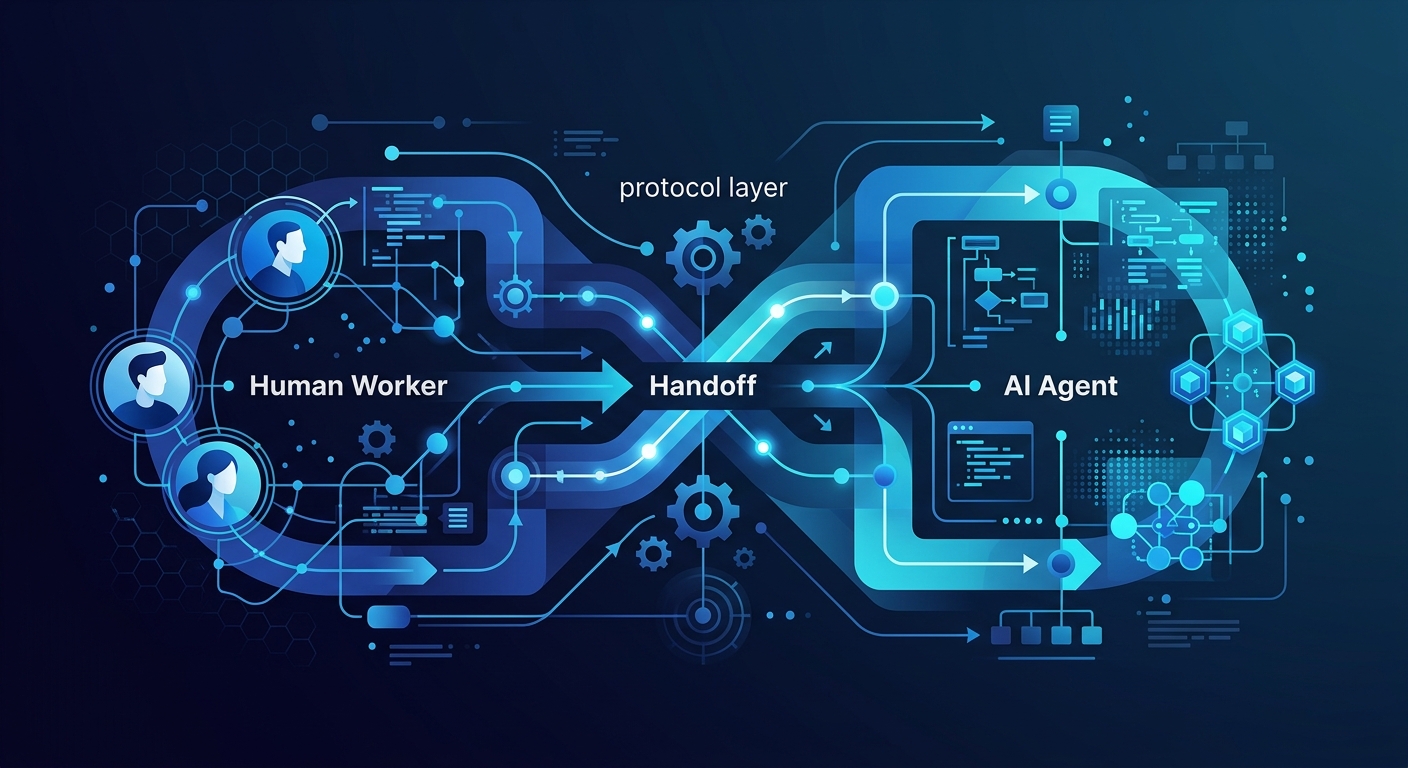
The transition from experimental AI to production-grade enterprise workforces hinges on a critical architectural decision: how work transitions between autonomous agents and human experts. In legacy deployments, handoffs are treated as technical edge cases rather than strategic control points. This oversight creates operational friction, erodes throughput, and obscures the true cost of AI integration. At meo, we engineer handoff protocols as foundational components of a scalable, accountable AI workforce. By treating these transitions as measurable commercial events, organizations eliminate management overhead, guarantee operational continuity, and align agent deployment directly with pay-for-performance outcomes.
The Strategic Imperative: Why Handoff Design Dictates AI ROI
Handoffs are not technical afterthoughts; they are operational control points that dictate workflow velocity, quality thresholds, and cost-per-outcome. When AI agents operate without structured transition mechanisms, compounding inefficiencies mask true ROI. While agentic workflows are designed to take initiative and exert autonomous control across multi-step processes [Vellum AI], unchecked autonomy creates unpredictable variance. Traditional management models, reliant on rigid hierarchical approvals, lack the precision required to govern dynamic AI decision-making. This mismatch generates friction: agents stall awaiting ambiguous approvals, while human managers become overwhelmed by low-value exception handling. The financial impact is measurable. Unoptimized handoffs inflate operational overhead, delay cycle times, and dilute accountability.
Enterprises that scale AI successfully treat the human-agent boundary as a commercial contract. Engineering explicit transition rules converts handoff latency into a trackable metric, directly linking it to commercial outcomes. This precision forms the foundation of a true agentic operating model, where workload distribution optimizes for cost efficiency rather than headcount preservation. When transitions are governed by strict parameters, organizations eliminate wasted capacity and justify pay-for-performance structures. Funding becomes contingent on guaranteed, measurable output—transforming AI from an experimental cost center into a predictable, outcome-driven workforce.
Architecting the Human-Agent Collaboration Model
Effective collaboration demands mathematical clarity around decision rights and cognitive load. Organizations must deploy explicit decision-rights matrices that define precisely where an agent executes autonomously and where human expertise is non-negotiable. These matrices eliminate the responsibility gray zones that plague early deployments, ensuring human intervention is reserved exclusively for high-judgment, regulatory, or strategic tasks. Simultaneously, cognitive load boundaries must be established to prevent operators from becoming de facto data processors for agent exceptions.
Operational continuity requires standardized context-transfer protocols. When an agent escalates a task, the accompanying data package must include complete state information, prior actions, confidence scores, and explicit reasoning traces. Without this rigor, human experts waste valuable cycles reconstructing context, reintroducing rework and institutional knowledge loss [AlignX AI]. Modern workflow architectures resolve this by embedding standardized context schemas directly into the execution pipeline. Production-grade deployment requires moving beyond simple prompt-response cycles to structured, state-aware orchestration layers [arXiv]. Institutionalizing these standards preserves institutional knowledge, eliminates redundant processing, and ensures continuity across multi-step workflows. This architectural discipline transforms fragmented tool stacks into a unified, enterprise-scale collaboration framework.
Trigger-Based Escalation and Reassignment Protocols
Static routing logic cannot support dynamic AI workloads. Enterprises must implement dynamic confidence-threshold routing that evaluates agent certainty in real time, escalating exceptions before they stall operations or degrade output quality. Thresholds are not arbitrary; they are calibrated against historical performance data, risk tolerance parameters, and commercial impact models. When an agent’s confidence drops below a predefined threshold or encounters an edge case outside its training parameters, the protocol triggers an immediate, structured escalation.
Crucially, escalation must be paired with fail-safe reassignment pathways that preserve clear accountability. Human managers should not become workflow bottlenecks managing ad hoc exceptions. Instead, routing logic directs tasks to specialized human queues or secondary agent pools based on predefined criteria. This requires lightweight, standardized communication frameworks that enable rapid state synchronization across systems. Next-generation protocols leverage REST messaging and model context synchronization to ensure seamless transitions across heterogeneous environments [Ruh AI]. Decoupling escalation from manual oversight maintains operational momentum while enforcing governance boundaries. This architecture aligns directly with our Pay-for-Performance Model, ensuring clients fund only successfully resolved outcomes rather than idle management overhead.
Accountability and Measurement in the AI Workforce Operating Framework
In an outcome-driven enterprise, unmeasured handoffs are unaccountable liabilities. Escalation and reassignment protocols must tie directly to commercial outcomes: cycle time reduction, error containment rates, first-pass resolution, and operational cost avoidance. Vague metrics like “agent uptime” or “task completion rate” obscure the economic impact of AI integration. Organizations must track handoff latency, context-transfer accuracy, and post-escalation resolution efficiency as primary KPIs.
To enforce accountability, enterprises must embed immutable audit trails and real-time performance telemetry into every transition point. Each handoff generates a verifiable record detailing trigger conditions, confidence metrics, context payloads, routing paths, and resolution times. This telemetry validates output, enforces contractual accountability, and aligns execution with outcome-based commercial models. Structured telemetry transforms handoff data into a strategic asset, enabling continuous calibration of routing thresholds and resource allocation [Pattern]. When auditability is baked into the architecture, organizations can scale deployment confidently while maintaining strict compliance and financial control. This measurement discipline separates experimental pilots from a mature AI workforce operating framework, where every transition is optimized for measurable commercial return.
Scaling the Agentic Operating Model Across Enterprise Functions
Enterprise-scale AI deployment fails when organizations rely on bespoke, point-solution integrations. Scaling requires modular, reusable handoff templates that standardize cross-functional integration without demanding custom engineering for each use case. These templates encapsulate proven escalation logic, context schemas, and routing thresholds, allowing business units to deploy agents rapidly while maintaining architectural consistency. Applied across customer service, compliance, or finance, standardized templates ensure protocols remain predictable, auditable, and commercially aligned.
Sustained scaling demands executive governance. Organizations must establish cross-functional councils comprising operations, technology, finance, and compliance leaders. These bodies continuously review telemetry, refine routing logic, update escalation thresholds, and align protocols with shifting commercial priorities. Treating handoff architecture as a living system enables iterative performance improvement while managing enterprise-wide risk. As agent autonomy expands, human oversight evolves from tactical intervention to strategic optimization. Organizations that institutionalize this approach transition from fragmented automation to an integrated, scalable operational paradigm. For enterprises executing this transformation, validated ROI & performance metrics provide the commercial foundation required to scale confidently.