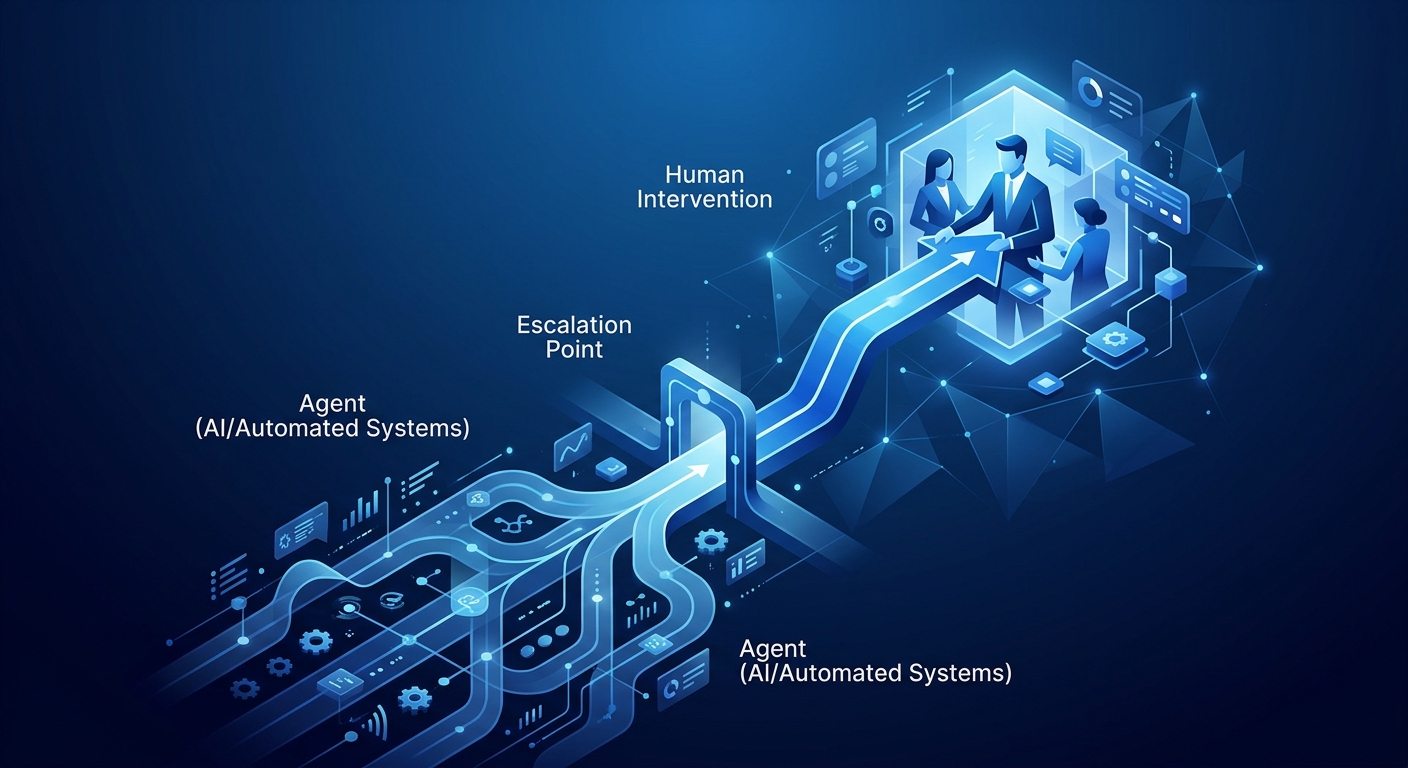
As enterprises transition from experimental AI pilots to production deployments, the difference between scalable success and costly operational leakage hinges on a single control layer: escalation. Too many organizations treat human intervention as a system failure rather than a strategic safeguard. At Meo, we engineer AI escalation protocols that function as performance guardrails—ensuring every autonomous action is measurable, accountable, and directly tied to verified business outcomes. By shifting from traditional labor overhead to a pay-for-performance model, executives can deploy an agentic operating model where oversight remains lean, outcomes are guaranteed, and ROI scales with volume. This guide outlines how to architect escalation frameworks that transform human oversight from a reactive cost center into a proactive, outcome-driven control mechanism.
The Strategic Imperative of Escalation in Agentic Operating Models
Escalation is not an automation breakdown; it is the foundational architecture of accountability. In a mature agentic operating model, handoff protocols must operate as strategic control mechanisms that protect ROI, enforce compliance, and align with enterprise risk tolerance. Traditional management layers often absorb ambiguity through informal oversight, creating hidden labor costs, inconsistent decision-making, and untraceable liability. Structured escalation rules replace managerial guesswork with deterministic routing. When an AI workforce operating framework encounters scenarios that breach predefined confidence thresholds, regulatory boundaries, or financial exposure limits, it seamlessly transfers execution to human experts. This alignment ensures capital is deployed only when autonomous resolution is viable, preserving margin and guaranteeing quality.
Organizations that embed escalation into their core governance model eliminate the friction between rapid deployment and strict compliance. The result is a scalable oversight architecture where human intervention functions as a precision instrument rather than a systemic bottleneck. Executives must treat these protocols as dynamic financial controls, not IT patches. When escalation is positioned as a strategic lever, it enables enterprises to replace bloated middle-management structures with structured, outcome-based oversight that scales linearly with transaction volume—not headcount.
Engineering Trigger Thresholds & Decision Boundaries
Effective AI escalation protocols require quantifiable precision, not subjective judgment. Executives must map ambiguity, edge-case complexity, and financial risk to establish data-driven triggers that operate autonomously. By implementing standardized frameworks like the Model Context Protocol and Agent Communication Protocol, organizations can dictate how agents interpret contextual boundaries, validate inputs, and route exceptions without manual intervention.
SLA-driven routing rules must automatically escalate tasks only when autonomous resolution probability falls below target thresholds or when real-time compliance checkpoints flag regulatory exposure. This ensures human capital is deployed exclusively where it yields the highest marginal return. For example, a financial services agent processing loan applications may autonomously handle 92% of standard cases but immediately escalate any file missing KYC documentation or exceeding a $500,000 risk ceiling. Embedding immutable audit trails directly into the workflow guarantees that every handoff is traceable, auditable, and defensible under regulatory scrutiny. By treating decision boundaries as dynamic, parameterized controls rather than static rules, enterprises continuously tune their systems to handle increasing complexity without expanding operational overhead. The objective is unambiguous: automate the routine, standardize the exception, and validate the outcome.
Structuring the Human-Agent Collaboration Model
A high-performing human-agent collaboration model requires unambiguous role delineation and continuous feedback integration. AI agents must own high-volume, deterministic workflows—processing transactions, synthesizing data, and executing standard operating procedures. Human experts reserve their cognitive bandwidth for strategic judgment, ethical oversight, and complex exception resolution. Intelligent escalation architectures thrive when they establish clear operational boundaries, shared context windows, and bidirectional communication channels.
Crucially, human interventions must never operate in isolation. Every escalated case should feed into closed-loop training mechanisms that convert human decisions into reinforcement signals, systematically expanding the agent’s autonomous resolution envelope over time. This requires a fundamental redesign of organizational structures for AI, shifting away from hierarchical supervision toward lean, cross-functional oversight pods. These pods operate on outcome KPIs rather than activity metrics. When structured correctly, human oversight becomes a continuous optimization engine. Agents learn from human corrections in real time, reducing future escalation frequency while improving decision quality. This symbiotic loop ensures that every dollar spent on human intervention generates compounding returns in agent capability.
Tracking Escalation Metrics & Performance ROI
Accountability in autonomous systems is meaningless without rigorous, financially anchored measurement. Executives must monitor core KPIs that directly correlate protocol efficiency with enterprise value: escalation rate, mean time to resolution (MTTR), cost avoidance, and first-contact autonomy rate. These metrics form the foundation of a verifiable ROI framework, enabling organizations to distinguish between productive oversight and operational leakage. Under a pay-for-performance deployment model, these KPIs dictate investment scaling. Organizations fund agent expansion only when verified business outcomes are achieved, ensuring uncompromised capital efficiency.
Outcome-based auditing must be institutionalized to measure quality variance, agent drift, and true operational leverage across the enterprise. By tying protocol performance directly to commercial contracts, organizations align vendor incentives with internal success metrics, eliminating pay-for-presence models that reward activity over impact. For instance, if an agent’s first-contact autonomy rate consistently exceeds 85% while maintaining sub-2% error margins, contract terms should automatically trigger expanded scope and volume. When escalation metrics are transparent, auditable, and financially anchored, the AI workforce transitions from an experimental technology to a predictable, high-yield operational asset. Every handoff becomes a measurable unit of value, not a hidden cost.
Operationalizing & Scaling Your Protocol
Deploying escalation protocols across legacy environments requires disciplined change management, systematic stress-testing, and iterative optimization. Embedding escalation governance into enterprise workflows ensures that new AI capabilities integrate seamlessly with existing ERP, CRM, and compliance systems, minimizing disruption while maximizing adoption velocity. Protocols must be rigorously stress-tested against adversarial edge cases, with quarterly drift analysis deployed to detect performance degradation as transaction volumes scale and market conditions shift. Research into sustainable human-agent communication confirms that long-term collaboration depends on adaptive frameworks that evolve alongside model capabilities and organizational maturity.
Organizations should systematically reduce manual touchpoints by expanding agent autonomy only when audit trails confirm consistent, high-fidelity performance. This iterative reduction of oversight, paired with the strategic expansion of autonomous throughput, drives the enterprise toward a fully accountable, self-optimizing workforce. The end state is not full automation, but a precision-calibrated system where every human-machine interaction is optimized for maximum business impact. By treating your escalation protocol as a living operational asset, you future-proof your deployment against model obsolescence, regulatory shifts, and scaling friction.
Conclusion
Human-agent escalation protocols are the operational backbone of accountable, enterprise-ready AI. When engineered with precision, they transform oversight from a reactive cost center into a lean, outcome-driven control layer that scales alongside strategic objectives. At Meo, we do not simply deploy AI agents—we architect guaranteed, pay-for-performance operating models where every escalation is a calculated step toward higher ROI, zero waste, and uncompromised accountability. Replace labor overhead with measurable outcomes. Partner with Meo to design, deploy, and scale your agentic operating model with absolute confidence.