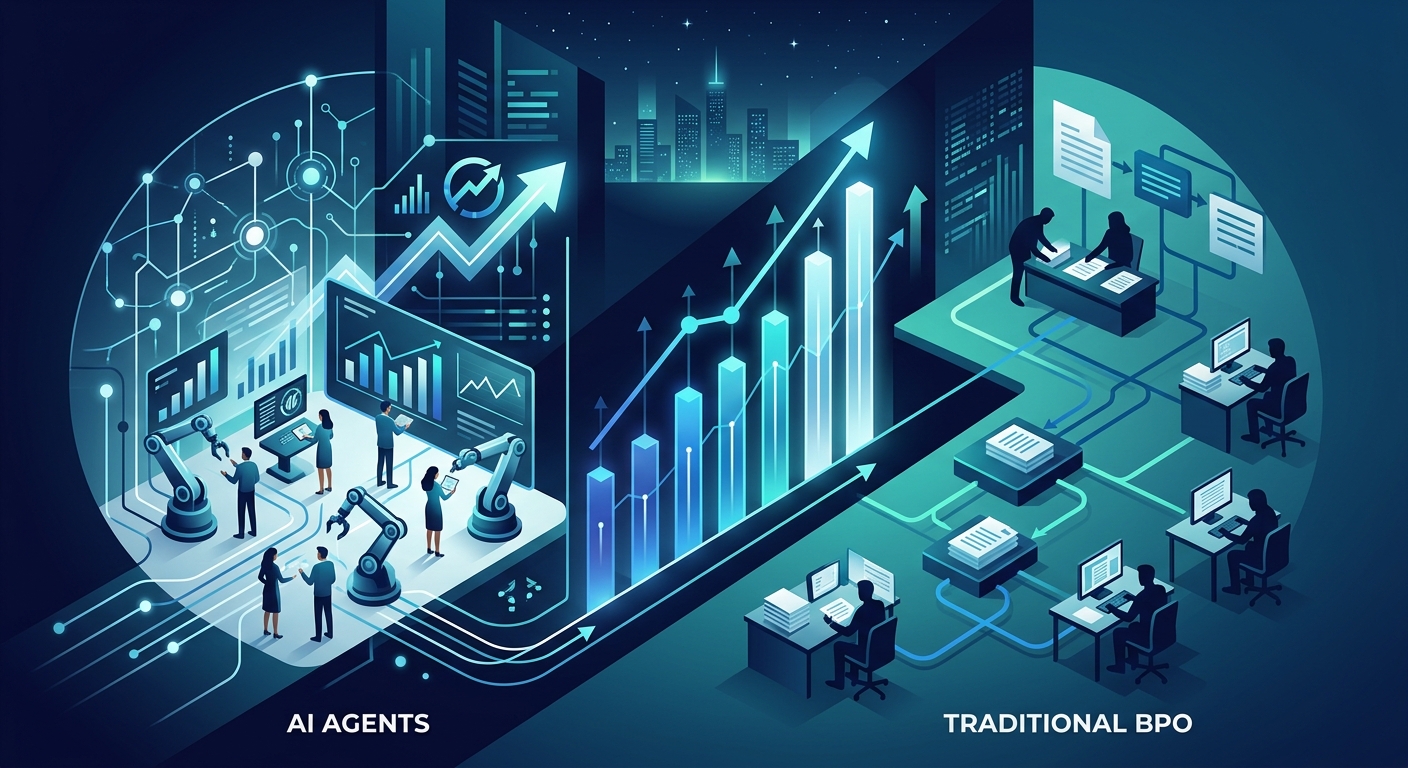
Enterprise operations require a fundamental economic recalibration. For decades, traditional Business Process Outsourcing scaled back-office functions, customer support, and transactional workflows through labor-hour billing. That model no longer aligns with modern margin targets or digital transformation mandates. The metric of success has shifted from cost-per-hour to outcome-per-dollar. Leaders are no longer optimizing headcount; they are replacing variable labor overhead with a predictable, auditable, and outcome-priced operating model.
The ROI Paradigm Shift: From FTE Overhead to Outcome-Based Execution
The core economic divergence lies in billing architecture. Legacy BPO monetizes capacity: organizations pay for hours, training cycles, and management oversight regardless of output quality. Agentic deployment ties investment directly to verified business outcomes. This shifts the operational focus from workforce administration to results orchestration.
Human teams require continuous supervision, quality sampling, and performance correction. AI workspaces execute deterministically. Overhead transforms into a transparent growth lever, with every dollar explicitly mapped to a KPI. This eliminates the financial opacity that historically constrained outsourced operations and establishes a new baseline for operational accountability.
Cost Architecture: Hidden Overhead vs Transparent Pricing
Published FTE rates capture only a fraction of traditional BPO expenses. Beneath seat pricing lies hidden overhead: multi-tiered management, continuous onboarding, attrition replacement, infrastructure markups, and QA auditing. These ancillary costs routinely inflate baseline budgets by 30–45%, eroding margins before deliverables are finalized.
AI agent economics operate on a transparent model: zero recruitment latency, instant capacity scaling, and fixed computational pricing tied to completed workloads. Enterprises typically achieve equivalent output at 10–20% of traditional costs while maintaining uninterrupted, 24/7 execution cycles Agentmelt.
Beyond direct spend, AI eliminates the "management tax." Executives and directors redirect hundreds of hours from supervision, scope reconciliation, and performance gap analysis to strategic optimization. Total cost of ownership drops as operational expenditure converts directly into processed transactions and resolved workflows, transforming variable overhead into a measurable, scalable asset.
Performance & Accountability: SLAs vs Verified Outcomes
BPO contracts typically anchor to input-centric Service Level Agreements—average handle time, response latency, utilization—measuring activity over impact. Agentic outsourcing flips this paradigm, tying accountability to resolution rates, transactional accuracy, revenue attribution, and cost per outcome. Hourly billing inherently incentivizes volume and duration; pay-for-performance aligns vendor economics directly with enterprise margins.
AI execution is structurally enforceable. Agents generate immutable logs for every interaction, enabling real-time ROI tracking, automated root-cause analysis, and continuous compliance verification without manual sampling. Industry data indicates 74% of enterprises deploying intelligent agents already report positive ROI, driven by measurable accuracy gains and direct revenue linkage Linko.
Leadership now demands disciplined frameworks that isolate AI-driven value from baseline operations IT Tech Pulse. By shifting from activity-based SLAs to verified business outcomes, organizations convert operational overhead into a continuously optimized profit center.
Scalability & Agility: Elastic Capacity vs Rigid Ramp Cycles
Elastic capacity is the primary strategic advantage of agentic deployment. Traditional BPO scaling demands 8–12 week recruitment and training cycles, creating rigid capacity ceilings that struggle with demand volatility. AI deployments scale from 10 to 10,000 agents in hours, aligning computational capacity with real-time workload fluctuations. Seasonal spikes, product launches, or regulatory deadlines no longer require overtime premiums or renegotiated contracts.
Strategic agility extends beyond volume. Legacy teams require weeks to update SOPs and validate quality after process changes. AI workloads reconfigure instantly via API updates and logic routing, eliminating retraining lag. Human teams scale linearly; agentic systems scale elastically. High-volume operations confirm AI absorbs demand surges without the quality degradation or cost inflation of traditional ramps Adaptivex. For margin-conscious enterprises, elastic capacity turns operational constraints into competitive advantages.
Risk, Security & Enterprise Governance
Enterprise governance demands strict data control. Traditional BPO introduces third-party residency risks, cross-border data transfers, and fragmented access logs. AI agents deployed within secure, isolated architectures ensure data remains within authorized boundaries and sovereign compliance zones.
Compliance is engineered into the workflow, not retrofitted. Automated PII redaction, policy enforcement, and deterministic routing eliminate the variability of human discretion. Architecturally, API-first AI systems prevent the vendor lock-in common in entrenched BPO contracts. Legacy integrations require costly middleware and impose multi-year exit penalties. Outcome-based deployments maintain interoperability, enabling enterprises to upgrade or swap components without disruption. For regulated industries, isolated and fully auditable execution loops provide a decisive risk-mitigation advantage.
The Transition Blueprint: Phased Migration to Agentic Operations
Migrating to agentic operations requires a disciplined, risk-managed approach. Begin with parallel-run validation: AI agents execute workflows alongside existing teams while process mining identifies high-volume, rule-based processes for automation. Establish a clear performance baseline before incremental workload handover.
Govern pilot deployments with strict metrics: baseline ROI thresholds, >95% accuracy for structured workflows, and human-in-the-loop protocols for edge-case handling. Treat AI as a performance multiplier that absorbs routine execution, freeing subject-matter experts for strategic exception management. As validation scales, transition mature workflows to autonomous execution, retaining human oversight only for novel scenarios requiring complex judgment or cultural nuance. This structured migration minimizes disruption, validates pay-for-performance economics in real time, and establishes a repeatable framework for enterprise-wide adoption.
Conclusion: The Strategic Imperative for Measurable Deployment
Traditional BPO, anchored to labor-hour economics and rigid scaling, cannot compete with the precision and margin efficiency of outcome-based AI execution. Pay-for-performance agentic workflows represent the new operating standard for enterprises requiring scalable, accountable, and continuously optimized processes. The path forward is deliberate: conduct an operational readiness assessment, audit high-volume workflows, and deploy a targeted pilot to validate ROI before full-scale migration.