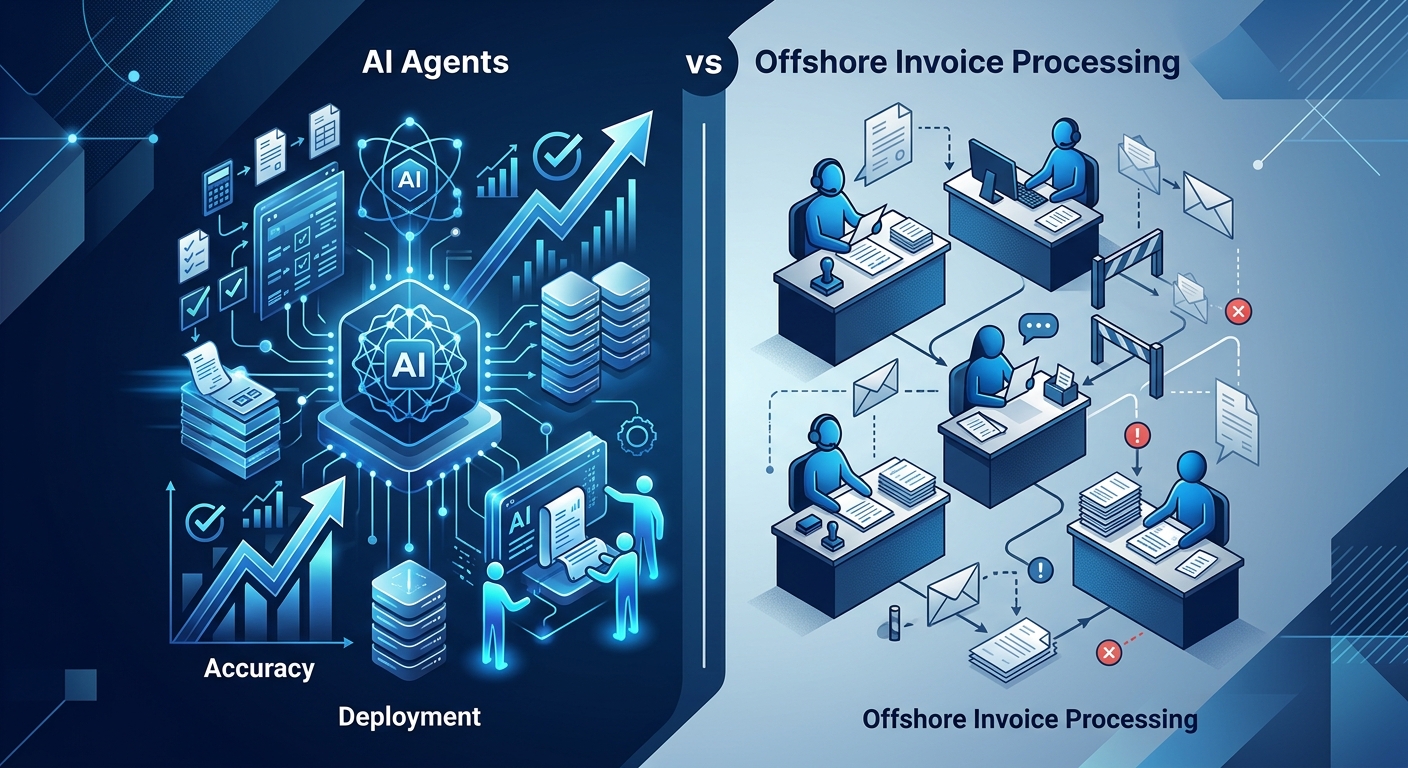
The accounts payable (AP) function sits at a critical inflection point. For decades, finance leaders have relied on offshore business process outsourcing (BPO) to manage invoice volume, prioritizing geographic labor arbitrage over direct operational oversight. The economics of scale have fundamentally shifted. Agentic process outsourcing vs. traditional BPO is no longer a theoretical debate; it is a structural operational mandate. This guide outlines why forward-thinking enterprises are transitioning from managed headcount to accountable AI agents, detailing the accuracy, deployment, and financial frameworks required to execute a risk-reversed AP modernization.
The Strategic Shift: Headcount Overhead to Measurable Outcomes
Traditional offshore AP models operate on a headcount-driven paradigm. Organizations pay for seats rather than outcomes, which inherently misaligns incentives. Agentic process outsourcing vs. traditional BPO fundamentally reorients procurement around verified business results instead of billable labor hours. Offshoring AP introduces systemic overhead rarely disclosed in initial contracts: 30–40% annual attrition rates, continuous recruitment and training cycles, multi-tiered quality assurance layers, and compliance drift as personnel rotate. These hidden costs consistently erode projected arbitrage.
AI agents eliminate headcount overhead entirely. Instead of managing distributed human workflows across time zones, enterprises deploy a scalable, accountable workforce that executes end-to-end invoice processing with deterministic output. The pay-for-performance model ties investment strictly to successfully processed invoices, approved exception resolutions, and closed financial periods. This shifts AP from a people-management cost center to a results engine delivering measurable operational throughput.
Accuracy & Compliance: AI Consistency vs. Human Variability
Human-driven AP processing remains vulnerable to fatigue, cognitive load, and procedural drift. Offshore invoice processing typically experiences baseline error rates between 1% and 3%, driven by OCR misreads, manual keystroke variations, and delayed reconciliation across disparate systems. In high-volume environments, these compounding inaccuracies trigger payment delays, duplicate invoices, and strained vendor relationships.
AI agents neutralize human variability through multi-model validation architectures. Rather than relying on a single extraction pass, modern agents cross-reference vendor master data, purchase orders, and historical invoice patterns in real time. They enforce business rules programmatically, flagging mismatches before data reaches the ERP. Every action logs to an immutable audit trail, transforming AP from an opaque process into a transparent, compliance-ready workflow. For enterprises navigating SOX, GDPR, or internal audit mandates, this zero-deviation architecture eliminates the compliance risk associated with inconsistent human execution. Learn how we architect Security, Compliance & Governance to meet enterprise-grade regulatory standards.
Automated exception routing ensures edge cases escalate to the correct human stakeholders with complete context, rather than stagnating in offshore email queues. The result is deterministic accuracy that scales linearly with volume instead of degrading under operational pressure.
Deployment & Scalability: Rapid Integration vs. Offshore Ramp-Up
Operationalizing an offshore AP team typically spans 60 to 90 days. The timeline encompasses vendor selection, contract negotiation, process mapping, hiring, training, and a prolonged stabilization period. By contrast, AI agents achieve production readiness in 2 to 6 weeks. This acceleration stems from an API-first integration design that connects directly to existing ERP and AP platforms—including SAP, Oracle, NetSuite, and Workday—eliminating the need for legacy infrastructure rewrites or parallel system migrations. See how our Data Integration & Setup methodology ensures frictionless connectivity from day one.
Beyond deployment speed, AI delivers elastic scalability that offshore BPO cannot replicate. Month-end closes, seasonal procurement spikes, and M&A portfolio integrations generate sudden volume surges. Traditional outsourcing forces rigid FTE renegotiations or results in degraded service levels. AI agents scale capacity instantly, processing thousands of invoices overnight without additional onboarding or contract amendments. This elasticity transforms AP from a processing bottleneck into a dynamic financial capability.
Financial Architecture: Fixed BPO Costs vs. Pay-for-Performance
Traditional BPO pricing remains structurally opaque. Enterprises pay fixed seat fees, absorb management markup, and incur recurring change-order costs whenever process scope expands. Industry analysis confirms that while offshore models promise 30–40% labor savings, actual total cost of ownership (TCO) is frequently offset by rework, compliance penalties, and managerial overhead Eesel AI. Analysts project that generative AI will drive processing costs down by over 30% annually through 2030 Eesel AI, while AI agents fundamentally decouple cost from volume.
The pay-for-performance architecture inverts this model. Enterprises only invest when agents deliver verified, business-ready outputs. If an invoice is misclassified, an exception is mishandled, or compliance thresholds are breached, payment is withheld. This risk reversal aligns vendor incentives precisely with enterprise financial outcomes.
Measurable ROI frameworks become possible immediately: cost-per-invoice can drop, payment cycles can accelerate through streamlined three-way matching, and AP personnel can transition from data entry to strategic finance functions such as cash flow optimization, vendor financing, and predictive analytics. The shift from labor arbitrage to AI agent ROI and business case tracking ensures every dollar invested directly correlates to financial close acceleration and working capital efficiency.
Deployment Roadmap: Executing a Seamless Transition
Transitioning from offshore AP to an AI-driven workforce requires a phased, risk-mitigated methodology engineered for enterprise continuity.
Phase 1: Foundation & Baseline Mapping Map existing invoice taxonomies, define exception thresholds, and benchmark current accuracy, cycle times, and cost-per-invoice metrics. This establishes a performance baseline for AI validation. Historical data is cleansed and structured to train agent decision boundaries.
Phase 2: Parallel Run & Calibration AI agents run concurrently with existing offshore or internal teams. Human-in-the-loop oversight validates outputs, calibrates rule engines, and refines exception routing. During this phase, Agent Monitoring & Quality Assurance protocols ensure accuracy consistently exceeds baseline benchmarks before full workload transition.
Phase 3: Full Handover & Continuous Optimization Once performance thresholds are consistently met, the AI workforce assumes primary processing responsibility. Continuous machine learning optimizes vendor recognition, rule prioritization, and exception handling over time. Outcome-based SLAs govern ongoing operations, ensuring the system evolves alongside procurement policy updates and regulatory changes.
Conclusion: Building an Accountable, Future-Ready AP Function
The executive mandate is clear: prioritize predictability, accountability, and outcome-based procurement over geographic labor arbitrage. AI agents do not merely automate AP; they institutionalize accuracy, compress financial closes, and deliver near-zero marginal cost scaling. By replacing offshore variability with deterministic execution, finance leaders reclaim working capital, strengthen audit posture, and elevate AP from a transactional cost center to a strategic advantage engine.
The transition to an AI-driven AP workforce is no longer experimental—it is a competitive necessity. Initiate an outcome-aligned pilot to quantify accuracy gains, project cost-per-invoice reductions, and secure the operational certainty that only a pay-for-performance AI workforce can deliver.