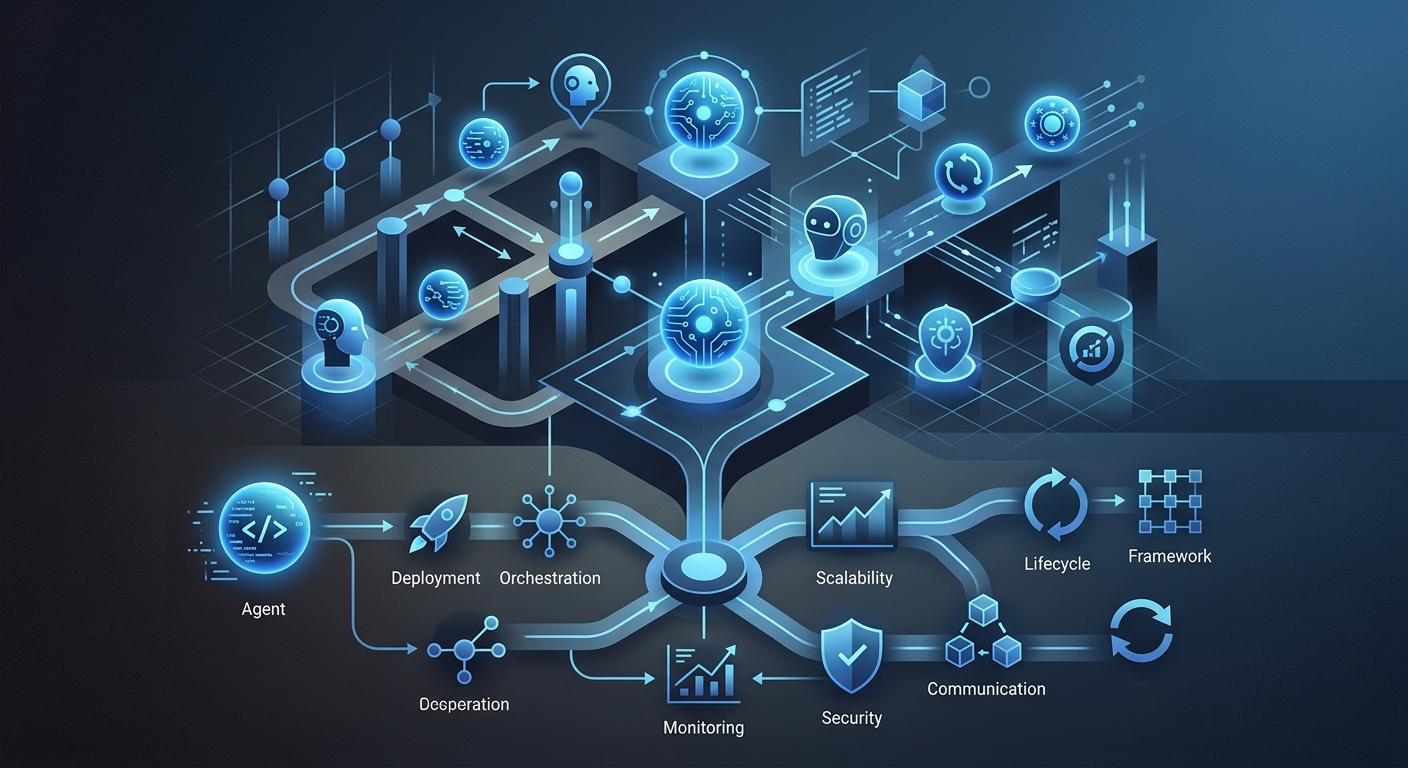
The shift from legacy automation to an agentic workforce fundamentally changes how enterprises allocate capital, manage risk, and scale operations. While traditional software executes predefined scripts, modern AI systems reason, adapt, and resolve complex workflows with measurable business impact. Successful deployment requires a unified vocabulary across executive leadership and operational teams. Mastering core agentic AI terminology is not an IT exercise; it is a commercial imperative. This guide translates technical concepts into executive-level operational language, establishing standardized AI workforce terminology as the strategic foundation for accountable, pay-for-performance deployments that replace fixed overhead with dynamic, outcome-driven capacity.
Defining the Agentic Enterprise
Traditional RPA and rule-based automation operate within rigid, linear boundaries. They execute sequential logic and fail when encountering unstructured data or edge cases. Autonomous AI agents, by contrast, are goal-driven systems capable of reasoning, planning, and adapting to dynamic conditions. Leaders must treat these systems not as tools to micromanage, but as digital employees assigned to specific operational roles. This shift enables enterprises to replace static labor costs with scalable, outcome-driven capacity. An AI agent handling supply chain reconciliation, for instance, proactively identifies discrepancies, queries databases, and executes resolution protocols within predefined business parameters. Standardizing terminology around scalability, reliability, and decision boundaries aligns technical capabilities with commercial objectives. When procurement and operations teams share a common glossary, they can accurately scope deployments, establish realistic performance thresholds, and eliminate the ambiguity that stalls enterprise adoption. The agentic enterprise is built on intentional role mapping, where every deployed system ties directly to a measurable operational outcome.
Multi-Agent Architecture & Orchestration
Deploying isolated agents creates fragmented automation. Enterprise value emerges only when systems operate as a coordinated workforce, governed by robust orchestration layers. The orchestrator acts as an operational conductor, routing tasks, managing dependencies, and aligning cross-functional execution with business priorities. Specialized agent teams collaborate to solve multi-step problems that exceed single-system capacity. For leaders, mastering handoff protocols and state management ensures seamless process continuity. State management preserves context, decisions, and intermediate results as work transitions between agents, eliminating redundant data entry and communication friction. Conflict resolution protocols prevent resource contention and prioritize competing tasks according to predefined business logic. Critically, enterprise-grade orchestration requires system resilience and failover design as non-negotiable standards. Mission-critical workflows cannot tolerate single points of failure. By architecting routing protocols that automatically bypass latency spikes or model degradation, organizations maintain operational continuity at scale. Orchestration is not a technical abstraction; it is the operational backbone that transforms experimental AI into a production-ready workforce.
Governance, Accountability & Compliance
Autonomous execution without structured oversight introduces unacceptable enterprise risk. Governance terminology must translate into clear operational controls aligned with compliance mandates and executive accountability. The distinction between human-in-the-loop and human-on-the-loop is foundational: the former requires explicit approval before critical actions, while the latter establishes continuous supervisory oversight with automated escalation thresholds. Enterprises must map these controls directly to risk tolerance, reserving mandatory human approval for financial commitments, regulatory reporting, and customer-facing interactions. Audit trail generation, permission scoping, and deterministic guardrails form the compliance infrastructure that makes autonomous systems enterprise-ready. Every agent action must generate an immutable log capturing inputs, reasoning steps, tool executions, and outputs. Permission scoping restricts systems to authorized data boundaries, preventing unauthorized cross-domain access. Deterministic guardrails enforce policy compliance by overriding probabilistic outputs that conflict with corporate standards. Properly implemented, governance is not a deployment bottleneck; it is the foundation of commercial viability. Traceable, accountable execution enables organizations to scale confidently, satisfy regulatory audits, and structure pay-for-performance contracts backed by verifiable, legally defensible outcomes.
Performance Measurement & Commercial Alignment
Traditional AI deployments often track technical vanity metrics: uptime, token consumption, or response latency. These indicators do not capture commercial value. Enterprises must shift to outcome-based KPIs, service-level agreement (SLA) tracking, and efficiency baselines that directly tie AI output to P&L impact. Performance measurement should prioritize task completion rates, first-contact resolution, error reduction ratios, and cycle-time compression. This shift enables pay-for-performance deployment models, fundamentally diverging from traditional SaaS or seat-based licensing. Organizations invest only when agents deliver verified business results. Measuring agent ROI requires a transparent framework: establish baseline labor and error costs pre-deployment, then track displacement, accuracy gains, and throughput improvements post-implementation. When an agent consistently resolves 85% of tier-two support inquiries within SLA parameters while cutting handling costs by 60%, the commercial justification is undeniable. Aligning AI workforce terminology with financial accountability transforms technology procurement from an operational expense into a strategic investment. Measurable outcomes replace speculative adoption, creating a sustainable model where digital labor scales directly with business demand.
Implementation Roadmap & Integration
Successful enterprise deployment requires disciplined integration, phased scaling, and continuous optimization. Tool calling, secure API integrations, and isolated sandbox environments form the technical prerequisites for controlled rollouts. Sandbox testing validates workflows in production-like conditions before live deployment, mitigating operational risk. Executives should mandate iterative workforce scaling over disruptive, big-bang launches. Starting with contained, high-ROI workflows allows teams to validate performance, refine decision boundaries, and manage organizational change without disrupting core operations. Continuous optimization depends on structured feedback loops, targeted model fine-tuning, and rigorous agent lifecycle management. Feedback loops capture operational outcomes and user corrections, continuously improving accuracy and contextual reasoning. Fine-tuning adapts base models to proprietary datasets and industry-specific workflows, reducing hallucination rates and increasing task precision. Lifecycle management encompasses version control, performance degradation monitoring, and systematic retirement of underperforming systems. By treating AI agents as dynamic employees rather than static software, enterprises maintain operational agility and sustained ROI. A disciplined roadmap ensures digital workforce expansion aligns with organizational readiness, technical maturity, and commercial objectives.
Conclusion
Standardizing on a precise, executive-level AI agent glossary is the critical first step to transforming experimental AI into a reliable, accountable workforce. When organizations align technical capabilities with operational governance, outcome-based measurement, and phased deployment strategies, they unlock a scalable alternative to traditional labor overhead. At meo, we engineer deployments around verified performance, ensuring enterprises invest only when agents deliver measurable business results. Ready to replace fixed costs with dynamic, outcome-driven capacity? Contact our team to design a pay-for-performance AI workforce aligned with your strategic priorities.