Executive Context: Why Procurement Needs an AI Workforce Lexicon
Procurement has historically operated as a cost center constrained by legacy automation, fragmented ERP modules, and manual workflow management. Today, the strategic shift toward outcome-driven autonomous agents requires executives to fundamentally recalibrate how they evaluate technology investments. This is not a software upgrade. It is the deployment of an intelligent, accountable workforce that directly drives cost reduction, cycle-time compression, and supplier performance optimization.
To bridge the gap between technical innovation and boardroom strategy, procurement leaders must adopt standardized AI workforce terminology. Clear, precise language eliminates vendor marketing noise, aligns technical capabilities with supply chain KPIs, and establishes the contractual foundation for scalable, pay-for-performance deployments. By mastering these agentic AI terms, executives can transition from theoretical pilots to verifiable operational impact, ensuring every technology commitment delivers measurable financial returns SupplyChainBrain.
Foundational Agentic AI Terms
Understanding autonomous agents begins with distinguishing true agentic AI from legacy automation. Traditional Robotic Process Automation (RPA) executes static, rule-based tasks without environmental awareness or adaptive reasoning. Autonomous agents, however, leverage advanced cognitive architectures to perceive complex procurement landscapes, formulate strategic execution plans, and manage multi-step workflows without continuous human oversight EE Times. Modern enterprise deployments rely on three core architectural components:
- Context Windows & Memory Retrieval: Agents maintain dynamic operational awareness across extended procurement cycles. Vector-based memory instantly recalls historical negotiations, supplier metrics, and compliance precedents, eliminating redundant data entry and preventing strategic drift.
- Tool-Use & API Integration: This framework transforms large language models into executable systems. Agents leverage authenticated connectors to execute real-time procurement decisions, including issuing RFQs, validating purchase orders against budget caps, and dynamically adjusting inventory reorder points.
- Multi-Agent Orchestration: Specialized workflows coordinate across the entire sourcing lifecycle. A market-pricing agent can operate simultaneously alongside a compliance validation agent, while a central orchestrator manages task delegation, conflict resolution, and priority routing.
Mastery of this terminology ensures leaders accurately scope deployments and avoid conflating generative chatbots with goal-directed decision systems AWS Builder.
AI Workforce Terminology & Accountability Frameworks
Enterprise-scale AI deployment demands rigorous accountability frameworks. Technical capability is irrelevant without operational guardrails, transparent telemetry, and measurable performance tracking. Modern deployments operate under SLA-driven contracts tied directly to business outcomes—cost avoidance, processing throughput, and error-rate reduction—rather than traditional software licensing metrics. Continuous telemetry tracks agent actions, decision latency, realized savings, and compliance adherence, transforming abstract AI capabilities into auditable financial metrics.
A critical operational distinction lies between human-in-the-loop (HITL) and agent-in-charge architectures:
- HITL Models: Require executive or category manager approval at predefined checkpoints. Ideal for high-stakes negotiations, novel supplier onboarding, or regulatory-sensitive categories.
- Agent-in-Charge Systems: Operate autonomously within strict, pre-approved policy boundaries. Escalation occurs only when predefined risk thresholds are breached or market anomalies emerge.
This architectural shift redefines human roles from tactical execution to strategic oversight, exception management, and continuous policy refinement.
To mitigate operational and regulatory exposure, enterprise deployments enforce auditable decision trails and immutable compliance guardrails. Every agent action, data query, and external communication is logged, version-controlled, and mapped directly to corporate policy. Risk allocation models define clear liability boundaries, ensuring autonomous decisions remain fully traceable for internal audits, SOX compliance, and external regulatory reviews. Aligning these technical frameworks with enterprise governance is non-negotiable. Establishing robust Security, Compliance & Governance protocols ensures autonomous systems meet stringent enterprise standards. Continuous Agent Monitoring & Quality Assurance corrects performance drift or policy misalignments in real time, guaranteeing investments remain tightly coupled with financial and operational targets.
Procurement-Specific AI Agent Definitions
Procurement workflows require specialized agent definitions that map directly to operational value streams and category management strategies. Generic AI terminology obscures how agents execute domain-specific tasks. Precise functional mapping is essential for enterprise adoption and ROI tracking.
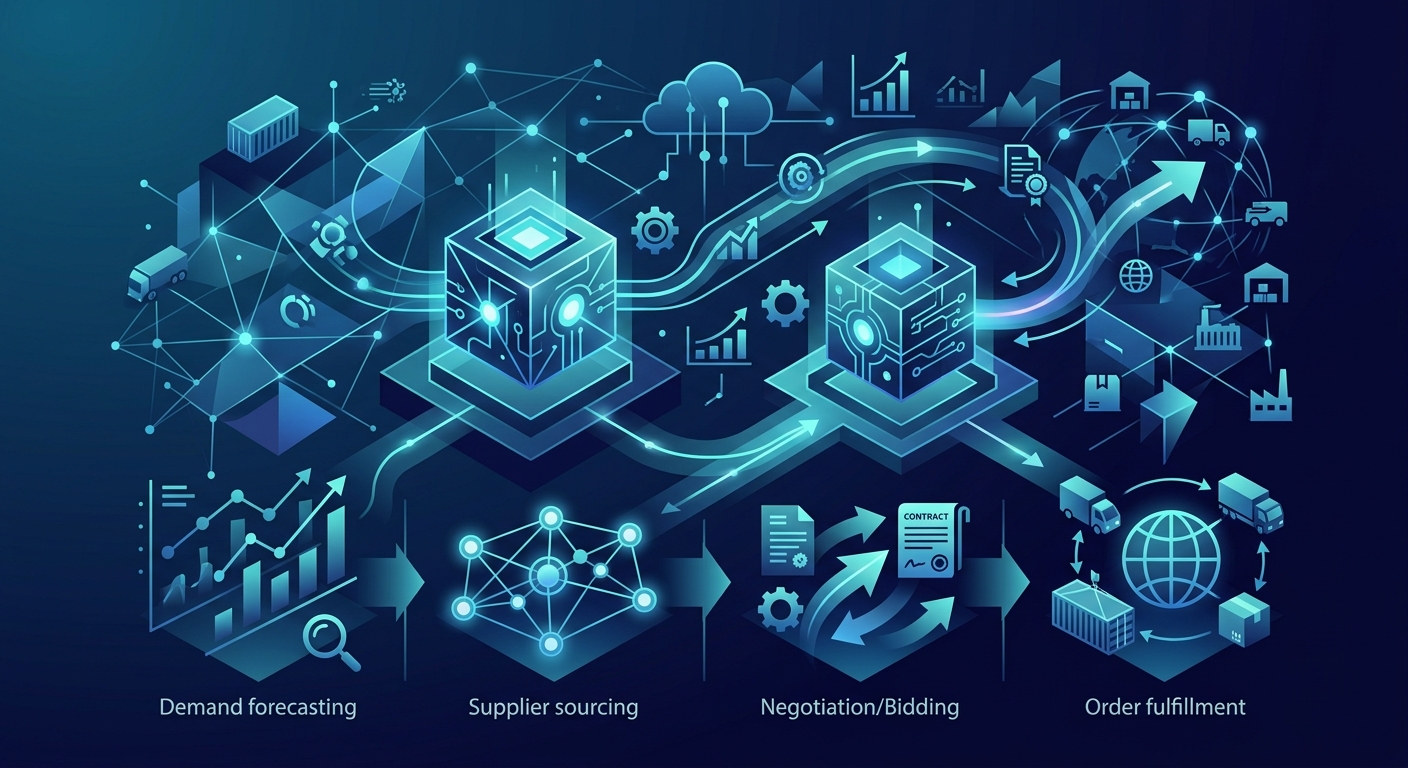
- Sourcing & Negotiation Agents: Automate RFx generation, analyze historical pricing benchmarks, and execute iterative supplier negotiations using predefined concession matrices. Strategies adapt dynamically based on supplier responsiveness, payment term preferences, and real-time commodity volatility.
- Contract Lifecycle Management (CLM) Agents: Move beyond static drafting to extract binding obligations from legacy contracts, monitor renewal triggers, and generate compliance-aligned amendments based on shifting regulations or volume commitments.
- Supplier Risk Intelligence Engines: Continuously ingest financial disclosures, geopolitical risk feeds, ESG data, and logistics alerts. Dynamic market-scoring models flag at-risk vendors weeks before bottlenecks impact production schedules.
- Invoice Reconciliation & Payment Agents: Automatically match purchase orders, delivery receipts, and vendor invoices. Discrepancies are resolved programmatically, and payments execute only when strict compliance and audit thresholds are satisfied.
Translating these capabilities into measurable results requires mapping agent actions directly to FTE displacement, cycle-time acceleration, and working capital optimization. Industry benchmarks show coordinated agent networks can compress strategic sourcing cycles by up to 60% while drastically reducing administrative overhead and manual reconciliation errors LinkedIn Pulse. By deploying purpose-built AI Supply Chain Agents, organizations replace fragmented manual workflows with a unified, outcome-driven operating model, creating a direct, auditable correlation between autonomous activity and margin expansion.
Operationalizing the Glossary for Enterprise Scale
A standardized glossary functions as an executive evaluation framework, not a passive technical reference. Leaders must use precise terminology to separate vendor marketing claims from genuine deployment maturity. When vendors promise "end-to-end AI," demand explicit documentation on whether the platform delivers true multi-agent orchestration with conflict resolution, or merely disconnected generative interfaces requiring manual handoffs. Require transparent performance telemetry, SLA guarantees, and risk allocation models before committing capital.
Mapping AI workforce terminology to internal governance ensures seamless cross-functional alignment across legal, IT, and procurement. Legal teams require explicit definitions of autonomous decision boundaries and immutable audit trails. IT mandates standardized API integration protocols and zero-trust data architectures. Procurement leadership must align these technical specifications with strategic category management and enterprise-wide cost-reduction targets.
Building a forward-looking, results-oriented roadmap requires phased deployment aligned strictly with verified business impact. Organizations should begin with contained, high-ROI workflows like spend classification or invoice matching, then systematically scale toward end-to-end sourcing orchestration and dynamic supplier risk management. Our proven Pay-for-Performance Model ensures enterprises only scale financial commitments when agents deliver verified, auditable outcomes, effectively eliminating upfront deployment risk.
By adopting a disciplined, metric-driven approach to agentic AI, procurement leaders can transform legacy operational bottlenecks into scalable, accountable digital workforces. Ready to quantify the autonomous procurement impact for your organization? Take our Agentic Readiness Assessment to identify high-value deployment opportunities and establish a clear, ROI-backed path to supply chain transformation.