The Executive Shift: From Manual AP to an Accountable AI Workforce
Traditional accounts payable relies on rigid rules and linear human workflows, creating bottlenecks that scale directly with transaction volume. When invoices deviate from pre-set parameters, manual intervention stalls cash flow, delays settlements, and inflates overhead. Agentic AI replaces this legacy model with autonomous digital workers that navigate financial ambiguity, enforce policy-aligned decisions, and execute end-to-end invoice matching without continuous oversight ChatFin.
Deployment success, however, depends on more than advanced algorithms—it requires linguistic precision. A standardized AI vocabulary aligns procurement, IT, and finance, ensuring all stakeholders interpret vendor capabilities and success metrics identically. Adopting a unified AI agent glossary eliminates implementation friction, prevents scope creep, and accelerates procurement cycles Maven AGI.
At Meo, we treat this transition as a structural workforce redesign. Rather than absorbing fixed labor costs for high-volume AP tasks, executives are shifting to outcome-driven, pay-for-performance AI models. Capital is allocated only when agents demonstrably clear backlogs, resolve discrepancies, and post verified payments—transforming AP from a fixed cost center into a scalable, predictable utility.
Core Agentic AI Terms & Autonomous Agent Definitions
To deploy AI effectively, finance leaders must replace legacy automation jargon with precise agentic AI terminology. Unlike Robotic Process Automation (RPA), macros, or static rule engines, autonomous agents operate on three core capabilities: goal-directed reasoning, contextual adaptation, and dynamic tool integration. RPA fails when a vendor modifies an invoice template. An autonomous agent recognizes the structural change, adapts its extraction logic, and continues processing without manual reprogramming Salesforce.
These agents function autonomously within strict policy guardrails. They maintain persistent memory of vendor behavior, apply contextual reasoning to ambiguous line items or partial shipments, and dynamically query ERP systems to cross-reference purchase orders and validate tax codes in real time. Deployed in multi-agent networks, they resolve complex, non-linear discrepancies that overwhelm single-threaded automation Zechariah Kasina.
Applied to invoice processing, this architecture delivers immediate operational leverage. Legacy systems trigger manual approvals for minor variances. Agentic systems evaluate discrepancies against corporate policy, historical precedent, and materiality thresholds. Built-in self-correction loops allow agents to update their operational knowledge base after resolving edge cases, continuously lowering exception rates and eliminating redundant managerial oversight.
The Automated Invoice Matching Process: Step-by-Step Agent Execution
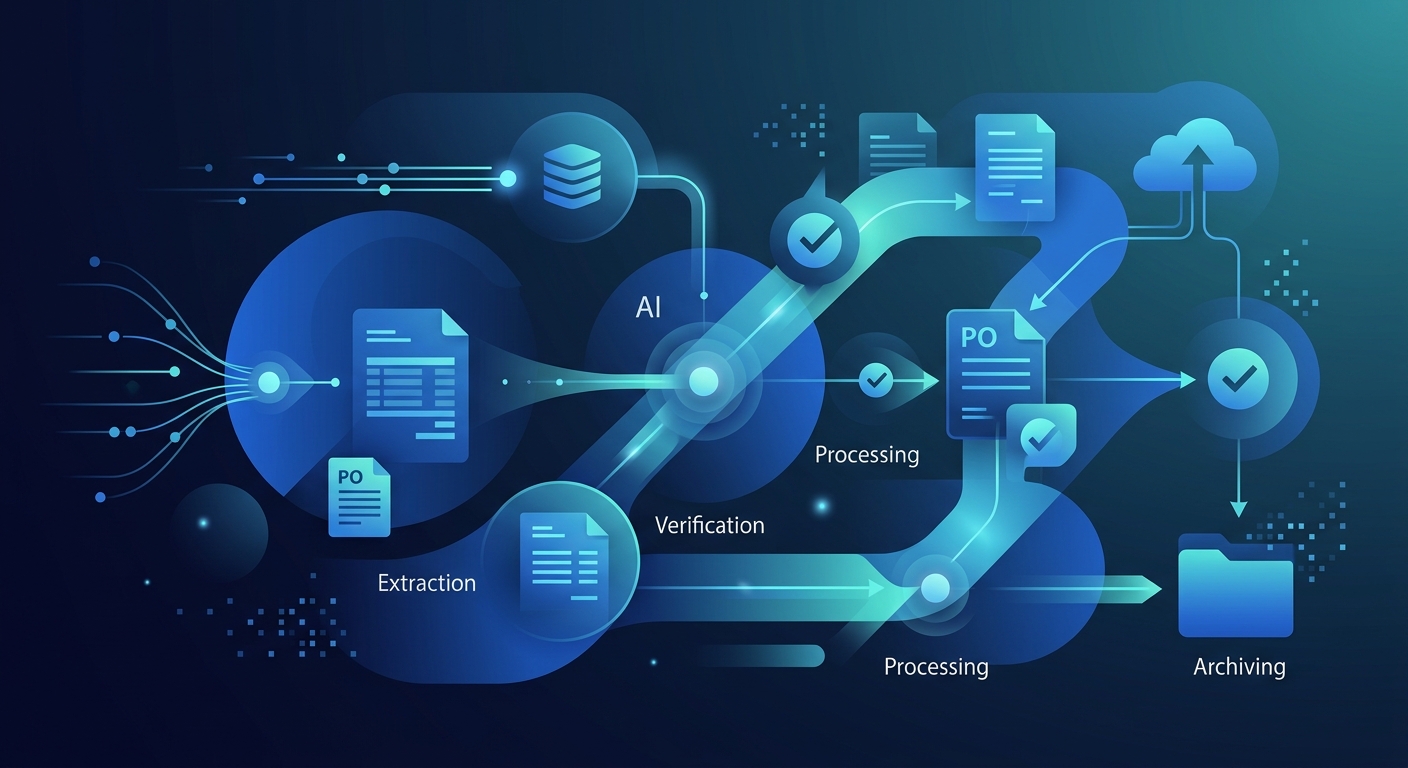
Deploying invoice matching automation requires a clear understanding of the agent execution lifecycle. The process begins with secure document ingestion. Agents parse unstructured inputs—PDFs, email attachments, EDI transmissions—while enforcing enterprise-grade encryption and SOC 2 compliance. Intelligent data extraction then maps vendor-specific formats to standardized accounting schemas, validating GL codes, tax jurisdictions, and payment terms before applying reconciliation logic.
The operational core is dynamic matching. Traditional AP relies on rigid 2-, 3-, or 4-way thresholds that reject invoices for minor, authorized variances. Autonomous agents apply contextual reasoning instead. They cross-reference mismatches against receiving logs, verify authorized PO amendments, and assess financial materiality before determining exception status. By autonomously resolving legitimate discrepancies within strict policy boundaries, these systems consistently reduce processing costs to under $1 per transaction without compromising financial controls ChatFin.
When discrepancies exceed risk parameters, agents execute structured exception routing. Rather than blind handoffs, agents compile a complete audit trail, isolate the variance, propose resolution pathways, and escalate to designated approvers. Human-in-the-loop protocols restrict manual intervention to high-risk, high-value, or policy-violating cases. Post-resolution, continuous learning loops capture the outcome, refine matching logic, and update vendor risk profiles—ensuring the digital workforce improves with every transaction Agentic Workforce.
Essential AI Workforce Terminology for Finance & AP Leaders
Translating technical architecture into measurable financial outcomes requires a shared AI workforce vocabulary. Executives must enforce precise definitions to align IT infrastructure with AP KPIs. Key terms include:
- SLA-Driven Execution: Contractually binding agents to measurable performance thresholds (e.g., 99.5% straight-through processing within 24 hours).
- Digital Worker Provisioning: Elastic allocation of compute capacity aligned with seasonal volume spikes, eliminating the need for permanent headcount or overtime during peak periods.
- Immutable Audit-Trail Compliance: Every agent decision—from OCR confidence scoring to payment routing—is cryptographically logged, version-controlled, and fully traceable. This is a corporate governance mandate, not just a technical specification.
Standardizing agentic AI terminology during RFPs eliminates vendor ambiguity and enforces strict contractual accountability Maven AGI. Precise terminology reduces implementation risk, accelerates procurement cycles, and ensures compliance with SOX, ASC, and IRS guidelines. By defining clear autonomy boundaries and treating AI as a managed workforce rather than a passive software plugin, organizations enforce compliance, track performance transparently, and scale capacity without accumulating technical or operational debt.
Structuring Pay-for-Performance Contracts for Autonomous Agents
The financial architecture of autonomous AP deployment must align with enterprise risk tolerance and capital efficiency. Pay-for-performance AI models shift implementation and operational risk from the enterprise to the provider. Instead of funding perpetual licenses, cloud compute, or upfront consulting, organizations compensate agents strictly against verified, auditable business outcomes.
Contracts are anchored to non-negotiable, measurable KPIs: cycle-time reduction, automated exception resolution rates, straight-through-processing accuracy, and guaranteed cost-per-invoice. For example, compensation triggers only when agents achieve a ≥96% match rate, post verified ERP entries within business hours, and reduce manual review time by ≥75%. This structure ties capital deployment directly to tangible operational gains.
At Meo, we deploy an executive accountability framework that eliminates administrative overhead. Real-time performance dashboards, uptime guarantees, and automated ROI verification give finance leaders complete visibility into workforce efficiency. This model removes upfront labor costs, aligns provider incentives with corporate profitability, and ensures AI adoption generates net-positive cash flow from day one.
Conclusion: Deploying a Scalable, Results-Driven AP Workforce
Mastering agentic AI terminology is no longer optional—it is a strategic prerequisite for defensible, enterprise-grade automation. Standardizing your internal AI glossary accelerates procurement, enforces financial governance, and eliminates legacy labor overhead. Transitioning to a pay-for-performance AI model transforms AP from a fixed cost center into a scalable, outcome-driven utility. Partner with Meo to deploy an accountable, results-verified AP workforce that scales only when your business achieves measurable outcomes.