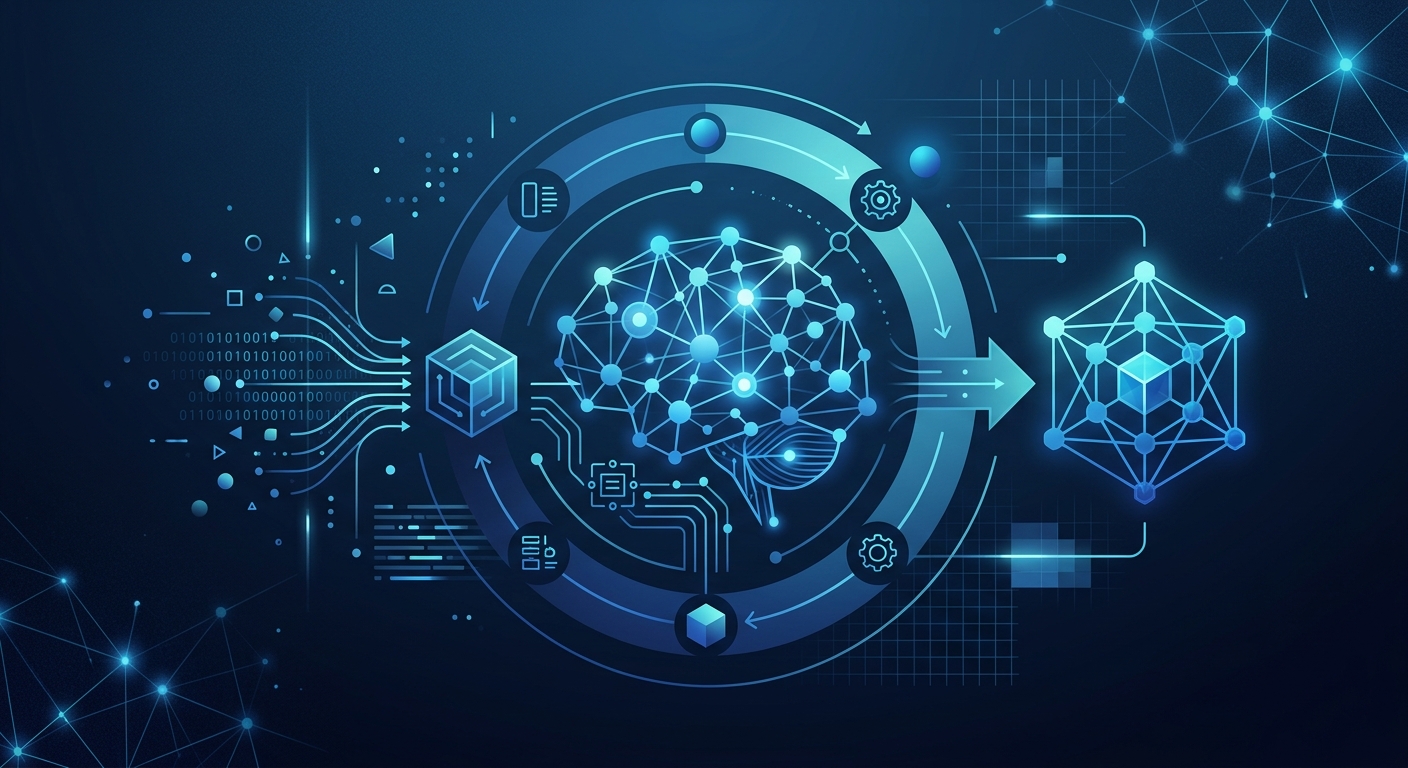
Custom AI model development is the specialized process of designing, training, and deploying proprietary machine learning architectures tailored to specific organizational data and business objectives. Unlike off-the-shelf software, a custom AI model is built to solve unique problems that generic solutions cannot address, such as predicting niche market trends or automating complex, industry-specific workflows. For modern enterprises, the shift toward custom development represents a move from being a consumer of technology to an owner of intellectual property.
Key Takeaways
- Proprietary Advantage: Custom models allow enterprises to use internal data that competitors cannot access, creating a unique competitive moat.
- Lifecycle Focus: Development is a socio-technical lifecycle including risk analysis, data curation, and continuous monitoring.
- Cost Efficiency: While training from scratch is expensive, transfer learning and fine-tuning are making custom AI accessible to more firms.
- Compliance & Risk: Regulatory shifts, such as a 149% increase in AI-related regulations in the U.S., necessitate rigorous documentation and safety frameworks.
What is AI Model Development?
AI model development is the comprehensive engineering process of creating an algorithm that can identify patterns, make predictions, or generate content based on input data. This process is not merely about writing code; it is a multi-stage lifecycle that involves data collection, feature engineering, model selection, training, and validation. According to the CDAC AI life cycle, this journey begins with a conception phase where the business problem is defined and risk analysis is performed before a single line of code is written.
In an enterprise context, AI model development must be aligned with organizational goals. It requires a cross-functional team of data scientists, data engineers, and domain experts. The goal is to produce a system that is not only accurate but also scalable and interpretable. As AI systems become more integrated into critical infrastructure, the development process has evolved to include "Safety by Design" principles, ensuring that the resulting model adheres to ethical and regulatory standards from the outset.
What is Custom AI Model Development?
Custom AI model development is the creation of bespoke machine learning solutions designed to work with a specific company's unique datasets and operational requirements. While a general-purpose AI might understand the English language, a custom AI model for a legal firm would be trained specifically on that firm's historical contracts, case law, and proprietary internal memos. This specialization allows for a level of precision and utility that generic models cannot match.
Key Insight: Custom AI development increasingly relies on transfer learning from prebuilt models to reduce computational costs. This allows firms to benefit from the power of foundation models while specializing them for private data.
The distinction between "standard" and "custom" often lies in the data. In custom development, data preparation and curation often consume the majority of the development timeline. This is where the organization's unique value is injected into the model. By focusing on high-quality, proprietary data, enterprises can build models that perform highly specific tasks, such as invoice exception handling, with far higher accuracy than a one-size-fits-all solution.
Who Needs Custom AI Model Development?
Not every organization requires a custom-built model. However, for those operating in highly regulated industries or those with unique proprietary data, custom development is often the only viable path. Organizations that handle sensitive information—such as healthcare providers or financial institutions—frequently choose custom development to ensure that their data never leaves their secure environment, maintaining strict data privacy compliance.
Furthermore, companies seeking a "competitive moat" find that custom models provide a distinct advantage. If every competitor is using the same public API, the playing field is level. A custom model trained on twenty years of proprietary supply chain data, however, can provide insights that no competitor can replicate. This is particularly relevant for firms looking into predictive maintenance, where the nuances of specific machinery and environments require localized learning.
When Should You Choose Custom vs. Pre-Built Models?
The decision between building a custom model and using a pre-built API (like GPT-4 or Claude) usually comes down to three factors: performance requirements, data privacy, and long-term cost. Pre-built models are excellent for rapid prototyping and general tasks like summarization or basic sentiment analysis. They offer low upfront costs and immediate deployment.
However, custom models are the superior choice when:
- Domain Specificity: The task requires deep knowledge of a niche field where public models lack training data.
- Data Sovereignty: The data is too sensitive to be sent to a third-party provider's servers.
- Inference Costs: At high volumes, the per-token cost of a public API can exceed the cost of hosting a smaller, optimized custom model.
- Ownership: The organization needs full control over the model's updates and versioning to prevent "model drift" from external changes.
Why is Custom AI Model Development Important, and What are Its Benefits?
Custom AI model development is important because it allows for the alignment of AI behavior with specific business logic and ethical values. The benefits extend beyond mere performance; they include increased efficiency, reduced operational risk, and the creation of new revenue streams. By owning the model, a company also owns the "weights" and the logic, which are valuable balance-sheet assets.
One of the primary benefits is the reduction of "hallucinations" or errors. A general model might provide a plausible-sounding but incorrect answer to a technical query. A custom model, constrained by a specific knowledge base and fine-tuned for accuracy, provides much higher reliability. This reliability is essential for autonomous regulatory change monitoring, where a single error could result in significant legal penalties.
What Types of Custom AI Models Can Be Built?
Enterprises today are building a wide array of custom models across different modalities:
- Natural Language Processing (NLP): Custom LLMs for internal knowledge management, legal analysis, or specialized customer support.
- Computer Vision: Models for quality control in manufacturing, medical imaging, or satellite imagery analysis.
- Predictive Analytics: Custom models for churn prediction, fraud detection, and demand forecasting.
- Generative Models: Creating proprietary synthetic data for testing or generating design prototypes in architecture and engineering.
Each of these types follows a similar development logic but requires different specialized hardware (like H100 GPUs for LLMs) and different data labeling strategies.
What is the Custom AI Model Development Process?
The process is a structured journey from a business idea to a production-ready system. Following the CDAC AI life cycle, the stages involve:
- Problem Definition & Risk Analysis: Identifying the KPI the model will improve and assessing potential biases or safety risks.
- Data Acquisition & Curation: Gathering, cleaning, and labeling the data. This is often 80% of the work.
- Model Selection: Deciding whether to build a "cold start" model or fine-tune an existing foundation model like Llama 3.
- Training & Optimization: Running the data through the algorithm and adjusting hyperparameters to minimize error.
- Evaluation: Testing the model against a "hold-out" dataset to ensure it generalizes well to new data.
- Deployment & Monitoring: Integrating the model into the business workflow and setting up continuous monitoring protocols to detect drift.
Key Insight: Model "drift"—the phenomenon where a model's performance degrades as real-world data changes—requires continuous monitoring post-production to ensure accuracy remains high.
What are the Costs Associated with Custom AI Model Development?
Costs can vary widely depending on the complexity and scale of the project.
| Cost Category | Estimated Range | Description |
|---|---|---|
| Data Engineering | $50k - $250k | Cleaning, labeling, and structuring proprietary data. |
| Compute/Training | $10k - $5M+ | Cloud GPU costs or on-premise hardware. (Gemini Ultra cost ~$78M). |
| Talent/Labor | $200k - $1M+ | Data scientists, ML engineers, and project managers. |
| Maintenance/Ops | $5k - $50k/mo | Monitoring, retraining, and hosting fees. |
According to the Stanford HAI 2024 AI Index, the cost of training state-of-the-art models is rising sharply, which is why most enterprises now focus on fine-tuning existing models rather than training from scratch. However, the "technical debt" of maintaining these models—monitoring for drift and retraining—remains a significant ongoing expense that must be budgeted for at the start of the project.
Addressing the Intellectual Property Gap
A common concern for enterprise leaders is ownership of the resulting model. When working with a third-party development team, intellectual property (IP) rights must be explicitly defined in the contract. Unlike standard software, AI IP includes not just the code, but also the trained model weights and the specific dataset used for training.
Typically, an internal team development ensures 100% IP retention. With third-party partners, enterprises should insist on an "assignment of rights" that transfers ownership of the specific fine-tuned weights to the company upon project completion. This prevents the developer from using your proprietary insights to build a competing model for another client.
Frequently Asked Questions
1. How long does it take to develop a custom AI model?
A typical enterprise-grade custom model takes between 4 to 9 months to move from conception to production, depending on data readiness.
2. Is a custom model better than GPT-4?
Not necessarily "smarter" in general knowledge, but a custom model is usually more accurate, faster, and cheaper for a specific, narrow task.
3. What is model drift?
Model drift occurs when the statistical properties of the target variable change over time, making the model less accurate as the world evolves.
4. How much data is needed for a custom model?
It depends on the complexity. Fine-tuning can often be done with as few as a few hundred high-quality examples, while training from scratch requires millions.
5. Can we build a custom AI on-premises?
Yes. Many enterprises choose on-premises deployment for sensitive data to ensure maximum security and control.
6. What is the biggest risk in custom AI development?
The biggest risk is poor data quality. If the training data is biased or incorrect, the model will faithfully reproduce those errors (Garbage In, Garbage Out).