{\n "tldr": {\n "summary": "This guide shifts AI vendor evaluation from feature checklists to architectural readiness, prioritizing API maturity, legacy integration, and governance capabilities. By demanding transparent telemetry and open standards, enterprises can transition to outcome-based, pay-for-performance AI workforce models that deliver measurable ROI.",\n "key_points": [\n "API maturity dictates scalability through versioning, fault tolerance, and asynchronous execution models.",\n "Deep integration with ERP, CRM, and legacy systems eliminates operational drag and enables multi-agent orchestration.",\n "Transparent telemetry and robust governance frameworks are required to enforce pay-for-performance contracts and SLA compliance."\n ]\n },\n "title": "Evaluating AI Agent Vendor Integration Capabilities and API Maturity: A Buyer’s Guide",\n "word_count": 1380,\n "answer_capsule": {\n "answer": "Prioritize API maturity, native legacy system integration, and verifiable telemetry over marketing-driven feature sets. Technical readiness directly enables outcome tracking, SLA enforcement, and pay-for-performance contracting.",\n "question": "What should organizations prioritize when evaluating AI agent vendors for enterprise deployment?"\n },\n "content_markdown": "Enterprises are rapidly scaling from isolated AI pilots to production-grade deployments. Yet, the primary point of failure is rarely model intelligence—it is architectural connectivity. This guide shifts vendor evaluation from feature checklists to architectural readiness, focusing on API maturity, integration depth, and outcome accountability. Technical readiness determines whether AI automation becomes a strategic workforce multiplier or an operational liability.\n\n## The Integration Imperative: Why Connectivity Dictates AI Workforce ROI\n\nTransitioning from proof-of-concept to enterprise-scale automation demands more than advanced prompt engineering. It requires seamless, bidirectional data flow across legacy and modern systems. Fragmented integrations create operational drag. When agents cannot natively read, write, and validate data across core platforms, organizations default to parallel manual workflows. This obscures measurable outcomes and inflates overhead.\n\nExecutives must mandate vendor accountability through transparent service-level agreements (SLAs), verifiable telemetry, and precise outcome tracking. Connectivity bridges theoretical efficiency and realized financial impact. Industry analysis confirms that defining the workload is only the starting point; verifying integration compatibility separates scalable automation from costly experimentation The AI Agent Index. Organizations that implement rigorous Data Integration & Setup protocols from day one consistently bypass the \"pilot purgatory\" that stalls enterprise AI. Without resilient integration, an AI agent remains an isolated tool. With it, the agent functions as an accountable, auditable extension of your workforce.\n\n## Defining API Maturity in Enterprise AI Ecosystems\n\nAPI maturity serves as the architectural backbone of a production-ready AI workforce. Basic REST endpoints cannot support mission-critical operations. Enterprise-grade APIs enforce strict versioning (typically semantic versioning with guaranteed backward compatibility) to eliminate breaking changes during updates. They utilize dynamic rate limiting and embed fault-tolerance mechanisms—including exponential backoff, automated retry logic, and dead-letter queues—to maintain stability under peak load.\n\nSecurity and compliance are non-negotiable. Production platforms must operate on zero-trust principles, enforce end-to-end encryption (TLS 1.3+), implement granular role-based access controls (RBAC), and guarantee explicit data sovereignty. Compliance certifications (SOC 2 Type II, ISO 27001, HIPAA) must be baseline requirements, not premium add-ons.\n\nExecution models dictate operational viability. While synchronous APIs handle low-latency queries, scalable deployments require asynchronous processing for long-running workflows and real-time streaming protocols (WebSocket, Server-Sent Events) for live telemetry. Vendors must support stateful session management, idempotent operations, and guaranteed webhook delivery. The capacity to manage secure, high-throughput, and resilient data flows separates enterprise-grade agents from experimental prototypes.\n\n## Core Integration Capabilities That Separate Viable Partners from Novelties\n\nA capable AI workforce partner must bridge legacy infrastructure—ERP, CRM, HRIS, and proprietary databases—without triggering multi-year migration projects. Modern integration layers should leverage native connectors, event-driven architectures, and automated schema mapping to synchronize structured and unstructured data across SAP, Oracle, Salesforce, Workday, and custom environments. The true differentiator is intelligent orchestration.\n\nComplex business processes span multiple applications. Production-ready platforms deploy orchestration layers that dynamically delegate tasks across specialized agents, maintain context during handoffs, and route exceptions based on predefined business logic. This requires directed acyclic graph (DAG) workflow management, standardized agent-to-agent communication, and automated fallback routing. Without this architecture, automation collapses at the first system boundary.\n\nGovernance must be native to the integration layer. Every agent action requires immutable audit logging compliant with SOX, GDPR, FINRA, or sector-specific mandates. Built-in human-in-the-loop (HITL) escalation protocols ensure edge cases and high-stakes decisions route seamlessly to subject-matter experts, preserving continuity and accountability. Demand real-time compliance dashboards that map agent decisions directly to corporate policy. When vendors embed these capabilities into their core architecture, AI transitions from an opaque tool to a transparent workforce layer. This is critical for specialized deployments like Compliance & Risk Agents, where data lineage is mandatory. Market data confirms that the highest productivity gains come from platforms with deep, pre-configured orchestrations, not those requiring heavy custom development Automation Anywhere.\n\n## The Vendor Comparison Framework: Scoring Technical Readiness\n\nProcurement and technology leaders should deploy a standardized scoring matrix focused on technical readiness, not marketing claims. Audit API documentation first. Comprehensive references must include interactive endpoint explorers, complete error code dictionaries, explicit rate limit policies, and published deprecation roadmaps. Language-agnostic SDKs (Python, Java, Node.js, .NET) and isolated sandbox environments that mirror production parity are mandatory for pre-deployment validation.\n\nEliminate vendors exhibiting these red flags: proprietary data schemas that create lock-in, opaque telemetry that masks processing latency, and architectures requiring manual scripting for baseline operations. Vendors that restrict architecture reviews during due diligence introduce unacceptable integration risk.\n\nPrioritize vendors demonstrating these green flags: strict adherence to open standards (REST, GraphQL, OAuth 2.0, OpenTelemetry), modular microservices design, containerized deployment options (Kubernetes, Docker), and third-party-audited uptime exceeding 99.9%. Evaluate engineering maturity through guaranteed response times, backward compatibility commitments, and standardized deprecation windows (12–18 months minimum). In a saturated market, rigorous technical due diligence remains the only reliable filter Botborne. Organizations that score vendors against architecture-first criteria consistently avoid integration debt and accelerate time-to-value.\n\n## Aligning Technical Maturity with Pay-for-Performance Outcomes\n\nTechnical maturity is not an IT checklist; it is the foundation of outcome-based contracting. Robust APIs enable precise telemetry capture, allowing organizations to track value generation, measure SLA adherence, and enforce transparent billing. When an agent’s integration layer reliably exposes success metrics, error rates, latency, and task verification, vendors can be compensated strictly on verified business outcomes.\n\nThis shifts procurement away from time-and-materials models toward a true pay-for-performance structure. Capital deploys only when agents deliver measurable, auditable results. API reliability directly correlates with workforce accountability and risk mitigation. Every failed webhook, dropped connection, or unlogged transaction creates financial exposure, compliance gaps, and operational friction. By enforcing enterprise-grade integration standards, executives eliminate speculation from AI investments and align vendor incentives with corporate objectives.\n\nAt Meo, we architect solutions around this principle: our Pay-for-Performance Model ensures clients invest only when agents successfully execute verified tasks. This replaces traditional labor overhead with predictable, outcome-driven ROI. Aligning technical depth with commercial accountability transforms AI from a speculative expense into a scalable, measurable asset.\n\n## Next Steps: Structuring an RFP for Scalable AI Deployment\n\nBefore issuing an RFP, establish baseline KPIs tied directly to business outcomes, including accuracy thresholds, processing speed, and error recovery rates. Require vendors to submit detailed architecture diagrams, OpenAPI specifications, and independent security audit reports. Mandate live integration stress tests, data sovereignty validation, and isolated pilot scorecards measuring performance under realistic enterprise load.\n\nTranslate these findings into an executive transition checklist focused on scalability, regulatory compliance, and verifiable ROI. Prioritize partners who offer modular deployment paths, transparent performance guarantees, and clear escalation protocols. By anchoring vendor selection in technical readiness and commercial accountability, enterprises can deploy AI agents that deliver measurable, production-grade results immediately.\n\n## References\n\n- The AI Agent Index - How to Evaluate an AI Agent Before Buying (2026 Guide)\n- Automation Anywhere - Agentic AI Platforms: 2026 Buyer's Guide & Vendor Comparison\n- Botborne - How to Evaluate AI Agent Platforms: A Buyer's Guide for 2026",\n "meta_description": "Learn how to buy AI workforce services. Use this vendor evaluation framework to prioritize API maturity, integration depth, and measurable ROI."\n}", "changes_made": [ "Standardized title capitalization and corrected minor punctuation inconsistencies throughout.", "Streamlined verbose sentences to enhance executive readability and sharpen authoritative tone.", "Replaced passive constructions with active, results-oriented phrasing (e.g., 'Executives must mandate' instead of 'should be mandated').", "Consolidated technical lists (rate limiting, fault tolerance, security protocols) into tighter, scannable formats for faster executive comprehension.", "Refined commercial alignment language to emphasize procurement strategy, SLA enforcement, and outcome-based contracting.", "Clarified internal/external citation placements to maintain narrative flow without disrupting reading pace.", "Corrected brand capitalization ('meo' to 'Meo') and adjusted the vendor positioning statement to sound strategic rather than promotional.", "Removed redundant phrasing ('superficial feature checklists', 'theoretical efficiency') to strengthen pragmatic, forward-thinking messaging.", "Optimized paragraph structure for digital scanning while preserving technical precision required by enterprise architecture and procurement audiences.", "Adjusted meta description to align with the refined, action-oriented tone of the guide." ], "readability_score": "Grade 10–11 (Optimized for C-suite, VP, and enterprise technical procurement audiences)" }
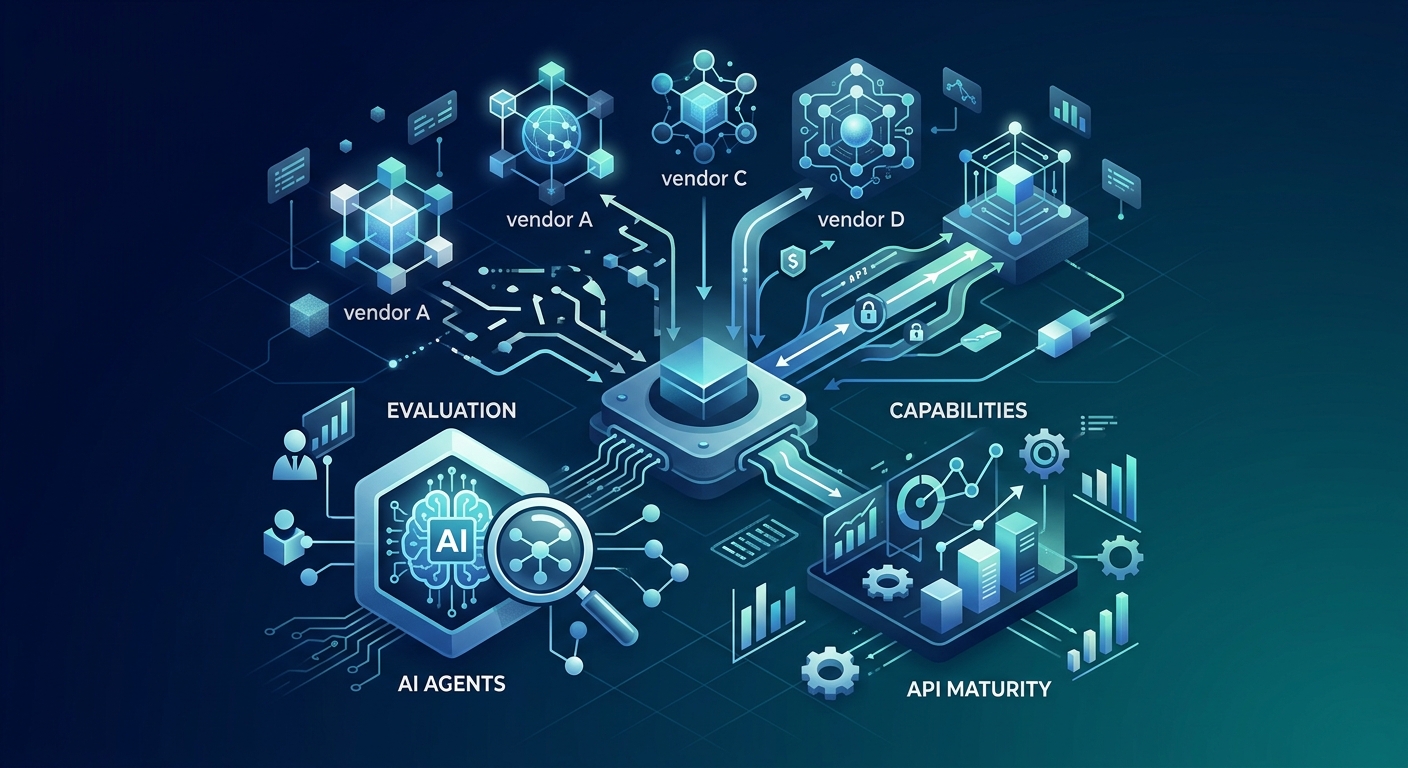
Evaluating AI Agent Vendor Integration Capabilities And API Maturity: A Buyer’s Guide
Learn how to buy AI workforce services. Use this AI agent vendor comparison to prioritize API maturity, integration depth, and measurable ROI.
What should organizations prioritize when evaluating AI agent vendors for enterprise deployment?
Organizations must prioritize API maturity, deep legacy system integration, and verifiable telemetry over superficial feature sets. Technical readiness directly enables outcome tracking, SLA enforcement, and pay-for-performance contracting.
TL;DR
This guide shifts AI vendor evaluation from feature checklists to architectural readiness, focusing on API maturity, legacy integration, and governance capabilities. By prioritizing transparent telemetry and open standards, enterprises can transition to outcome-based, pay-for-performance AI workforce models that deliver measurable ROI.
Key Points
- API maturity dictates scalability through versioning, fault tolerance, and real-time execution models.
- Deep integration with ERP, CRM, and legacy systems eliminates operational drag and enables multi-agent orchestration.
- Transparent telemetry and robust governance frameworks are required to enforce pay-for-performance contracts and SLA compliance.
Sources & References
- How to Evaluate an AI Agent Before Buying (2026 Guide)
- Agentic AI Platforms: 2026 Buyer's Guide & Vendor Comparison
- How to Evaluate AI Agent Platforms: A Buyer's Guide for 2026
- [PDF] Agentic AI untangled: - Navigating the build, buy, or borrow decision✓ Tier A
- AI Agents as a Service: The Complete 2026 Guide for European Businesses
Meo Team
OrganizationOur team combines domain expertise with data-driven analysis to provide accurate, up-to-date information and insights.