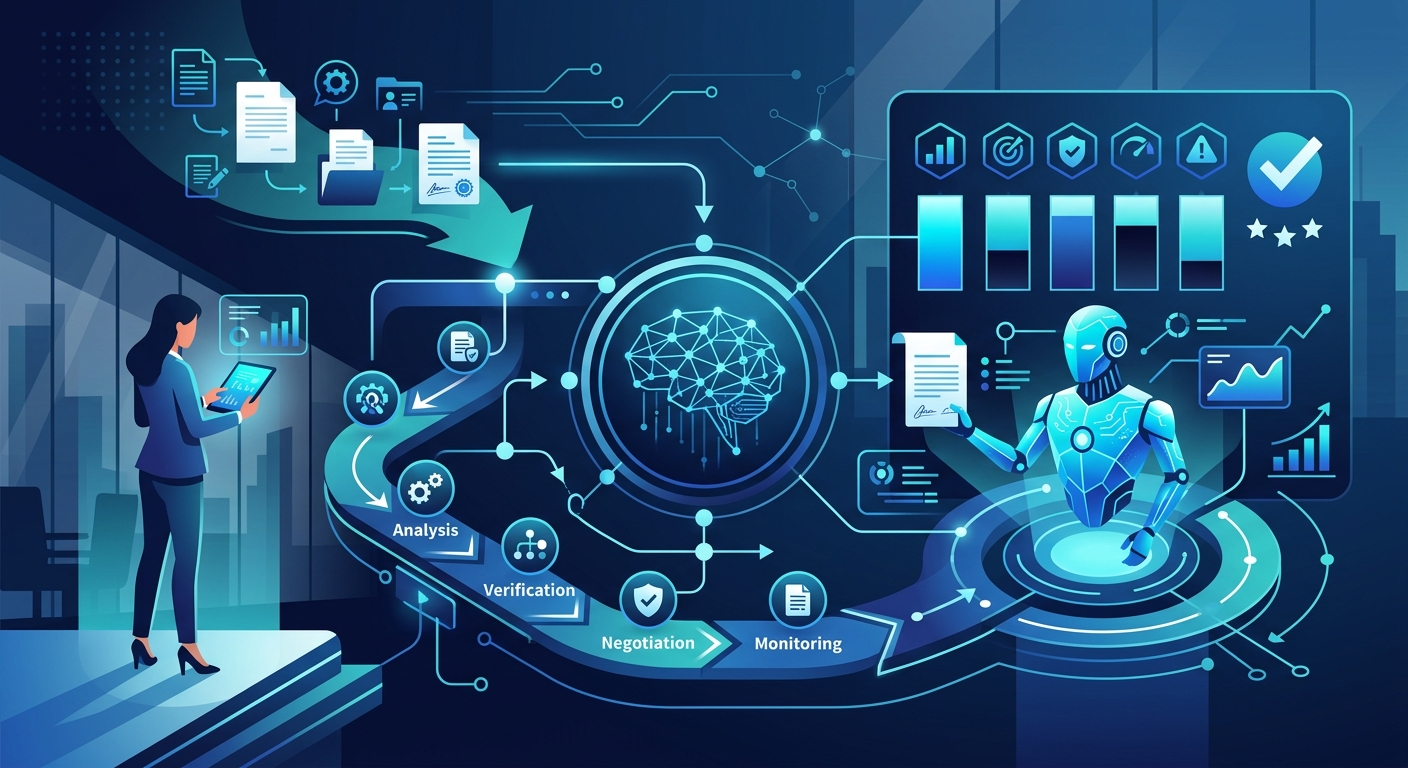
Contract operations are no longer a back-office function awaiting digitization. They are a strategic lever governing revenue velocity, risk exposure, and operational margin. As organizations transition from static SaaS procurement to autonomous digital workforces, evaluation frameworks must adapt. This guide provides an executive blueprint for assessing, deploying, and scaling AI contract agents that deliver verifiable, outcome-driven results. The mandate is clear: stop purchasing software licenses. Start investing in accountable, performance-driven AI workforces.
Why Traditional CLM Evaluation Fails AI Agents
Legacy CLM procurement relies on static feature matrices, UI demonstrations, and vendor presentations. This methodology is obsolete for agentic AI. AI agents are not passive tools; they are autonomous workers that execute, reason, and adapt. Traditional software checklists obscure their actual business impact. Evaluation must shift from capability inventories to outcome accountability. Feature-based assessments fail because agents must process unstructured data, interpret nuanced legal intent, and execute autonomous routing decisions. Modern contract management transforms static documents into dynamic, actionable data, accelerating the entire lifecycle SpotDraft. Prioritize measurable outcomes—cycle time compression, error reduction, and throughput scalability—over interface polish or feature checkboxes. Procurement leaders who anchor AI agent vendor comparison to verifiable metrics consistently outperform peers trapped in legacy evaluation cycles.
Core Evaluation Criteria for AI Contract Agents
Deploying AI that reduces labor overhead requires evaluating three non-negotiable capabilities:
- Contextual Reasoning: Keyword matching is obsolete. Agents must interpret jurisdictional nuances, enforce corporate playbooks, and dynamically redline clauses based on predefined risk tolerances. Enterprise-ready frameworks now mandate jurisdictional awareness and intelligent playbook execution as baseline deployment requirements goHeather.
- End-to-End Workflow Autonomy: Viable agents draft, review, route, and execute agreements without manual intervention. Human-in-the-loop (HITL) oversight should trigger only at strategic exception points, preserving operational stability while maximizing autonomous throughput WorkflowGen.
- Enterprise Integration: Agents must natively extract CRM data, validate financial terms against ERP ledgers, and archive executed contracts. Without mature APIs and robust data pipelines, agents remain isolated prototypes. Verify that vendors provide proven Data Integration & Setup protocols to embed agents within existing infrastructure.
Measuring Accountability: KPIs That Matter
AI accountability is defined by quantifiable metrics, not vendor promises. Establish performance baselines before deployment. Without historical benchmarks, ROI remains theoretical. Audit current workflows to document manual touchpoints, then define precise operational thresholds for success Botborne. Prioritize three KPIs:
- Cycle Time Compression: Measure hours from draft initiation to execution. Capable agents reduce this by 40–70% by eliminating routing bottlenecks.
- Compliance & Risk Accuracy: Track false-positive rates, missed obligation alerts, and deviations from approved legal playbooks.
- Audit Trail Fidelity: Require cryptographic logging of every autonomous decision, clause modification, and approval handoff to meet regulatory standards.
Demand transparent dashboards that map agent activity directly to business outcomes. Agents must also surface continuous improvement insights, identifying negotiation friction and recommending playbook adjustments. For deeper operational visibility, Compliance & Risk Agents establish the foundation for continuous, audit-ready tracking.
AI Agent Vendor Comparison Framework
Architectural transparency separates production-ready agents from experimental prototypes. When conducting an AI agent vendor comparison, prioritize explainable architectures over proprietary black-box models. Black-box systems fail legal audit requirements by obscuring decision pathways and complicating liability attribution.
Enterprise-grade data governance is mandatory. Scrutinize vendors for data residency controls, encryption standards, retention policies, and role-based access. Contract data is highly sensitive; architectures lacking strict isolation and compliance with SOC 2, GDPR, or industry-specific frameworks introduce unacceptable liability. Verify that Security, Compliance & Governance protocols guarantee client-controlled data sovereignty.
Finally, evaluate model portability and API maturity. Vendor lock-in is a critical procurement failure. Require open APIs, standardized export formats, and explicit model migration pathways. If a vendor cannot integrate with your existing stack or penalizes model switching with excessive retraining costs, the long-term risk outweighs short-term pricing advantages. Treat AI agents as interoperable workforce components, not closed ecosystems.
How To Buy AI Workforce Services: The Pay-for-Performance Model
Traditional SaaS subscriptions decouple cost from value, charging for licenses regardless of utilization or outcomes. Modern procurement aligns vendor economics with verified business results. Structure contracts around measurable throughput, error reduction, and cycle time compression. Pay-for-performance models eliminate speculative spend and transfer execution risk to the provider.
Implement pilot programs with explicit success gates. Run a 30-day validation window targeting a specific contract category (e.g., NDAs, vendor MSAs, or renewals). Establish hard thresholds: minimum volume, maximum error tolerance, and strict audit compliance. Terminate underperforming pilots without penalty. Scale successful deployments systematically to replace legacy overhead.
Compare pricing models rigorously. Demand transparent, outcome-based contracts that tie vendor compensation to verified performance, mirroring best practices in enterprise AI adoption Intercom. At meo, our Pay-for-Performance Model ensures investment aligns strictly with delivered business results. This shifts AI from a fixed capital expense to a variable, ROI-positive operating cost.
Actionable Next Steps for Procurement Leaders
Transitioning to an outcome-based contract workforce requires disciplined execution:
- Form a Cross-Functional Governance Committee: Combine legal, IT security, procurement, finance, and operations leadership. AI agents simultaneously impact compliance, data architecture, and P&L. Unified oversight prevents siloed procurement missteps.
- Execute a 30-60-90 Day Roadmap: Days 1–30: Establish baselines, define KPIs, and configure legal-approved playbooks. Days 31–60: Run controlled pilots, measuring cycle time, compliance accuracy, and audit fidelity against strict thresholds. Days 61–90: Scale validated agents across broader contract categories and decommission redundant manual workflows. Utilize proven Implementation Methodology frameworks to minimize disruption.
- Shift from Fixed Overhead to Variable Outcomes: Traditional CLM and legal outsourcing scale linearly, compressing margins. AI agents scale exponentially while preserving quality and compliance. By Building an Agentic Operating Model, leaders can permanently decouple contract throughput from headcount growth.
The future of contract lifecycle management belongs to organizations that treat AI agents as accountable workforce assets. Stop buying software. Start purchasing outcomes.