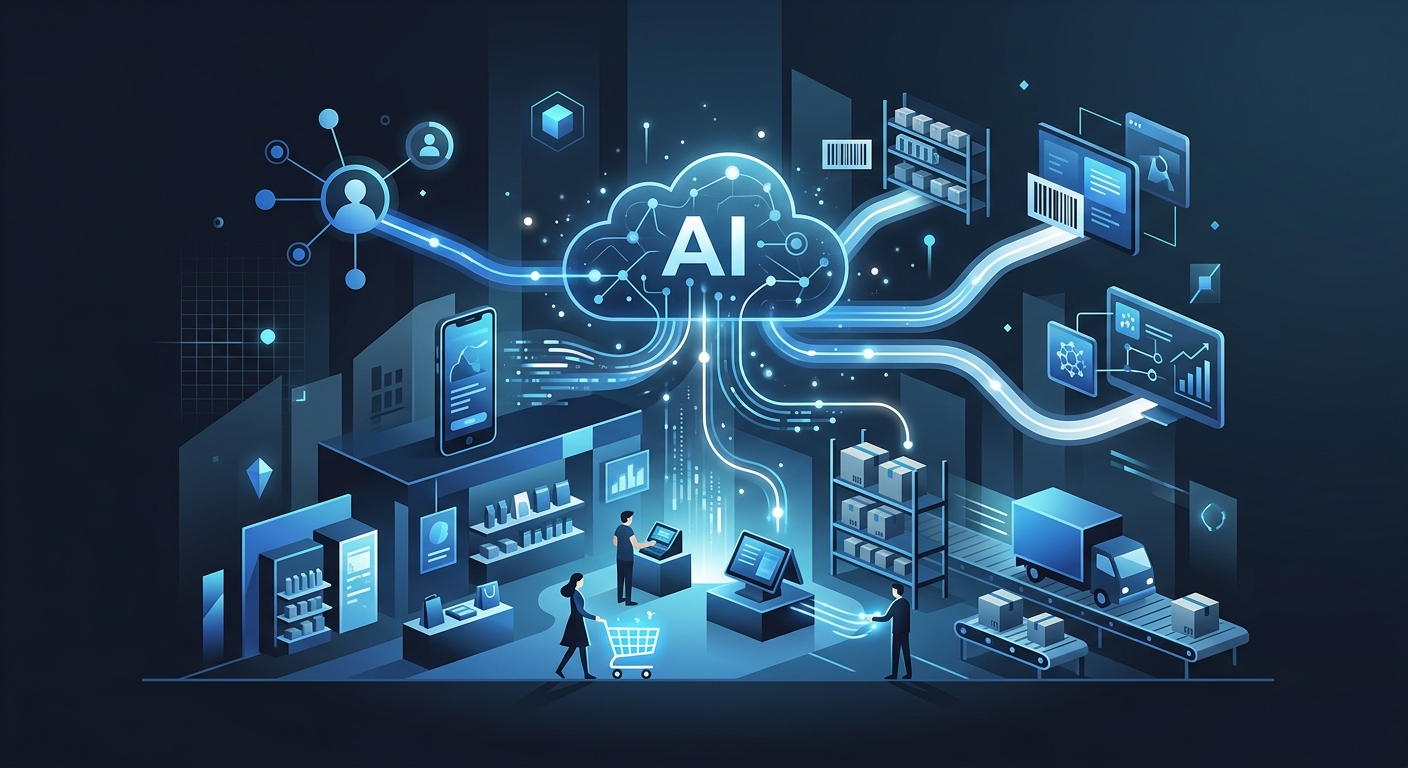
Artificial Intelligence (AI) is no longer a peripheral experiment for the modern retailer; it has become the fundamental architecture of the industry. In the current landscape, AI in retail business is defined as the integration of machine learning, computer vision, and generative models to optimize the entire value chain, from procurement to the final checkout. The transition from rule-based automation to predictive, agentic systems is forcing a total rethink of how value is created and captured in commerce.
Key Takeaways
- Strategic Archetypes: Retailers must decide if they are "destination players" (direct sales) or "evaluation players" (winning through AI recommendation engines).
- Modernization Pillars: Success requires simultaneous modernization across commercial, operational, and supply chain functions.
- Governance First: Scaling AI effectively depends on five pillars: governance, platform strategy, data access, ethics, and AI literacy.
- Predictive Power: Advanced machine learning models now analyze over 37 months of historical data to manage complex variables like calendric special days.
"AI is a moving target. It's not sitting still; it's aspirational because what was considered AI 30 years ago ... is not considered cutting-edge AI anymore." – Chris Caplice, Executive Director, MIT Center for Transportation and Logistics (MIT Sloan)
AI's Impact on the Retail Business Model
The most profound shift occurring today is how AI in retail business is moving from a tool for task automation to a core driver of new business models. Historically, retailers focused on location and inventory breadth. Today, the competitive advantage has shifted toward data-driven intimacy and operational agility.
According to BCG, retailers must now choose their "endgame" as AI platforms upend the customer journey. This leads to two primary retail archetypes:
- Destination Players: These are brands where customers shop directly. Their AI roadmap focuses on immersive experiences, loyalty, and brand-exclusive value.
- Evaluation Players: These retailers win by being the top recommendation on AI-powered shopping assistants and platforms. Their focus is on data interoperability and algorithmic visibility.
By redefining these models, AI allows businesses to move away from static seasonal planning toward dynamic, real-time responses to market shifts. This isn't just about selling more; it's about fundamentally changing the cost structure of the retail enterprise.
How AI is Driving Retail Transformation
AI is driving transformation by modernizing commercial, operational, and supply chain functions simultaneously. This holistic approach ensures that a gain in one area—such as a more accurate demand forecast—immediately translates into labor optimization in the warehouse and personalized marketing in the storefront.
Retail AI by BCG X highlights that proprietary tools using advanced analytics are now essential for retail sustainability across the entire value chain. This transformation is visible in three key areas:
- Commercial: Dynamic pricing models that adjust based on competitor moves, inventory levels, and consumer demand elasticity.
- Operational: Computer vision in physical stores to track shelf-gap detection and reduce "shrink" or theft without intrusive security measures.
- Supply Chain: Integrating multi-modal data to predict disruptions before they occur, allowing for proactive rerouting of goods.
Demand Forecasting and Predictive Analytics
One of the most quantified successes in AI in retail business involves demand forecasting. Traditional methods often struggled with "calendric special days"—holidays or events that do not occur on the same date every year.
Research published in ScienceDirect utilized over 37 months of actual retail sales data from an Austrian retailer to prove that machine learning models significantly outperform traditional statistical methods. By analyzing historical patterns alongside external variables, these AI systems can reduce stockouts by up to 20% while simultaneously lowering overstock levels.
For enterprise leaders, this means capital that was previously tied up in excess inventory can be redeployed into growth initiatives. Predictive analytics transforms the supply chain from a reactive cost center into a proactive strategic asset.
Organizational Capabilities: Leaner, Smarter, and More Strategic
To capture the full value of AI, retailers must develop specific organizational capabilities. It is not enough to buy the software; the organization must be restructured to support it. This involves moving toward a more agentic enterprise where AI agents handle routine decision-making, freeing human talent for high-level strategy.
PwC identifies five critical missions for retailers to structure their transformation:
- AI Governance: Establishing clear rules for how AI makes decisions.
- Platform Strategy: Moving away from siloed tools toward a unified AI architecture.
- Data Access: Breaking down internal data silos so the AI has a "single source of truth."
- Ethics: Ensuring AI does not introduce bias into pricing or hiring.
- AI Literacy: Training the workforce to collaborate with AI tools effectively.
Investment Plans: Sustained and Strategic
Investment in AI in retail business is shifting from experimental "innovation labs" to core capital expenditure. Leaders are no longer looking for quick wins; they are building for 2026 and beyond. This requires a sustained financial commitment to both the technology and the data infrastructure.
| Investment Layer | Focus Area | Expected Outcome |
|---|---|---|
| Infrastructure | Cloud-native data lakes and GPU clusters | Scalability for LLMs and real-time processing |
| Applications | Demand forecasting & Personalized engines | Increased conversion and reduced waste |
| Talent | Data scientists & AI Orchestrators | Internal capability to iterate on proprietary models |
| Governance | Compliance & Security frameworks | Reduced legal risk and consumer trust |
Responses to These Shifts: Navigating the Legal Landscape
As retail businesses implement AI for consumer profiling, they must navigate increasingly complex legal frameworks. The EU AI Act is a primary example, employing a risk-based approach that affects any company whose AI outputs touch EU users, regardless of where the company is headquartered.
Compliance for high-risk applications—such as those used for credit scoring or extensive consumer behavior profiling—requires rigorous documentation, human oversight, and transparency. In the United States, legislation like Texas's TRAIGA is focusing on governance transparency. Retailers who fail to build AI agent data privacy compliance into their systems from day one face significant fines and reputational damage.
Actions for 2026: The Roadmap to AI Maturity
As we look toward 2026, the urgency to act is clear. Retailers that remain in the "pilot phase" will find themselves unable to compete with the efficiency of AI-native competitors.
Immediate Actions for Enterprise Leaders:
- Audit Your Data: AI is only as good as the data it consumes. Ensure your 37+ months of historical data is cleaned and accessible.
- Define Your Archetype: Are you a destination for customers, or are you optimizing for AI discovery?
- Implement Ethical Guardrails: Establish a compliance and risk agent framework to monitor AI decisions in real time.
- Focus on SMEs: If you are a small-to-medium enterprise, focus on "low-barrier, high-impact" use cases like automated customer support or basic inventory replenishment rather than trying to build custom LLMs from scratch.
We Value Your Privacy: The Consumer Trust Factor
In the era of AI in retail business, data is the currency, but trust is the bank. Consumers are increasingly aware of how their data is used for hyper-personalization. Retailers must be transparent about data collection and offer clear value in exchange for consumer information.
Implementing robust data security protocols and adhering to a strict privacy policy is not just a legal requirement—it is a competitive advantage. When customers feel their data is safe, they are more likely to engage with AI-driven features like virtual try-ons and personalized style assistants.
Frequently Asked Questions
How does AI improve inventory management in retail?
AI uses predictive analytics to analyze historical sales data, weather patterns, and social trends to forecast demand accurately. This reduces both stockouts and overstock, optimizing capital allocation.
What is the difference between a destination player and an evaluation player?
A destination player is a retailer where customers go specifically to shop with that brand. An evaluation player focuses on winning the "recommendation" from AI assistants and search engines to capture the customer at the point of intent.
Is AI in retail business affordable for small businesses?
Yes. Small-to-medium enterprises (SMEs) can use SaaS-based AI tools for demand forecasting and customer service. By focusing on high-impact, low-barrier use cases, SMEs can scale without massive R&D budgets.
What are the risks of using AI for consumer profiling?
The primary risks include data privacy violations, algorithmic bias, and non-compliance with international laws like the EU AI Act. Robust governance is required to mitigate these risks.
How does AI impact retail jobs?
While AI automates routine tasks like inventory counting and basic customer queries, it creates a need for new roles in AI orchestration, data analysis, and strategic management. You can learn more about this in our guide to jobs replaced by AI.
What are 'calendric special days' in demand forecasting?
These are events like Easter, Ramadan, or Prime Day that do not fall on the same date every year. AI models are significantly better than traditional software at predicting the sales surges associated with these shifting dates.