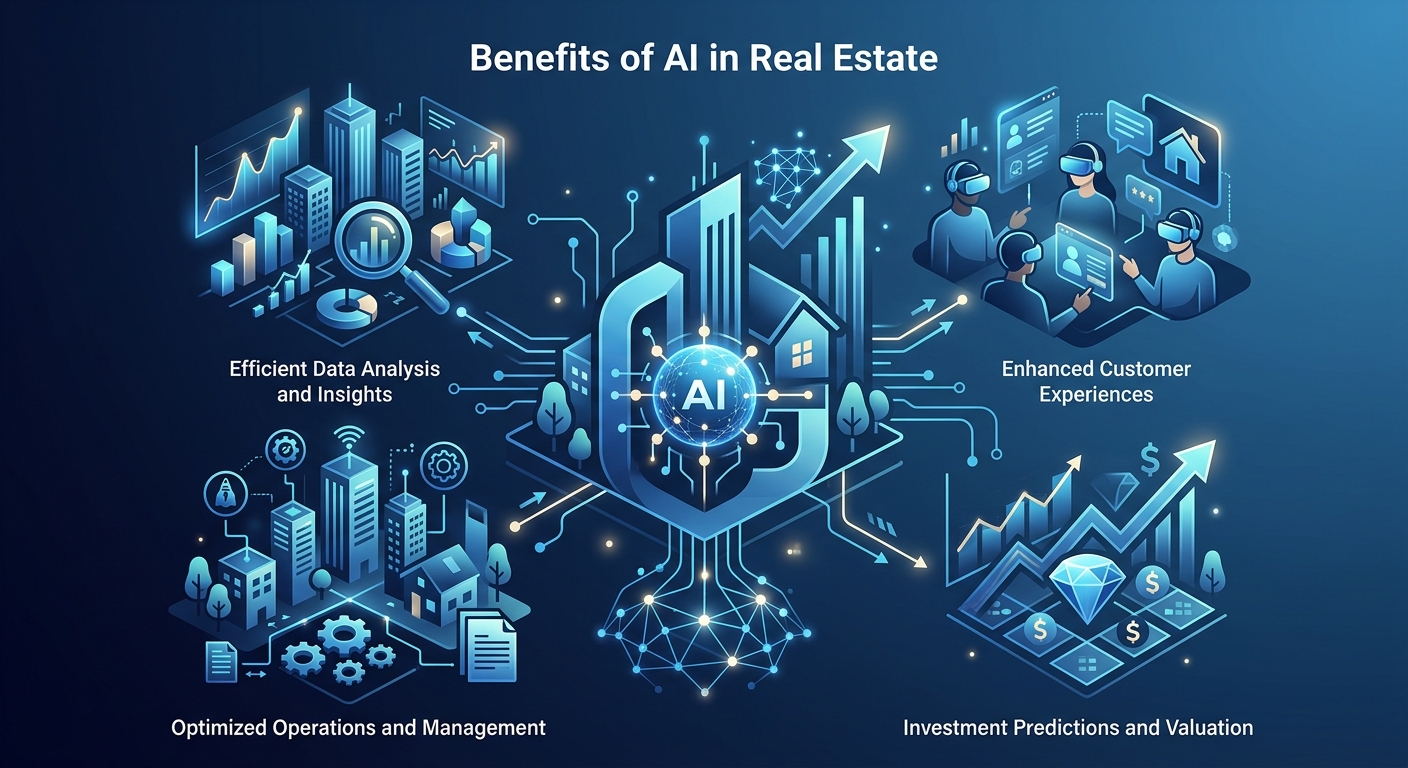
The real estate industry is undergoing a fundamental shift as artificial intelligence (AI) transitions from a speculative novelty to a core operational requirement. For enterprise decision-makers, the benefits of AI in real estate extend far beyond simple automation; they represent a total reconfiguration of how value is identified, managed, and extracted from physical assets. Artificial Intelligence (AI) is a branch of computer science that enables machines to simulate human intelligence to perform tasks such as pattern recognition, predictive forecasting, and autonomous decision-making.
In the current market, AI adoption is in its early stages across the real estate sector, yet it is already showing significant promise in automating routine tasks and optimizing complex investment strategies. According to PwC, the most advanced operators are now developing "fully AI-enabled properties" that use automation for tours, leasing, and resident services to offer high-quality units at a significant discount to traditional competitors.
Key Takeaways
- Operational Efficiency: AI reduces overhead by automating property tours, leasing, and tenant screenings, allowing for leaner onsite staffing.
- Predictive Maintenance: Systems analyze sensor data to identify repair needs before they become costly emergencies.
- Enhanced Valuations: AI-driven models provide more accurate, real-time property appraisals by processing thousands of market variables simultaneously.
- Risk Mitigation: Predictive analytics allow investors to forecast market shifts and tenant behavior with higher precision than traditional methods.
- Competitive Pricing: By lowering operational costs, AI enables firms to offer competitive rental rates while maintaining or increasing profit margins.
Introduction to AI in Real Estate
Artificial Intelligence is no longer a futuristic concept for property owners; it is a current reality. The integration of AI into real estate, often referred to within the broader "PropTech" movement, involves the application of Machine Learning (ML) and Natural Language Processing (NLP) to the vast datasets generated by the built environment.
Traditionally, real estate has been a data-rich but insight-poor industry. Information on lease terms, maintenance history, and local market trends often sits in siloed spreadsheets. AI acts as the connective tissue, synthesizing this data to provide actionable intelligence. For Real Estate Brokers, this means shifting from administrative facilitators to strategic advisors who use technology to prove value to clients.
Understanding Artificial Intelligence in the Property Market
To understand the benefits of AI in real estate, one must first recognize the three primary ways AI interacts with the property market: through data analysis, automation, and prediction.
Data analysis involves the ingestion of thousands of data points—everything from local school ratings and transit proximity to historical price fluctuations. Automation focuses on the "doing"—handling tenant inquiries via chatbots or processing lease applications. Prediction, perhaps the most valuable for enterprise leaders, involves forecasting future outcomes, such as which properties are most likely to appreciate or which tenants are at risk of defaulting on rent.
Key Insight: AI-enabled properties are not just more efficient; they represent a new asset class where technology-driven cost savings are passed directly to the bottom line, often allowing for lower rental prices without sacrificing yields.
AI Real Estate Benefits and Use Cases
The practical use cases for AI are expanding daily. In the commercial sector, AI is used to optimize energy consumption in large office buildings by predicting occupancy patterns and adjusting HVAC systems accordingly. In the residential sector, it is transforming how property managers interact with tenants.
One of the most significant benefits is the streamlining of the tenant lifecycle. Automated tenant screening, for instance, can process background checks and credit scoring in seconds rather than days. Texas Real Estate Research Center notes that this not only saves time but also significantly reduces the resources required for manual administrative work, allowing property managers to focus on high-value resident relations.
Modernizing Property Searches with AI
For years, property searches were limited by the accuracy of manual tagging and the patience of the searcher. AI has transformed this into a highly personalized experience. Modern AI-driven search engines use "computer vision" to analyze property photos, identifying features like "natural light," "modern kitchen," or "hardwood floors" without a human ever having to type those tags.
Furthermore, recommendation engines—similar to those used by Netflix or Amazon—now suggest properties to investors and home buyers based on their past behavior and stated preferences. This reduces the "time to contract" by ensuring that Real Estate Sales Agents are showing properties that have a much higher statistical likelihood of being a match.
AI-Enhanced Real Estate Valuation Methods
Valuation is the heartbeat of real estate, yet traditional appraisals are often slow and subjective. AI-Enhanced Valuation Methods, also known as Automated Valuation Models (AVMs), use deep learning to provide instantaneous property estimates. These models do not just look at recent sales; they incorporate real-time data such as local crime rates, noise pollution levels, and even social media sentiment about a neighborhood.
However, reconciling these AI-generated valuations with legal appraisal standards remains a challenge for the industry. To address this, many professionals are adopting the Uniform Property Data Report, a standardized framework developed by Fannie Mae and Freddie Mac. This ensures that the data fed into AI models meets the rigorous standards required for mortgage underwriting and institutional investment. This alignment is crucial for AI Mortgage Brokers who need to ensure that automated technology does not run afoul of federal regulations.
Predictive Analytics for Market Trends and Investment
Predictive analytics is the use of historical data, statistical algorithms, and machine learning techniques to identify the likelihood of future outcomes. In real estate, this is used to identify "up-and-coming" neighborhoods before they reach peak pricing.
Investors use AI to analyze "off-market" data, such as building permit filings or local business licenses, to predict where gentrification or commercial growth will occur. By identifying these trends early, institutional investors can achieve "alpha"—returns that exceed the market average. This is a core component of AI real estate investing, where data scientists are becoming as important as traditional brokers.
Streamlining Property Management Tasks
Property management is traditionally a high-touch, low-margin business. AI is changing that by automating the most labor-intensive tasks. One of the primary applications is Predictive Maintenance.
By using IoT (Internet of Things) sensors, property managers can monitor the health of elevators, boilers, and roofing systems in real time. Texas Real Estate Research Center highlights that these systems can address potential issues before they become major problems, significantly reducing repair costs and improving tenant satisfaction.
"The most advanced operators in this space are developing fully AI-enabled properties—automated tours, leasing, and resident services—with fewer or no onsite amenities to provide high-quality rental units at a discount." — PwC (Emerging Trends in Real Estate 2024)
Data Privacy and Security in AI Real Estate
As firms feed sensitive tenant financial information into AI systems, data privacy becomes a paramount concern. Property management firms must implement robust data protection measures to safeguard sensitive records from unauthorized access. This includes adhering to GLBA-related expectations for financial data and navigating the evolving landscape of US state privacy laws.
When deploying AI, enterprises should look toward AI Agent Data Privacy Compliance frameworks. Ensuring that data is encrypted at rest and in transit, and that AI models are not "leaking" sensitive information into the public domain, is essential for maintaining tenant trust and legal compliance.
Scaling AI: Infrastructure and Costs for Brokerages
While the benefits of AI in real estate are clear, the cost of entry can be high for small-to-mid-sized independent brokerages. Scaling AI tools requires significant cloud infrastructure. Research indicates that GPU (Graphics Processing Unit) compute is the largest expense for AI-driven platforms, often consuming 40–60% of technical budgets for firms developing proprietary models.
For most brokerages, the solution is not to build, but to buy or partner. Using Enterprise AI Agent Orchestration allows smaller firms to access powerful AI models through APIs, avoiding the massive overhead of maintaining their own hardware while still reaping the benefits of automated workflows.
Take Control with Rentana's AI Platform and Other Tools
Platforms like Rentana and other PropTech leaders are providing the interface for this transformation. These platforms offer a centralized "brain" for property portfolios, integrating lease management, maintenance tracking, and financial reporting into a single AI-driven dashboard.
By taking control of their data through these platforms, real estate firms can move from reactive management to proactive strategy. They can identify which assets are underperforming and why, whether it is due to inefficient energy use or a slow response time to maintenance requests. This level of granularity was previously impossible for large-scale portfolios.
Frequently Asked Questions About AI in Real Estate
How is AI used in real estate today?
AI is currently used for automated property valuations, tenant screening, predictive maintenance, and personalized property recommendations. It also powers chatbots that handle initial tenant inquiries and schedule viewings without human intervention.
Can AI replace real estate agents?
While AI can automate routine tasks like data entry and lead qualifying, it cannot replace the human elements of negotiation, emotional intelligence, and complex local market expertise. Instead, it acts as a force multiplier for agents.
What is predictive maintenance in property management?
Predictive maintenance uses AI to analyze data from building sensors to predict when equipment (like an HVAC system) is likely to fail. This allows for repairs to be made before a total breakdown occurs, saving money and keeping tenants satisfied.
Is AI-generated property valuation accurate?
AI valuations are highly accurate for standardized properties in high-volume markets. However, they may still struggle with unique or luxury properties that lack comparable data points. They are best used as a starting point for professional appraisal.
What are the risks of using AI in real estate?
Primary risks include data privacy breaches, algorithmic bias in tenant screening, and the high cost of implementing and maintaining the necessary technology infrastructure.
How does AI help in real estate investing?
AI helps investors by identifying market trends, forecasting rental yields, and analyzing off-market data to find undervalued properties before they appear on traditional listing services.
Final Thoughts
The integration of AI into real estate is not a trend that will fade; it is the new standard of operations. For enterprise leaders, the choice is clear: adopt AI to drive efficiency and alpha, or risk being outcompeted by more agile, tech-enabled firms. By focusing on predictive maintenance, automated leasing, and data-driven valuations, real estate professionals can unlock significant value in their portfolios while providing a superior experience for their tenants.