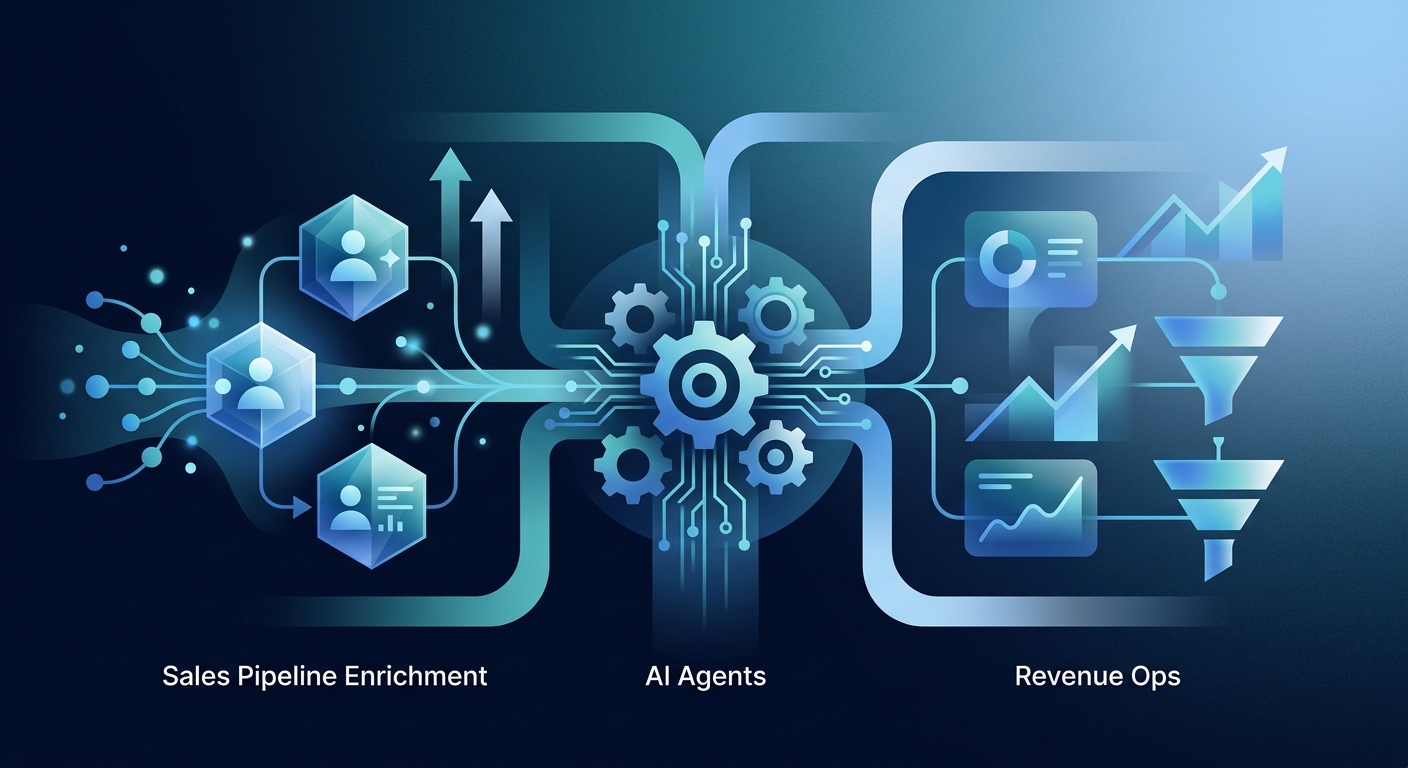
Private equity operators face a critical inflection point: traditional go-to-market scaling can no longer support aggressive exit timelines or compound margin expansion. Portfolio companies must transition from headcount-heavy revenue operations to an agentic, outcome-driven infrastructure. Deploying autonomous AI systems allows firms to absorb variable demand, eliminate administrative bottlenecks, and accelerate pipeline velocity without bloating fixed costs. This framework details how private equity AI value creation shifts from speculative technology adoption to measurable, exit-ready EBITDA growth.
The EBITDA Imperative: Why Traditional RevOps Scaling Fails PE Portfolios
Manual pipeline enrichment and fragmented CRM hygiene create hidden labor overhead that compresses portfolio margins. Historically, PE firms have relied on linear headcount expansion to fuel top-line growth. However, conventional hiring cycles cannot match the 100-day integration timelines modern operators demand. Onboarding, training, and ramping SDRs and RevOps staff consume critical quarters, creating severe cash flow drag during the sensitive post-acquisition phase. Leading operators are now prioritizing initiatives that drive measurable financial expansion, moving away from experimental tech pilots toward systems that directly impact the P&L CLA Connect.
The strategic imperative is clear: decouple revenue capacity from payroll to ensure exit readiness. Traditional BPOs and offshore RevOps teams introduce management overhead, compliance risks, and inconsistent data quality that complicate due diligence and depress valuation multiples. An agentic operating model replaces unpredictable SG&A with scalable, variable expense structures. EBITDA improvement AI agents eliminate administrative bottlenecks, accelerate cash conversion, and deliver the clean, predictable financials institutional buyers demand. When revenue operations function as a controllable, high-velocity asset rather than a cost center, operators can stress-test pricing, dynamically reallocate territory resources, and defend gross margins across economic cycles.
Architecting the AI Revenue Agent Workforce
Building a high-velocity revenue engine requires specialized, autonomous systems—not monolithic software or fragmented SaaS point solutions. Operators must deploy purpose-built portfolio company AI agents focused on discrete, high-impact functions: real-time data enrichment, buyer intent mapping, compliance routing, and continuous CRM hygiene. Unlike rigid automation scripts that fail at the first edge case, modern AI agents execute complex, multi-step workflows autonomously Percepture.
These agents integrate seamlessly with existing CRMs, marketing automation platforms, and sales enablement stacks via secure, enterprise-grade APIs. This architecture bypasses the operational disruption of legacy overhauls, enabling deployment in weeks, not months. For a detailed breakdown of our integration architecture, see our Data Integration & Setup methodology. Once live, the agents operate as a transparent, 24/7 workforce across global time zones. Every data append, routing decision, and enrichment task is recorded in immutable execution trails, ensuring full audit readiness for PE operating partners.
This visibility transforms revenue operations from a black box into a measurable, controllable asset. Strict data governance guardrails and compliance protocols ensure agent activity aligns with corporate security standards while maximizing throughput. The result is a resilient, self-optimizing revenue infrastructure that scales instantly with portfolio demand—requiring zero incremental payroll, benefits, or performance management overhead.
Pipeline Enrichment at Scale: From Manual Drudgery to Predictive Flow
Manual data processing remains the primary bottleneck in modern sales pipelines. When SDRs spend hours scrubbing spreadsheets, cross-referencing databases, and manually updating records, deal velocity stalls and rep turnover accelerates. AI-driven enrichment eliminates this friction by automatically appending real-time firmographic, technographic, and intent signals at the moment of capture. Advanced systems extract, validate, and structure complex data across disparate sources in minutes, dramatically accelerating lead qualification cycles V7 Solutions.
Beyond basic appending, intelligent agents deploy dynamic scoring and routing frameworks that instantly prioritize high-propensity accounts. This predictive flow ensures account executives engage only with fully qualified, context-rich opportunities, decoupling rep capacity from administrative overhead. By automating early-funnel tasks, organizations compress sales cycles by 20–30% and increase win rates through superior contextual engagement. Continuous automated enrichment ensures pipeline accuracy improves daily, not quarterly.
As data quality improves, forecasting precision sharpens, enabling PE operators to allocate capital with surgical accuracy and eliminate wasted marketing spend on low-intent channels. Revenue operations transitions from a reactive support function to a proactive growth engine, instantly monetizing inbound signals. This shift requires zero additional headcount—only the intelligent orchestration of existing data streams and GTM playbooks.
Operating Leverage Through AI-Driven Revenue Operations
True portfolio value creation hinges on maximizing operating leverage: driving disproportionate top-line growth from fixed or declining cost bases. PE operating leverage AI deployments establish closed-loop feedback systems where autonomous agents continuously analyze conversion data, win/loss ratios, and engagement patterns to refine GTM motions. Instead of relying on static, quarterly-updated playbooks, agents dynamically adapt routing rules, messaging frameworks, and follow-up cadences based on proven conversion data.
As AI systems ingest historical portfolio data, they rapidly improve at identifying high-potential opportunities, tracking performance trajectories, and flagging at-risk accounts before churn occurs Brownloop. This continuous optimization directly reduces Customer Acquisition Cost (CAC) and accelerates revenue throughput. When pipeline velocity increases without proportional headcount growth, gross margins expand, directly boosting exit valuations and multiples.
Operators can stress-test pricing models, simulate territory expansions, and dynamically reallocate resources across portfolio companies. To understand the financial mechanics behind this structural shift, review our AI Agent ROI & Business Case framework. This transition is not merely technological; it is a fundamental restructuring of how revenue organizations consume capital. Scalable growth is an architectural choice, not a hiring mandate. By embedding intelligence into every stage of the revenue lifecycle, firms build a self-sustaining growth engine that compounds in value with each closed deal.
The meo Pay-for-Performance Model: Fees Tied to Agreed Metrics
Traditional AI implementations burden PE firms with heavy upfront CapEx, lengthy pilot phases, integration risks, and uncertain ROI. meo eliminates this exposure through a strict pay-for-performance framework. We do not charge for software licenses, implementation hours, or speculative potential. Clients invest only when verified pipeline velocity, enriched opportunities, and closed revenue appear on the executive dashboard.
This outcome-aligned model synchronizes our incentives with core PE objectives: scalable growth, measurable efficiency, and accountable value creation. Leading autonomous platforms are rapidly shifting toward performance-based architectures, prioritizing tangible business results over feature checklists FitGap. By adopting this framework, portfolio companies bypass traditional adoption delays and realize immediate operational cash flow improvements.
Every dollar spent ties directly to a revenue event, transforming AI from a speculative IT expense into a variable-cost growth lever. To see how our pricing ties outcome fees to agreed metrics and aligns with EBITDA targets, review our Pay-for-Performance Model overview. The result is predictable, auditable margin expansion that withstands rigorous due diligence scrutiny. meo does not simply deploy technology; we deliver an accountable, results-driven workforce that funds its own deployment.
Conclusion
The window for traditional, headcount-driven revenue scaling has closed. PE operators demanding predictable EBITDA growth, accelerated exit timelines, and defensible valuation multiples must transition to agentic revenue operations. By replacing manual overhead with autonomous, audit-ready AI agents, portfolio companies achieve instant operating leverage, lower CAC, and compounding pipeline velocity. meo’s pay-for-performance model eliminates implementation risk and aligns our success directly with your financial outcomes. Deploy AI agents that execute, measure, and deliver. Schedule a strategic assessment to architect your AI-driven revenue engine today.