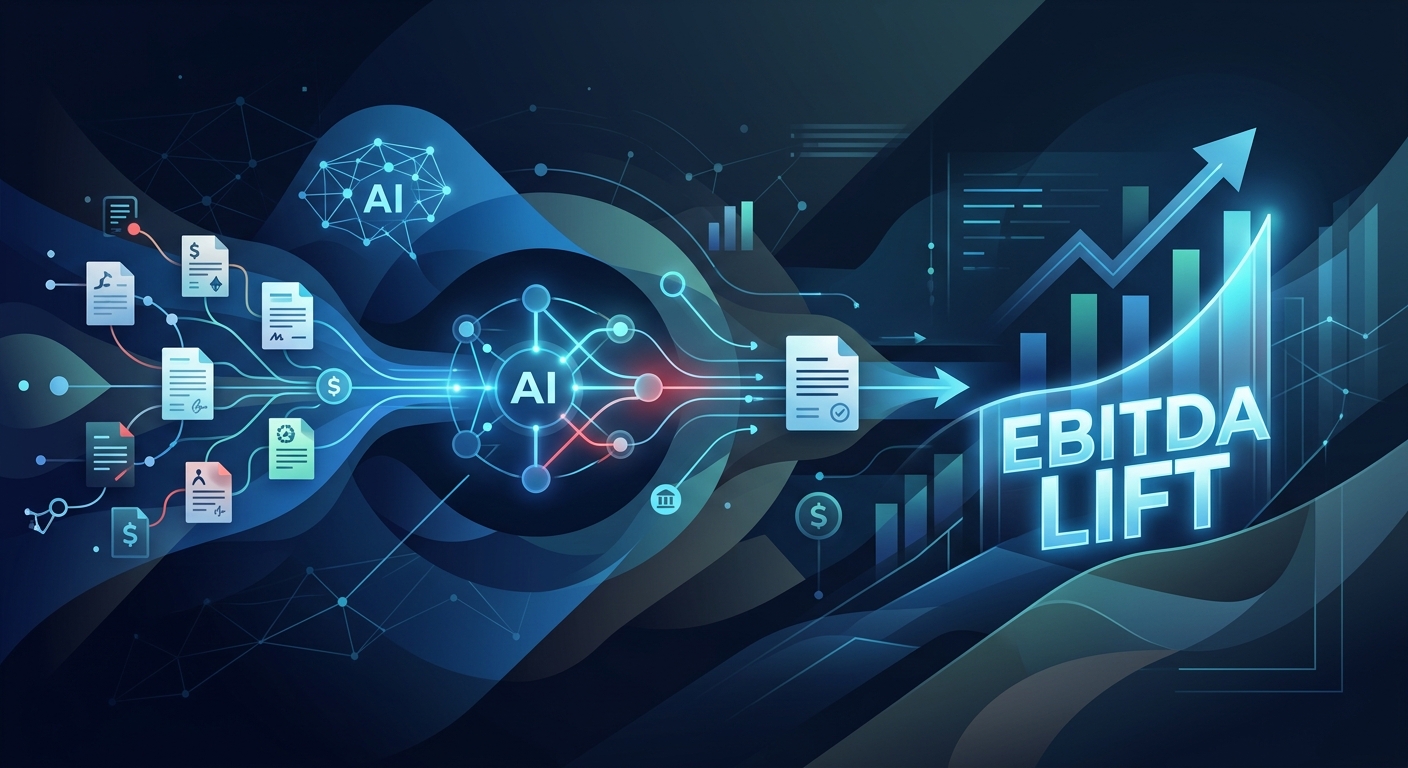
Procurement contract reconciliation has historically been relegated to back-office compliance. For private equity firms and their portfolio companies, that framing ignores a hard reality: unaddressed procurement leakage directly erodes EBITDA. As hold periods compress and margin expansion drives exit multiples, manual invoice-to-contract matching is obsolete. meo elevates reconciliation into a scalable value-creation lever. We deploy autonomous AI agents that function as an accountable digital workforce. Through a strict pay-for-performance model, firms capture recovered spend and drive measurable EBITDA growth—without upfront capital risk or implementation friction.
The Hidden EBITDA Drain in Procurement Reconciliation
Manual invoice matching systematically misses 2–5% of addressable spend. This leakage compounds through pricing drift, unclaimed volume rebates, expired promotional terms, and compliance gaps that standard audits overlook. Operating partners consistently rank procurement leakage as a top-three barrier to margin expansion, particularly as master service agreements fracture across platform acquisitions and bolt-on roll-ups.
The decentralized nature of modern supply chains magnifies the problem. When subsidiaries negotiate independently, tiered pricing becomes opaque and early-payment discount windows expire unnoticed. Industry leaders now recognize procurement optimization as a primary driver of enterprise value. Procurement is among the most underleveraged areas where AI directly moves EBITDA. Without continuous, intelligent oversight, these micro-leaks compound into millions in unrealized value CLA.
Why Legacy Systems and Shared Services Fail to Scale
Traditional ERPs and centralized shared services were engineered for transactional processing, not dynamic contract intelligence. Legacy exception handling relies on batch processing and manual triage, creating a dangerous lag between PO issuance and payment. By the time a discrepancy surfaces, vendor negotiation leverage has evaporated and recovery windows close.
Scaling headcount to manage this bottleneck only inflates SG&A without delivering proportional returns. Adding AP or procurement analysts creates a linear cost structure that directly contradicts the nonlinear growth expectations of modern portfolio strategy. Furthermore, rule-based automation collapses under the complexity of real-world vendor agreements. Static rules cannot interpret unstructured terms, adapt to dynamic SLAs, or reconcile multi-currency pricing tiers. Legacy tools and human-heavy workflows create structural ceilings that only autonomous, agentic architectures can overcome AI Agents vs. Traditional Automation.
How AI Agents Create Operating Leverage
Autonomous AI agents operate as a 24/7 digital workforce, continuously cross-referencing invoices, POs, receiving logs, and master agreements in real time. Unlike static software, these agents execute end-to-end reconciliation workflows without human handoffs. They autonomously detect pricing variances, identify missed rebate thresholds, flag unauthorized rate escalations, initiate vendor disputes, and trigger structured recovery workflows. This transforms procurement from a reactive audit function into a proactive, continuously optimizing value-protection system.
The architecture is inherently scalable. When a platform company acquires an add-on, the same agent framework extends instantly to the new vendor ecosystem. There are no lengthy implementations or training overheads. This immediate deployment delivers tangible operating leverage from day one, allowing teams to capture margin improvements across newly integrated assets before legacy processes stall. By embedding agents directly into procurement workflows, firms eliminate the latency that traditionally allows overpayments to slip through Percepture. The result is a self-correcting financial operation that compounds EBITDA gains throughout the investment lifecycle Fractional Agent. For operating partners, this means transitioning from episodic, post-close cost-cutting to continuous, embedded value extraction.
Quantifying the EBITDA Impact
The financial impact of AI-driven reconciliation is highly measurable and driven by three primary levers. First, direct margin expansion occurs through the systematic recovery of overpayments, reclamation of unapplied rebates, and strict enforcement of contracted pricing. Second, labor overhead drops significantly as finance and procurement FTEs shift from manual exception management to high-impact initiatives like strategic sourcing, vendor consolidation, and category management. Third, predictive variance analytics prevent future leakage by flagging anomalous billing patterns before payment authorization.
Compared to traditional AP automation, the EBITDA lift is substantial and compounding. Firms report rapid payback periods driven by verified cash recovery and reduced operating expenses—not theoretical efficiency gains. The ability to trace every recovered dollar to a specific contract term provides the granular financial transparency required for board reporting and exit readiness AI Agent ROI & Business Case.
The meo Pay-for-Performance Deployment Framework
meo operationalizes this capability through a strict pay-for-performance framework that eliminates capital risk and guarantees accountability. There is zero upfront expenditure. Clients pay only when verified EBITDA lift and recovered spend are documented. This model de-risks AI adoption while ensuring technology spend never outpaces actual portfolio value creation.
Our agents function as a measurable, accountable workforce—not opaque software. Every action generates a full audit trail, SLA tracking is embedded into the operational layer, and reporting is standardized for executive consumption. Performance pricing is explicitly aligned with PE investment theses, ensuring every deployed dollar correlates directly to margin expansion. This removes traditional friction between operations and IT, accelerating time-to-value while maintaining strict financial governance Pay-for-Performance Model.
By tying compensation directly to verified outcomes, meo operates as a true financial partner to portfolio management. Transparent dashboards track recovered spend, variance reduction rates, and FTE reallocation metrics, giving operating partners the empirical data needed to validate theses and optimize 100-day plans.
Execution Roadmap for PE Operating Partners
Successful deployment follows a disciplined, phased roadmap designed to integrate seamlessly with existing financial operations. Engagement begins with a 30-day pilot targeting high-volume, high-variance vendor categories (e.g., logistics, IT infrastructure, or raw materials) to establish baseline recovery metrics and validate contract intelligence. This rapid proof-of-concept delivers immediate visibility into leakage patterns and maps the EBITDA improvement trajectory without disrupting core procurement functions.
Integration with existing ERP, procurement, and CLM systems occurs via secure API connectors and lightweight middleware, eliminating disruptive data migrations and prolonged IT resource allocation. Post-pilot, continuous optimization cycles synchronize with 100-day plans, add-on roll-ups, and exit readiness timelines. As the framework scales, it continuously refines reconciliation logic, adapting to new contract structures and expanding vendor coverage. For operating partners, this means deploying a system that not only recovers historical leakage but actively safeguards margin expansion through the entire hold period and exit process Implementation Methodology.
Ready to convert procurement reconciliation from a cost center into a measurable EBITDA lever? Contact meo to launch your risk-free, pay-for-performance pilot and capture verified margin expansion across your portfolio.