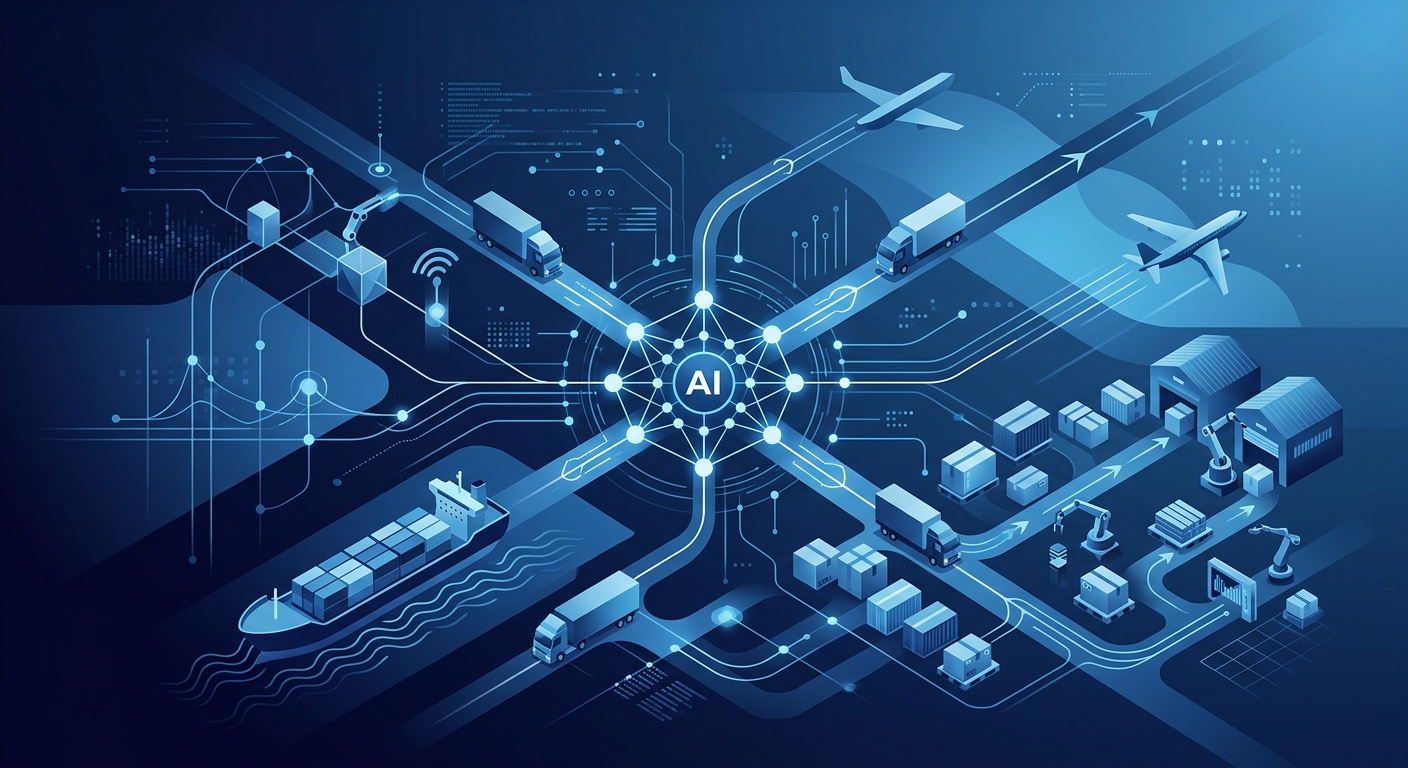
The Evolution of AI in the Logistics Industry
Artificial Intelligence (AI) in the logistics industry is a specialized application of machine learning, computer vision, and natural language processing designed to optimize the movement of goods, information, and capital across global supply chains. For decades, the sector relied on operations research—a mathematical approach to problem-solving. However, as global supply chains have grown in complexity, traditional human-led operations research is no longer sufficient to manage the sheer volume of variables involved in modern freight and warehousing.
Today, the industry is shifting toward "Agentic AI," where autonomous software agents do more than just provide insights; they take actions to resolve disruptions in real time. This evolution is driven by the need for resilience in the face of significant external and internal pressures. According to BCG, leading logistics players are now using AI agents to streamline operations, elevate efficiency, and create new value for customers. This transition marks a move from reactive logistics to predictive, autonomous ecosystems.
Key Takeaways
- Cost Efficiency: Early adopters of AI-enabled supply chain management have achieved a 15% reduction in overall logistics costs.
- Inventory Optimization: AI tools have driven a 35% improvement in inventory levels, reducing capital lock-up and stockouts.
- Service Excellence: Service levels have seen a 65% enhancement among firms utilizing advanced AI analytics.
- Executive Confidence: 70% of CEOs from over 150 firms agree that AI is delivering a strong ROI despite high initial adoption costs.
Logistics Planning Use Cases and Route Optimization
One of the most immediate applications of AI in logistics is vehicle routing and strategic planning. While small-scale businesses can often manage routes through human intuition, large-scale operations involving thousands of vehicles and millions of delivery permutations require machine intervention. Companies like Uber Freight are pioneering this space by applying technology to minimize the time, cost, and distance of trucking and freight.
AI route optimization goes beyond simple GPS mapping. It integrates real-time data such as weather patterns, traffic congestion, port delays, and driver rest mandates to calculate the most efficient path. MIT Sloan notes that at larger scales, human problem-solving no longer suffices for these complex routes. By automating these decisions, firms can reduce fuel consumption and improve delivery predictability, which is critical for maintaining high service levels.
Key Insight: AI-driven route optimization doesn't just find the shortest path; it dynamically re-routes assets based on live environmental data, reducing idle time by up to 20% in high-density urban corridors.
4 Inventory Management with AI
Inventory management is the backbone of a lean supply chain. AI transforms this function from a backward-looking reporting task into a forward-looking strategic asset. There are four primary ways AI enhances inventory management:
- Dynamic Reorder Points: Instead of static safety stock levels, AI calculates reorder points based on real-time consumption rates and lead-time variability.
- Stockout Prediction: By analyzing historical patterns, AI can predict when a SKU is likely to go out of stock weeks before it happens.
- SKU Rationalization: AI identifies underperforming products that are consuming warehouse space without generating sufficient margin.
- Multi-echelon Inventory Optimization (MEIO): AI optimizes inventory across the entire network—from manufacturers to regional distribution centers—rather than in silos.
According to research from Georgetown University, these AI-driven improvements have led to a 35% improvement in inventory levels, allowing companies to maintain lower stock while simultaneously increasing product availability.
5 AI in Demand Forecasting
Demand forecasting is the practice of using historical data and external signals to predict future customer requirements. Traditional forecasting often fails because it cannot account for "black swan" events or subtle shifts in consumer sentiment. AI addresses this by processing unstructured data from social media, news reports, and even local weather forecasts to refine predictions.
In the context of Digital Twin Technology, AI can simulate thousands of "what-if" scenarios to show how a sudden spike in demand would impact the supply chain. This allows logistics providers to position inventory closer to demand centers before the demand even manifests. The result is a reduction in expedited shipping costs and a more resilient supply chain that can withstand market volatility.
Automated Warehousing Use Cases and Robotics
Warehousing is perhaps the most visible area of AI implementation. Automated warehousing involves the use of AI-powered robots and software to handle the picking, packing, and sorting of goods. Unlike traditional automation, which follows rigid paths, AI-driven robotic fleets use computer vision and reinforcement learning to navigate dynamic environments and handle varied objects.
| Technology | Use Case | Primary Benefit |
|---|---|---|
| Autonomous Mobile Robots (AMRs) | Goods-to-person picking | Reduces worker travel time by 50-70% |
| AI Sorting Arms | Parcel induction and sorting | Increases throughput without increasing footprint |
| Automated Storage and Retrieval (AS/RS) | High-density storage | Maximizes vertical warehouse space by up to 40% |
| Drones | Inventory counting and cycle counts | Eliminates the need for manual height-access checks |
For legacy warehouses, the transition often involves retrofitting existing equipment with sensors. While the hardware requirements are significant, integrating these systems into an Enterprise AI Agent Orchestration framework allows for seamless coordination between the warehouse floor and the back office.
Top 10 Logistics AI Platforms for 2025
Selecting the right platform is critical for achieving the ROI mentioned by industry leaders. The following platforms are currently leading the market in AI-driven logistics:
- Project44: Specialized in real-time supply chain visibility and predictive ETAs.
- FourKites: Uses AI to track shipments across all modes and provide exception management.
- Uber Freight: A leader in autonomous freight matching and route optimization.
- Locus Robotics: Provides AI-powered AMRs for warehouse fulfillment.
- Blue Yonder: Offers a comprehensive AI platform for demand planning and inventory management.
- Manhattan Associates: Known for AI-infused warehouse management systems (WMS).
- Convoy: (Now part of Flexport) Focuses on digital freight networks and automated matching.
- C3 AI: Provides enterprise-grade predictive maintenance and supply chain risk software.
- GreyOrange: Specializes in AI-driven robotic fulfillment and warehouse orchestration.
- Samsara: A leader in IoT and AI for fleet management and driver safety.
Back Office and Analytics Use Cases
AI's impact isn't limited to the physical movement of goods; it is also transforming the administrative side of logistics. Back-office management use cases include automated freight auditing, invoice processing, and customs documentation. For instance, AI agents for invoice exception handling can resolve discrepancies between purchase orders and shipping manifests without human intervention.
In analytics, AI enables predictive maintenance of the fleet. By monitoring engine vibrations, temperature, and fuel consumption, AI can predict when a truck or a warehouse conveyor belt is likely to fail. As detailed in our guide on Predictive Maintenance, this proactive approach prevents costly downtime and extends the lifespan of expensive capital assets.
Ethical Considerations and Data Governance
As logistics companies share more data with third-party AI vendors, data governance becomes a critical concern. Organizations must implement frameworks that establish clear rules for data ownership and lineage tracking. Key compliance measures include the use of AI Agent Data Privacy Compliance protocols to ensure that sensitive shipment data and customer information are not exposed.
Another ethical challenge is the "black box" problem. When an AI route optimization system suggests a route that a veteran driver disagrees with, there must be a mechanism for feedback. Companies are increasingly adopting "Explainable AI" (XAI) to provide drivers and operators with the reasoning behind automated decisions, building trust between human workers and machine intelligence.
"The logistics industry is facing unprecedented pressures, both externally and internally." – BCG Report, 2025 (Agentic AI in Logistics: A Strategic Imperative)
Frequently Asked Questions
What are the advantages of AI in logistics?
The primary advantages include a 15% reduction in logistics costs, a 35% improvement in inventory accuracy, and a 65% increase in service levels. AI also enhances resilience by providing predictive insights into potential supply chain disruptions.
How does AI improve last-mile delivery?
AI improves last-mile delivery by optimizing routes in real time based on traffic and weather, grouping deliveries more efficiently, and providing customers with highly accurate delivery windows (Predictive ETAs).
Is AI adoption in logistics expensive?
While the initial investment in sensors, robotics, and software can be high, 70% of CEOs report a strong ROI. The long-term savings in fuel, labor, and inventory carrying costs typically outweigh the setup expenses.
Can AI replace human logistics managers?
AI is not replacing managers but rather augmenting their capabilities. It handles the data-heavy, repetitive tasks of routing and forecasting, allowing humans to focus on strategic relationships and complex problem-solving. You can see more on this in our analysis of Computer and Mathematical Occupations.
What is Agentic AI in logistics?
Agentic AI refers to AI systems that have the ability to execute tasks autonomously. In logistics, this might mean an AI agent that automatically re-books a shipment when it detects a port delay, rather than just alerting a human to the problem.
How does AI help with warehouse safety?
AI uses computer vision to monitor warehouse floors for safety hazards, such as spilled liquids or workers entering restricted zones near moving robots, alerting supervisors instantly to prevent accidents.