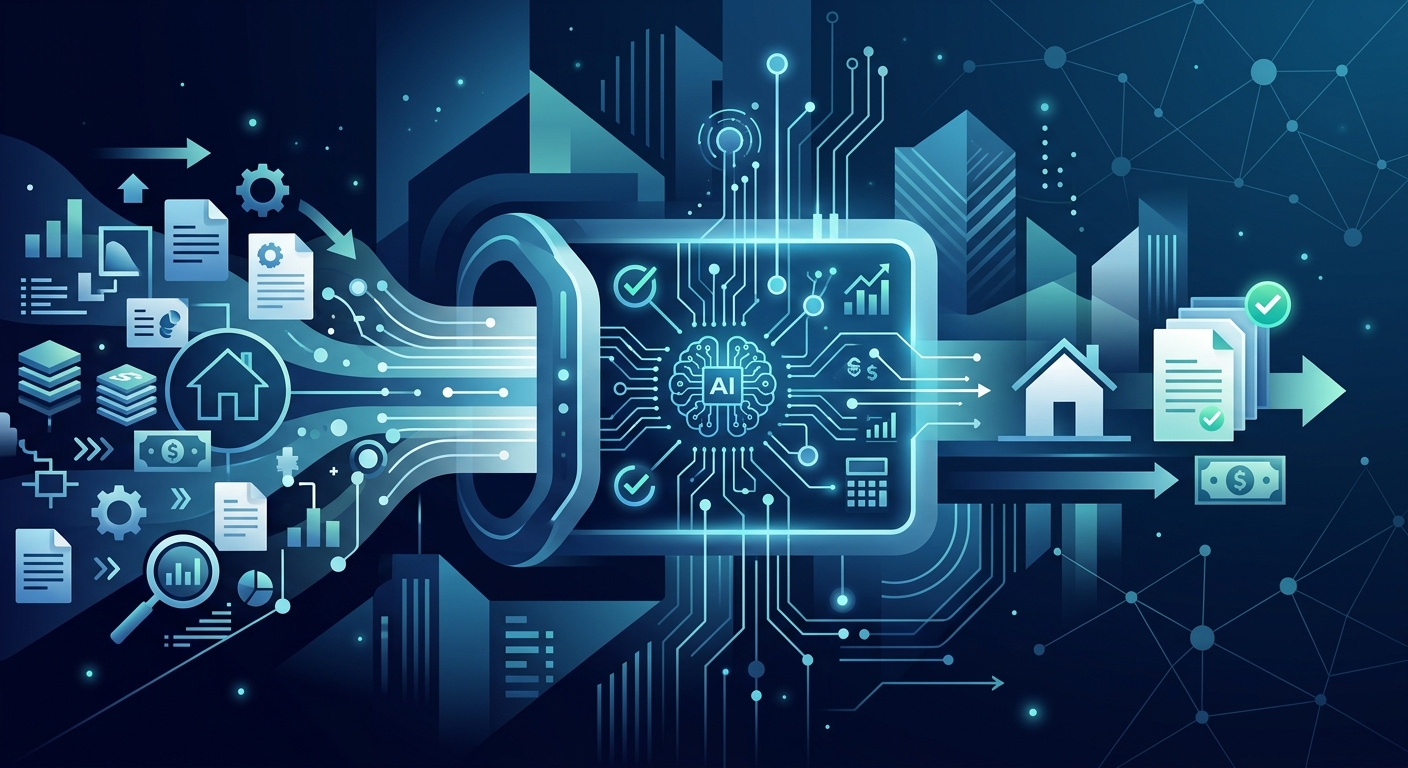
Margin compression, rate volatility, and persistent talent shortages have exposed the structural fragility of traditional mortgage operations. Lenders can no longer absorb fixed overhead while waiting for volume to recover. The industry must shift from purchasing static software licenses to deploying a scalable underwriting workforce that operates on verified outcomes. At Meo, mortgage AI agents are engineered as an on-demand, accountable labor layer—replacing costly manual processes with predictable, performance-driven execution. This is not a software upgrade. It is a fundamental restructuring of how lending capacity is procured, scaled, and measured.
The Shift from Software to Scalable Underwriting Workforce
Traditional automated underwriting systems (AUS) have reached their functional ceiling. Built on rigid architectures and linear processing logic, legacy platforms struggle to adapt to shifting investor overlays, evolving document formats, and dynamic compliance mandates. What once multiplied capacity now restricts it.
Modern AI underwriting replaces the static software model with an elastic, outcome-driven workforce. Autonomous agents scale up during refinance surges and scale down during purchase slowdowns without requiring additional headcount or infrastructure spend. The operational directive is straightforward: redirect capital expenditure from perpetual licensing fees toward measurable processing throughput. By treating AI as a production workforce rather than an IT asset, lenders unlock operational leverage, transforming underwriting from a fixed cost center into a scalable, predictable production line Visionet.
Why Legacy Automated Underwriting Falls Short Today
Rule-based engines were designed for an era of standardized W-2 income, conventional LTV thresholds, and static guideline interpretations. Today’s market requires dynamic decisioning across gig economy income, complex asset documentation, and layered investor overlays. When legacy systems encounter non-standard files, they default to manual exception queues, extending cycle times and eroding borrower confidence.
This bottleneck is compounded by outdated SaaS pricing. Lenders pay fixed monthly fees regardless of loan volume, market conditions, or processing output. This rigid overhead compresses net margins, particularly when pull-through rates fluctuate with interest rate shifts. Manual intervention in these edge cases introduces human error, increases rework, and elevates operational risk Ocrolus. Legacy automated underwriting no longer optimizes efficiency; it digitizes the bottleneck.
How AI Underwriting Agents Execute End-to-End
Meo’s mortgage AI agents operate as integrated underwriting professionals, managing files from initial submission to clear-to-close readiness. Upon ingestion, agents autonomously classify, extract, and normalize data across tax transcripts, bank statements, employment verification forms, and property appraisals. They cross-reference extracted values against source documents, flag discrepancies in real time, and reconcile mismatched figures without human intervention.
Risk parameters are continuously calibrated against live Fannie Mae, Freddie Mac, and FHA guideline updates, ensuring every decision aligns with current secondary market requirements. Agents dynamically calculate DTI ratios, evaluate compensating factors, and apply investor-specific overlays based on loan type and channel. Crucially, this architecture integrates directly with existing LOS environments via secure APIs and standardized data pipelines. There is no disruptive rip-and-replace implementation. Agents layer directly over current infrastructure, leveraging existing data lakes and workflow orchestrations. By eliminating redundant data entry and automating conditional logic, lenders achieve consistent, high-velocity processing while retaining institutional control over file movement Quantiphi. The result is a streamlined pre-funding workflow that reduces cycle times, minimizes manual touchpoints, and improves borrower experience through predictable turnaround FundMore.ai.
Measurable Outcomes Over Black-Box Automation
Many AI platforms operate as opaque decision engines, obscuring the rationale behind approvals or denials. Meo rejects black-box automation in favor of engineered accountability. Every underwriting action is governed by transparent KPI tracking: cost per loan processed, time-to-clear-to-close, exception resolution velocity, and conditional approval accuracy. These are not retrospective reports; they are live operational dashboards that drive continuous process optimization.
Decision integrity is maintained through immutable audit logs. Every ingested document, applied guideline, weighted risk factor, and generated condition is timestamped and cryptographically secured. This creates a complete, tamper-proof decision lineage that satisfies internal QA, secondary market due diligence, and external compliance reviews. Accountability is not a post-deployment feature; it is the foundational constraint governing agent behavior. Lenders gain full visibility into agent performance, enabling precise capacity planning, accurate forecasting, and defensible operational audits. When AI functions as an accountable workforce, uncertainty is replaced by verifiable throughput.
Pay-for-Performance: Aligning Vendor Risk with Lender ROI
Traditional vendors monetize access, charging for seats, modules, and storage while shifting market volatility risk entirely to the lender. Meo’s pay-for-performance AI model inverts this paradigm. Lenders invest only when agents deliver verified, production-ready results. Pricing is directly tied to processed volume, successfully cleared files, and funded loans.
This alignment eliminates idle software overhead. During rate-driven contractions, costs contract proportionally. During volume surges, capacity scales instantly without capital approvals or procurement delays. Lenders preserve working capital, protect net margins, and convert underwriting from a fixed liability into a variable, outcome-backed production function. By decoupling cost from capacity and tethering it to execution, lenders achieve predictable unit economics and sustainable profitability across market cycles. This is the operational advantage of a workforce that only incurs cost when it performs.
Compliance, Auditability & Regulatory Confidence
Regulatory risk cannot be automated away; it must be engineered into the decision architecture. AI underwriting agents operate within strict compliance guardrails, embedding adherence to ECOA, TRID, and Fair Lending standards directly into workflow logic. Agents continuously monitor for disparate impact, automated disparity flagging, and guideline deviations that could trigger regulatory scrutiny or secondary market repurchase demands.
For complex edge cases, regulatory gray areas, or borrower disputes, human-in-the-loop protocols activate seamlessly. Senior underwriters retain final authority on high-risk files, while agents provide curated decision packets, risk summaries, and compliance checklists to accelerate review. All workflows generate comprehensive reporting frameworks tailored to federal examiner requirements, GSE audit standards, and internal risk committee reviews CGI. This dual-layer approach ensures regulatory confidence without sacrificing processing velocity. Lenders operate with the precision of machine execution and the judgmental oversight of experienced professionals.
Deployment Roadmap for Mortgage Lenders
Successful AI underwriting deployment requires disciplined, phased execution. Meo initiates onboarding with conventional conforming and low-complexity refinance files, establishing baseline accuracy and integration stability. Within 30 days, agent performance is rigorously benchmarked against historical human processing metrics, measuring cycle time reduction, exception rates, and cost-per-file. Once accuracy and operational trust are validated, capacity expands progressively into jumbo, portfolio, and non-QM segments. This structured rollout ensures minimal disruption, rapid ROI validation, and sustainable scaling aligned with institutional risk appetite.
Conclusion
The future of mortgage lending belongs to organizations that replace fixed overhead with outcome-driven execution. AI underwriting is no longer experimental; it is a production-ready workforce that scales with volume, guarantees auditability, and aligns directly with your bottom line. Meo’s pay-for-performance model ensures you only invest when agents deliver verified, fundable results. Stop paying for idle software. Start funding a workforce that performs on demand.
Ready to replace underwriting overhead with measurable throughput? Contact Meo to schedule a performance benchmarking assessment and deploy accountable AI agents within your existing LOS architecture.