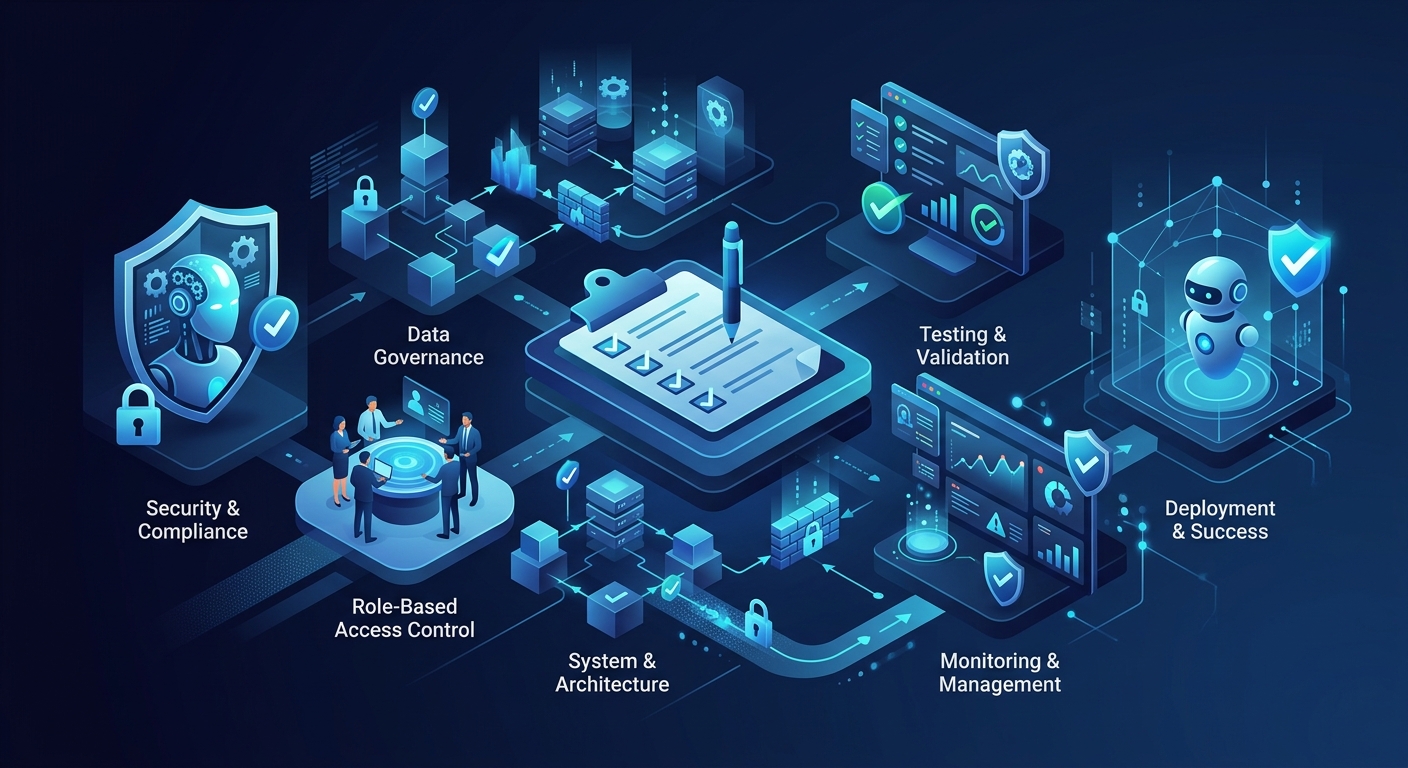
Enterprises no longer pilot artificial intelligence for novelty. They deploy it to replace fixed labor overhead with variable, outcome-driven capacity. However, autonomous systems introduce novel risk vectors that bypass conventional perimeter defenses. Without a rigorous security baseline, AI initiatives stall in compliance bottlenecks or trigger unmanaged liability. This checklist positions AI agent security as the operational foundation for a measurable, accountable AI workforce. By engineering safeguards directly into the deployment pipeline, organizations transform security from an IT cost center into a performance multiplier. The result is predictable ROI, enforceable business outcomes, and a deployment pathway that scales labor capacity without scaling risk.
The Executive Case for Secure AI Deployment
Treating security as a post-deployment audit is a strategic liability. In a pay-for-performance model, security protocols function as revenue enablers. Every compliance checkpoint directly correlates with workforce reliability, output consistency, and contractual accountability. Unstructured deployments inevitably generate shadow AI, regulatory friction, and operational liability. Transforming unsanctioned experimentation into scalable, production-grade workflows requires a deliberate security posture that prioritizes governance before expansion AI agent security: the complete enterprise guide for 2026 | MintMCP Blog.
Aligning compliance protocols with workforce outcomes requires mapping every security control to a business KPI. When an AI agent assumes customer service, procurement, or compliance routing, its security posture must match or exceed the accountability standards of the human functions it replaces. Executives who establish enterprise AI governance as a prerequisite achieve significantly faster time-to-value. By enforcing non-negotiable security thresholds upfront, organizations eliminate deployment friction, ensure regulatory alignment, and guarantee that AI capacity scales only when it delivers auditable, labor-replacing results.
Phase 1: Data Privacy & Access Control Validation
Autonomous agents require direct access to proprietary datasets, customer records, and operational workflows. Consequently, AI data privacy must be engineered into the architecture before deployment begins. Implement strict data classification and minimization protocols across both training and runtime pipelines. Restrict agent access strictly to the datasets required for designated functions. Over-provisioned access is the primary root cause of unauthorized data synthesis and compliance breaches.
Deploy zero-trust, role-based access control (RBAC) models engineered specifically for autonomous workflows. Traditional identity and access management (IAM) frameworks assume human-initiated, intermittent requests; AI agents operate continuously, requiring dynamic credential rotation and session-bound permissions. Legacy security architectures cannot address the non-deterministic behavior of agentic systems, leaving enterprises exposed to novel threats that compromise data integrity Building an AI Agent Security Framework for Enterprise-Scale AI. Enforce foundational safeguards—including encryption at rest, field-level tokenization, and strict egress filtering—prior to production rollout. This ensures every agent action remains cryptographically bound to its authorized scope, eliminating data drift and unauthorized lateral movement.
Phase 2: Enterprise AI Governance Architecture
Autonomy does not mean abdication. Enterprises must establish explicit accountability chains between human operators and autonomous agents. Document and assign ownership for every decision node, exception handler, and escalation pathway. For high-impact workflows, a designated human steward must retain final override authority and audit responsibility. This structure eliminates operational ambiguity and ensures clear liability assignment, addressing the reality that AI risk management requires a fundamentally different approach than traditional IT governance—one that accounts for autonomous, non-deterministic decision-making Enterprise AI Agent Security and Compliance: A Risk Management Guide.
Map operational workflows to regulatory standards using a unified AI compliance framework. Align agent behaviors with documented control objectives across GDPR, SOC 2, HIPAA, and industry-specific mandates. Institutionalize governance through a cross-functional executive committee spanning legal, security, operations, and finance. This body must review agent scope, approve data boundaries, and validate performance thresholds prior to deployment. By embedding governance during the design phase, organizations transform compliance from a reactive constraint into a proactive scaling mechanism. The resulting AI workforce is auditable, predictable, and contractually defensible.
Phase 3: Threat Mitigation & Real-Time Monitoring
Static security scans are obsolete against dynamic AI workloads. Replace periodic audits with continuous AI agent security monitoring that actively detects prompt injection, adversarial manipulation, model hallucination, and data exfiltration. Modern threat landscapes demand specialized oversight layers. Deploy dedicated guardian agents operating in parallel with primary models to intercept malicious inputs, validate output alignment, and enforce behavioral boundaries in real time AI Agent Security In 2026: What Enterprises Are Getting Wrong.
Implement automated output validation protocols with strict human-in-the-loop escalation triggers. If confidence scores fall below predefined thresholds or outputs deviate from operational playbooks, execution must pause and route to a qualified operator. Crucially, correlate security telemetry with performance KPIs. Monitor false-positive rates, intervention frequency, and resolution latency alongside task completion time and cost-to-serve. This integrated approach maintains operational velocity while guaranteeing integrity. Security transitions from a hidden liability to a transparent, measurable performance indicator.
Phase 4: Performance-Linked Security SLAs & Continuous Audits
In a pay-for-performance ecosystem, security compliance must be contractually bound to output guarantees. Define explicit Security Service Level Agreements (SLAs) governing uptime, breach tolerance, hallucination thresholds, and audit readiness. Compensation and scaling should be contingent upon agents operating within these parameters while delivering verified business outcomes. This structure eliminates the traditional misalignment between IT security budgets and operational ROI, ensuring every AI investment directly funds measurable results.
Automate audit trails and regulatory reporting to guarantee board-level transparency. Log every agent decision, data access event, security alert, and human override in an immutable, query-ready format. Continuous automated reporting reduces compliance overhead by 60–80% while maintaining a rigorous regulatory posture. Finally, mandate iterative security hardening. As AI workforces scale, threat surfaces evolve. Implement scheduled red-teaming, adversarial dataset retraining, and dynamic policy updates to ensure security scales linearly with capacity. This continuous improvement cycle replaces traditional labor overhead with guaranteed, risk-mitigated outcomes—fulfilling the core promise of the accountable AI workforce.
Conclusion
Secure AI deployment is not an administrative checkbox; it is the operational backbone of a scalable, accountable workforce. By embedding data privacy, governance architecture, real-time threat mitigation, and performance-linked SLAs into your deployment pipeline, you transform AI agents from experimental overhead into predictable revenue drivers. Fixed labor costs decrease, compliance exposure is systematically mitigated, and business outcomes become contractually enforceable.
At meo, we engineer AI agents that scale exclusively when they deliver verified results. Our pay-for-performance model ties outcome fees to secure, auditable, and operationally proven AI work. Contact our executive deployment team to transition from pilot to production with zero upfront capital risk.