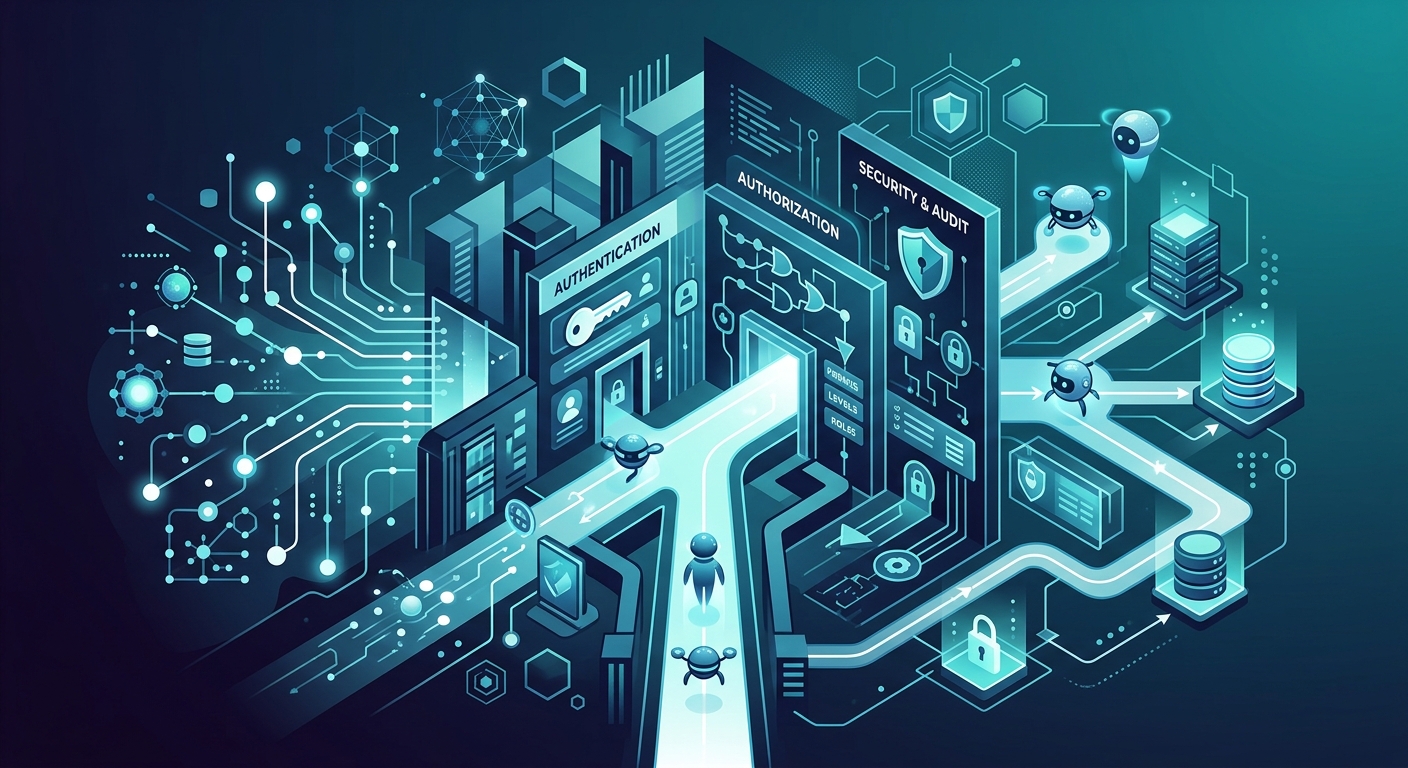
Deploying autonomous AI agents into enterprise environments is no longer experimental; it is an operational imperative. However, without precise credentialing and strict boundary enforcement, AI initiatives rapidly devolve into unmanageable cost centers. Access controls are not compliance checkboxes—they are the foundational architecture that transforms experimental models into a scalable, accountable workforce. At meo, we treat security as the primary enabler of measurable ROI. By hardening access protocols at the deployment layer, organizations transition from labor-heavy overhead to a pay-for-performance model where every AI action is traceable, auditable, and directly tied to business outcomes.
The Executive Imperative: Why Access Controls Dictate AI ROI
Treating AI agents as a scalable workforce requires rigorous credentialing standards matched to machine-speed execution. Loose scoping introduces operational risk that directly erodes ROI. When agents operate outside defined boundaries, they generate unpredictable outputs, trigger compliance violations, and create liability exposure that nullifies efficiency gains. MintMCP notes that transforming shadow AI into a sanctioned capability requires explicit governance structures to prevent unauthorized data traversal.
Security infrastructure is a non-negotiable prerequisite for pay-for-performance AI models. Without it, organizations cannot isolate failures, attribute financial impact, or guarantee outcome-based billing. Strict access controls restrict agents to the exact systems, datasets, and workflows required to deliver results. This precision eliminates speculative spending and aligns AI investment with verifiable metrics, transforming security from a cost center into a revenue-protecting asset.
Architecting Enterprise AI Governance for Autonomous Agents
Effective governance requires adapting traditional access models to autonomous execution patterns. Role-Based Access Control (RBAC) and Attribute-Based Access Control (ABAC) must be engineered for non-human workflows where operational context shifts in real time. Rather than static roles, agents operate under dynamic policy envelopes that evaluate task requirements, environmental risk, and data sensitivity before granting execution rights.
Implementing least-privilege boundaries across legacy systems, APIs, and cloud environments is critical. Agents must never inherit broad administrative privileges. Instead, they request just-in-time (JIT) credentials scoped to discrete transactions or workflow sequences. This minimizes lateral movement risks and prevents cascade failures. Microsoft emphasizes that without proper governance foundations, AI agents introduce severe vulnerabilities related to sensitive data exposure and boundary erosion.
Establishing clear accountability chains ensures executive-ready audit trails. Every agent decision, data query, and system modification must be cryptographically signed and logged to a centralized governance ledger. By mapping agent actions to responsible owners via RACI matrices, enterprises maintain transparency and accelerate incident response EPC Group. This architecture transforms governance from a retrospective audit into a real-time operational control system.
Building an AI Compliance Framework That Scales
Regulatory compliance in autonomous environments cannot rely on manual oversight. Organizations must map explicit regulatory requirements—including GDPR, SOC 2, HIPAA, and ISO 27001—directly to machine-readable permission sets. Agility at Scale highlights that securing enterprise AI agents demands a fundamentally different approach than traditional cybersecurity, one that accounts for autonomous decision loops and dynamic data consumption. Compliance must be embedded in the execution layer, not applied post-hoc.
Deploying policy-as-code architectures enables automated, real-time enforcement. Translating regulatory mandates into executable code (e.g., Open Policy Agent rules) ensures agents are instantly blocked from non-compliant actions. This eliminates human bottlenecks and guarantees consistent enforcement across thousands of concurrent threads. Policy-as-code also provides version control, automated testing, and instant rollback—essential capabilities for maintaining compliance across evolving regulatory landscapes.
Designing immutable audit trails further streamlines risk assessments and reduces compliance overhead. Write Once, Read Many (WORM) storage guarantees agent logs cannot be altered, deleted, or backdated. Paired with automated compliance scanners, these trails generate real-time readiness reports for auditors and regulators. This infrastructure shifts compliance from a periodic scramble to a continuous, automated state of readiness, directly supporting Responsible AI standards and enterprise risk frameworks.
Step-by-Step Implementation: From Policy to Production
Deploying hardened access controls requires a disciplined, phased approach that prioritizes stability before scale. The following roadmap ensures zero disruption to core operations while rapidly maturing AI capabilities.
Phase 1: System Discovery, Data Classification, and Baseline Mapping Catalog every system, API, and dataset the AI workforce will access. Classify data by sensitivity (public, internal, confidential, restricted) and map baseline permissions accordingly. Identify dependency chains to prevent downstream failures when restricting access. This establishes exact operational boundaries.
Phase 2: Secure Credential Provisioning and Encrypted Integration Assign dedicated, non-human service identities to each agent role. Implement mutual TLS (mTLS) and encrypted API gateways for all agent-to-system communication. Replace static keys with short-lived, dynamically issued tokens scoped to specific tasks. This limits credential compromise windows to minutes, not months.
Phase 3: Phased Rollout with Human Validation and Failure Testing Run agents in shadow mode, executing tasks parallel to human operators without committing changes. Implement validation gates requiring human approval for high-risk actions. Conduct rigorous failure-mode testing—simulating API outages, malformed inputs, and adversarial prompts—to verify access controls under stress. Document exceptions and iteratively refine boundaries.
Phase 4: Autonomous Activation Tied to Security and Performance KPIs Transition to autonomous execution only after meeting strict security and accuracy thresholds. Link activation to measurable KPIs: error rates below 0.5%, zero unauthorized data access attempts, and 99.9% SLA compliance. Scaling becomes strictly outcome-driven. Agents demonstrating consistent results within governance boundaries receive expanded permissions. Deviations trigger immediate automated rollback, neutralizing operational and compliance risk.
Continuous Monitoring and AI Data Privacy Protocols
Static access controls degrade as agent behaviors and enterprise environments evolve. Real-time behavioral anomaly detection is essential to identify privilege drift, anomalous query patterns, or unauthorized lateral movement. When thresholds are breached, automated systems instantly escalate alerts and revoke execution tokens without human intervention. This dynamic response ensures resilience against internal misconfiguration and external threats.
Data privacy must be enforced at the execution layer through strict minimization, tokenization, and encryption. Agents ingest only the data fields required for a given task, with PII automatically redacted or tokenized before processing. Jetruby notes that enterprise AI platforms must embed standardized security protocols across all deployment layers to maintain operational consistency. Privacy-by-design architecture prevents unauthorized exposure while preserving workflow velocity. Secure enclaves and end-to-end encryption guarantee compliance without sacrificing the performance that drives AI value.
The meo Advantage: Accountability-Driven Security & Performance Alignment
At meo, pre-hardened access controls are not an afterthought—they are the operational engine behind our pay-for-performance model. By eliminating traditional compliance overhead through certified, ready-to-deploy configurations, we remove financial guesswork from AI adoption. Clients invest only when agents deliver verifiable business results. Our governance architecture ties security boundaries directly to measurable ROI, transitioning operations from unpredictable cost management to a transparent, outcome-driven workforce. With meo, access controls do not just protect data; they make returns measurable.