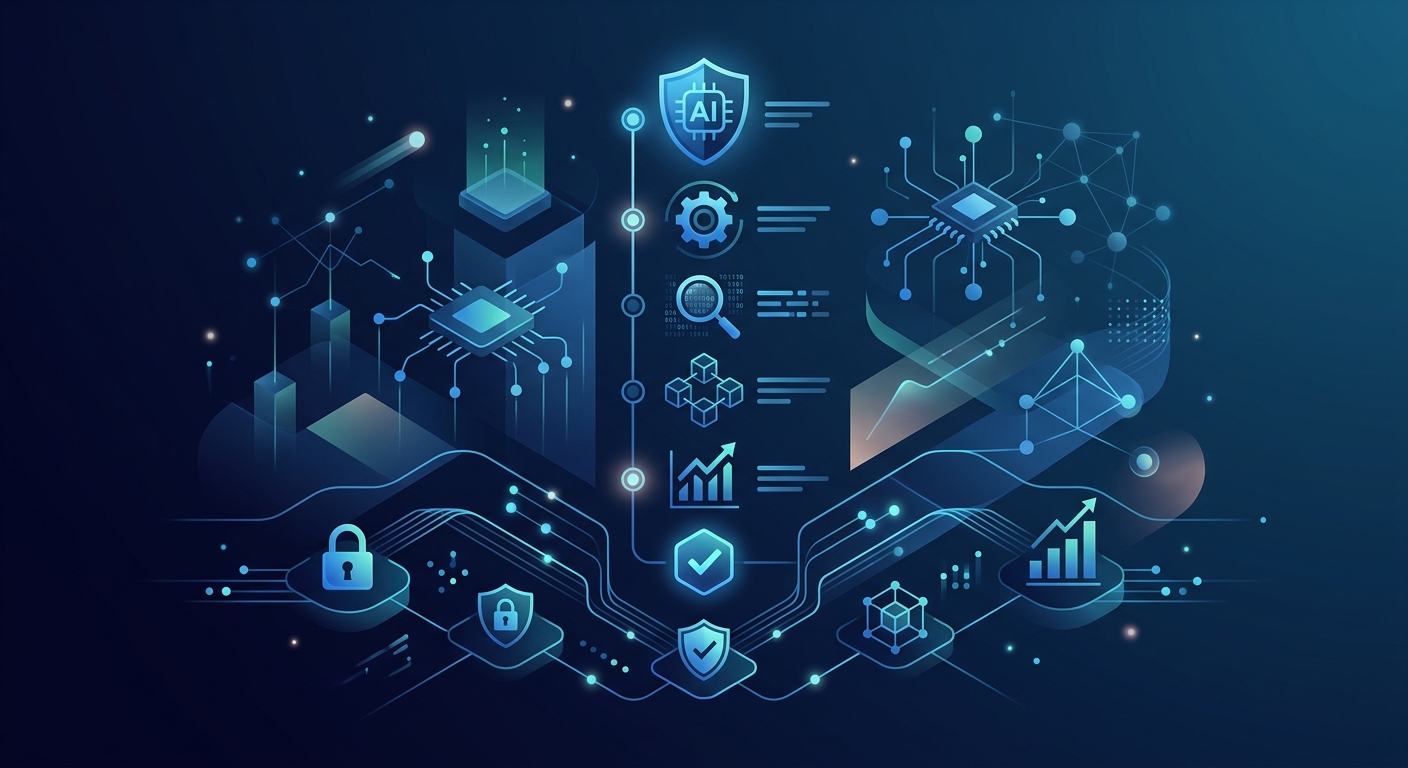
Deploying autonomous AI agents without rigorous oversight is a financial liability, not merely a technical risk. Leading enterprises no longer treat governance as a compliance cost center. Instead, they leverage structured controls as a strategic ROI multiplier. At meo, we have demonstrated that a mature enterprise AI governance framework is the absolute prerequisite for deploying scalable, accountable digital workforces. By embedding security and compliance directly into the agent lifecycle, organizations can safely replace fixed labor overhead with measurable, outcomes-driven performance. This checklist details the essential controls required to operationalize AI agents safely, securely, and profitably.
1. Map Regulatory Requirements to an AI Compliance Framework
Autonomous agents operate across complex regulatory landscapes. Align their capabilities with industry mandates before deployment. Map agent functions directly to established frameworks like GDPR, SOC 2, HIPAA, and ISO 27001 to define clear operational boundaries (AI Governance Checklist 2026). This alignment ensures every automated action remains within legally defensible parameters. Define explicit decision boundaries and hardwire human-in-the-loop escalation triggers into high-risk workflows. When agents encounter edge cases, ambiguous inputs, or risk thresholds that exceed predefined limits, they must seamlessly route control to human operators rather than attempting autonomous resolution. To eliminate shadow AI, standardize policy documentation and enforce strict approval gates across all agent lifecycles. Centralized inventory management and automated compliance testing are now baseline requirements. Treat compliance as foundational architecture, not an afterthought, to transform regulatory adherence into a competitive advantage (Top 10 AI Governance Best Practices for 2026).
2. Implement Zero-Trust Protocols for AI Agent Security
Traditional perimeter defenses cannot secure autonomous systems that dynamically interact with internal APIs, external databases, and user interfaces. Enforce a zero-trust architecture where every request is authenticated, authorized, and encrypted. Apply strict least-privilege access models so agents interact only with the exact datasets and tools required for their designated tasks. Pair this with automated credential rotation and role-based API keys for every agent endpoint to prevent lateral movement during a compromise (Enterprise AI Agent Security and Compliance). Secure all data transit and model inference calls with end-to-end encryption and tokenized authentication. Before production deployment, mandate rigorous adversarial red-teaming, prompt-injection simulations, and third-party supply-chain vulnerability scans. Treat agents as untrusted entities until cryptographically verified, ensuring autonomous operations never compromise enterprise infrastructure (Agentic AI Security: Best Practices in 2026).
3. Embed AI Data Privacy by Design Across Workflows
Data privacy cannot be retrofitted; it must be engineered into the architecture from inception. Deploy automated PII masking and data sanitization pipelines that scrub sensitive information before agent ingestion or memory caching. This preprocessing layer prevents the storage or inadvertent leakage of personally identifiable information during training or inference. Establish strict data retention schedules paired with cryptographic purging protocols for transient logs and session histories. Unlike legacy systems that retain data indefinitely, AI requires explicit lifecycle controls. Automated expiration workflows guarantee historical context is securely erased once it exceeds operational necessity. Configure regional data residency controls to ensure cross-border compliance and localized processing. Route agent workloads through jurisdiction-specific compute zones to maintain data sovereignty while adhering to international privacy mandates. This by-design approach transforms privacy from a legal vulnerability into an operational standard, directly reducing exposure and enabling responsible scale (AI Governance Checklist 2026).
4. Establish Real-Time Monitoring & Automated Audit Trails
Visibility drives accountability. Log all agent decisions, tool executions, and data accesses in tamper-evident ledgers optimized for forensic review. These immutable records establish a verifiable chain of custody, enabling rapid root-cause analysis during incidents or regulatory inquiries. Configure dynamic anomaly thresholds to instantly detect policy drift, scope creep, or unauthorized autonomous behaviors. When agents operate outside trained parameters—such as accessing restricted databases or executing unapproved API sequences—automated circuit breakers must trigger immediate suspension and alert security teams. Integrate governance telemetry with existing SIEM, GRC, and IT operations dashboards for unified enterprise visibility. AI agent governance is rapidly becoming a mandatory component of enterprise security assessments, following the adoption trajectory of modern API gateways (LinkedIn: AI Agent Governance). Continuous monitoring shifts governance from periodic audits to real-time risk mitigation.
5. Link Governance Controls to Pay-for-Performance ROI Metrics
Risk governance delivers strategic value only when tied directly to financial outcomes. Move beyond viewing compliance as a sunk cost. Architect governance frameworks to drive ROI through measurable efficiencies. Track compliance-driven cost avoidance, including reduced audit preparation time, regulatory penalty mitigation, and quantified breach risk reduction. Correlate governance maturity with labor overhead displacement. Measure agent output accuracy, resolution speed, and error reduction rates to calculate precise operational value per deployed agent. At meo, we structure vendor partnerships around outcome-based milestones, ensuring governance maturity directly triggers performance payments. When agents operate within verified compliance boundaries, process with auditable accuracy, and resolve tasks autonomously, they earn their deployment budget. This pay-for-performance model aligns vendor incentives with enterprise success, shifting the financial paradigm from fixed-capacity headcount to scalable, accountable digital labor. Governance is not an expense; it is the operational backbone of a high-yield workforce.
Conclusion Structured AI risk governance is the operational foundation required to scale autonomous workforces safely and profitably. Align compliance frameworks, enforce zero-trust security, embed privacy by design, implement real-time monitoring, and tie every control directly to financial outcomes. Executives can confidently transition from experimental pilots to production-grade digital teams. At meo, we operationalize this exact framework to ensure your AI workforce delivers measurable results under strict accountability. Deploy safer agents. Reduce fixed overhead. Pay only for verified outcomes.