Understanding AI's Role and Overcoming Misconceptions
Artificial Intelligence (AI) is a branch of computer science that enables machines to simulate human intelligence to perform complex tasks, solve problems, and learn from data. In a business context, implementing AI is no longer an experimental luxury; it has become a fundamental necessity for maintaining market competitiveness. According to a recent McKinsey survey cited by MIT Sloan, 88% of organizations now use AI in at least one business function.
One of the most common misconceptions is that AI is a "plug-and-play" solution that yields immediate, automated profits. In reality, implementing AI is a long-term strategy, not a quick fix for deep-seated business problems. It requires a fundamental shift in how organizations handle data, make decisions, and manage human capital. Leaders must view AI as an augmentative tool that enhances human capabilities rather than a total replacement for human judgment.
"Adopting AI isn't just about deploying technology but reshaping your organization's business model and aligning its culture, goals, and resources." — Stave (Harvard Business School Online)
What Is Your Company's AI Maturity Level?
Before deploying any software, executives must assess their organization's AI maturity. This assessment determines whether the company has the technical infrastructure and cultural readiness to support advanced algorithms. The maturity scale generally ranges from "Foundational" (experimenting with siloed tools) to "Transformational" (AI is integrated into the core business model).
Assessing maturity involves evaluating three core pillars: data quality, talent, and executive buy-in. Organizations often fail during implementation because they attempt to deploy advanced generative AI models without first cleaning their legacy data silos. A firm's maturity level dictates whether it should build custom solutions or buy off-the-shelf software. High-maturity firms often invest in Enterprise AI Agent Orchestration Terms & Implementation Patterns to create a cohesive ecosystem of automated agents.
How Can Businesses Use AI to Drive Value?
Businesses can use AI to optimize virtually every department, from marketing to supply chain logistics. The primary value drivers of AI include predictive analytics, process automation, and enhanced personalization. For example, AI-informed intelligent choice architecture can triage customer service inquiries and incoming calls, ensuring that complex cases reach human agents while routine queries are handled by bots.
In the financial sector, AI systems are increasingly used to overcome human cognitive biases, such as the sunk-cost bias, in investment decisions. By analyzing historical data without emotional attachment, AI can provide objective recommendations on whether to continue or abandon a project. Furthermore, AI helps businesses understand their customers' needs and preferences through sentiment analysis, as noted in The Competitive Advantage of Using AI in Business.
Generative AI or Machine Learning: Which AI Tool to Use and When?
Choosing the right tool is critical for ROI. Machine Learning (ML) is best suited for structured data tasks, such as forecasting sales or detecting fraud. It excels at finding patterns in numbers and providing predictions. For instance, ML is the backbone of Predictive Maintenance: AI & IoT Enterprise Guide, where it predicts equipment failure before it occurs.
Generative AI (GenAI), on the other hand, is designed for unstructured data like text, images, and audio. It is ideal for content creation, code generation, and interactive customer support. While GenAI captures the headlines, many enterprise problems are still best solved by traditional ML or a hybrid approach. Implementing the wrong tool leads to "technology debt," where the cost of maintaining the tool exceeds the value it provides.
7 Benefits of Artificial Intelligence in Business
According to UC Online, the benefits of AI extend across the entire value chain. Here are seven key advantages:
- Increased Operational Efficiency: Automating routine tasks allows employees to focus on high-value strategic work.
- Enhanced Customer Experience: 24/7 support and hyper-personalized recommendations increase retention.
- Data-Driven Decision Making: AI processes vast datasets faster than any human team, providing real-time insights.
- Cost Reduction: Long-term labor savings and error reduction in manual data entry significantly lower overhead.
- Improved Risk Management: AI can detect anomalies in financial transactions or security logs in milliseconds.
- Product Innovation: AI identifies market gaps and accelerates R&D cycles through simulation.
- Scalability: AI tools can handle exponential increases in workload without a linear increase in headcount.
Which Human Capabilities Best Complement AI's Shortcomings?
AI is powerful, but it lacks several critical human traits: empathy, ethical judgment, and complex creative intuition. Successful AI implementation requires a "Human-in-the-loop" (HITL) model. Humans are essential for defining the ethical boundaries of AI and for supervising its output to ensure accuracy and compliance.
For example, while an AI can draft a legal contract, a human lawyer must review it for nuance and local jurisdiction. In healthcare, AI can suggest a diagnosis based on scans, but a physician must provide the empathetic communication required for patient care. Understanding these boundaries is a core part of Enterprise AI Agent Workflow Design.
Measuring the ROI of an AI Pilot Program
One of the biggest gaps in current AI literature is how to measure the success of a pilot before scaling. To measure the ROI of an AI pilot, organizations should use cost-focused KPIs such as labor savings, automation rates, and reductions in manual data entry errors. These metrics must be linked to the P&L and established against clear baselines before the pilot begins.
Key Insight: Measuring AI ROI requires accounting for the "full cost" of implementation, including the time human staff spend on "rework" or correcting AI errors during the learning phase.
For more specific guidance, see Measuring AI Agent ROI For Enterprise Customer Support Automation. Success should be measured not just in dollars, but in "time to value" and employee adoption rates.
Ethical Sourcing and Privacy: The Proprietary Data Challenge
How do you legally and ethically source proprietary data for training internal AI models? This is a critical question for compliance. While federal laws are still evolving, state-level regulations like California's AB 2013 will soon require developers to publicly disclose dataset sources and the types of data used.
To remain compliant with GDPR and CCPA, businesses must ensure that any personally identifiable information (PII) is anonymized or removed before it enters a training set. Furthermore, companies should prioritize "first-party data"—data collected directly from their own customers with explicit consent—rather than relying on scraped or third-party datasets that carry high legal risks. For more on this, review our AI Agent Data Privacy Compliance protocols.
Step-by-Step Guide: Implementing AI in Business Operations
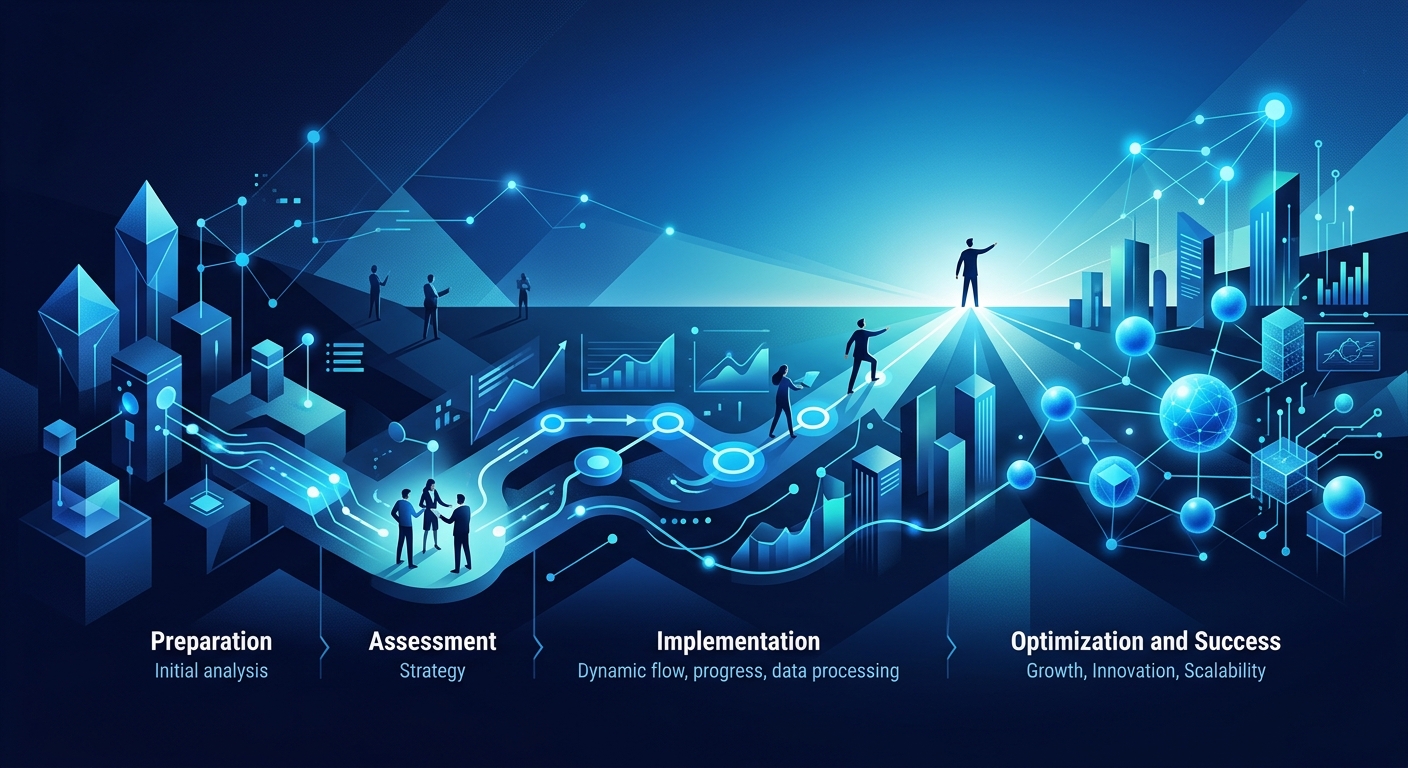
Implementing AI should follow a structured, phased approach to minimize risk and maximize buy-in.
Phase 1: Identification and Prioritization
Identify business bottlenecks that involve repetitive data processing or high-volume customer interactions. Use a 2x2 matrix to rank these opportunities based on "Ease of Implementation" vs. "Potential Business Impact."
Phase 2: Data Preparation
Clean and centralize your data. AI is only as good as the data it is trained on. If your data is trapped in department-specific silos, the AI will produce fragmented and inaccurate results.
Phase 3: The Pilot Program
Launch a small-scale pilot in a single department. This allows you to test the technology and the organizational reaction without risking the entire enterprise. Use this phase to gather the ROI metrics mentioned earlier.
Phase 4: Scaling and Integration
Once the pilot proves successful, integrate the AI into broader workflows. This often involves Step-by-step Workflow Mapping For Enterprise AI Agents to ensure that the AI interacts seamlessly with existing software like CRM and ERP systems.
Technical Requirements: Private LLMs vs. Cloud Hosting
Executives must decide whether to host AI models on-premise or in the cloud. Cloud-based costs range from $400–$700 monthly for a single A6000 Ada GPU to over $13,000 per month for high-end H100 instances. While the cloud offers flexibility, it can lead to high recurring costs.
Technical hardware requirements for private, on-premise LLMs include dedicated GPU servers, such as a 4-GPU configuration with 384GB of VRAM. While the upfront cost is high (often exceeding $20,000), on-premise hosting provides superior data security and lower long-term costs for high-volume processing. This is particularly relevant for firms in highly regulated industries like finance or healthcare.
Frequently Asked Questions
How long does it take to see ROI from AI implementation?
Most enterprises see initial efficiency gains within 3–6 months, but full strategic ROI—where the business model itself is enhanced—usually takes 12–24 months of consistent iteration.
Do I need to hire a team of data scientists to start?
Not necessarily. Many businesses start by using no-code or low-code AI platforms, or by partnering with specialized AI consultancies to run their initial pilot programs.
What is the biggest risk of implementing AI?
Beyond technical failure, the biggest risk is cultural resistance. If employees fear that AI will replace them, they may resist using the tools or undermine data quality. Transparency and upskilling are the most effective mitigations.
Can AI help with regulatory compliance?
Yes. Specialized agents can be used for Automated Regulatory Change Tracking, ensuring that your business stays current on global law changes in real time.
Is my data safe with Generative AI?
Only if you use enterprise-grade versions of these tools. Consumer-grade AI often uses your inputs to train its models, which can expose trade secrets. Always use private instances or enterprise agreements that guarantee data privacy.
AI: A New Beginning, Not an End
The future of AI in business is not a world without humans, but a world where humans are empowered by intelligent systems. As AI continues to evolve, it will move from a tool that answers questions to a system that takes proactive actions. Organizations that master AI implementation today will be the ones that define the markets of tomorrow. This journey requires patience, data discipline, and a commitment to continuous learning.