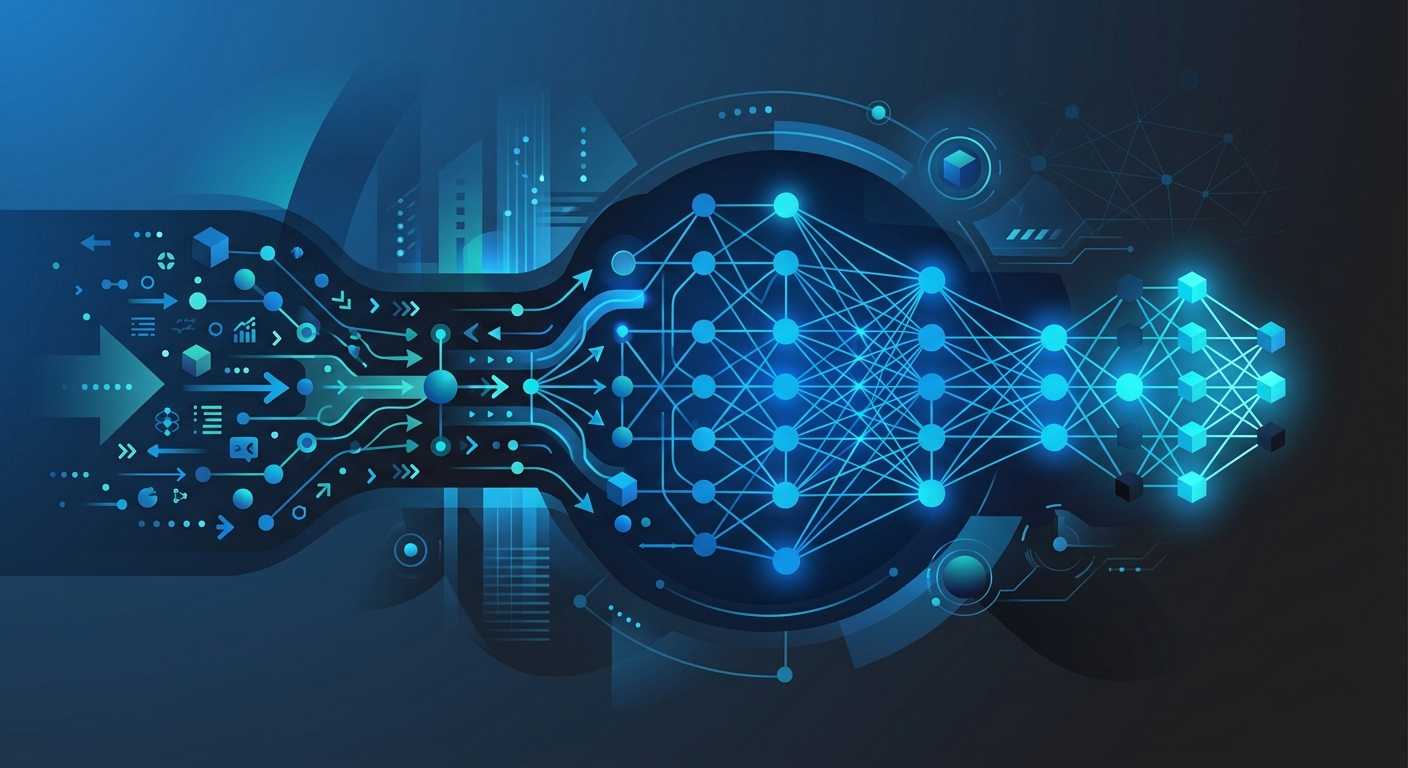
Training an AI model is the process of teaching a machine learning algorithm to recognize patterns, make decisions, and predict outcomes by processing vast datasets through mathematical functions. In the enterprise context, this transition from raw data to actionable intelligence enables autonomous operations and predictive analytics. Modern AI model training relies heavily on Deep Neural Networks (DNNs), which are collections of composite functions capable of approximating input-output relations for any given dataset Springer Nature.
Key Takeaways
- Definition: Training an AI model involves feeding an algorithm data so it can learn patterns and improve its accuracy over time.
- Methodology: Organizations must choose between supervised, unsupervised, and reinforcement learning based on their specific business goals.
- Hardware: Training a 7B parameter model locally in 2025/2026 requires at least 8–9 GB of VRAM for quantized versions.
- Efficiency: Using pre-trained models via transfer learning can reduce initial training costs by up to 70%.
Understanding the Basics: AI, ML, and DL Concepts
To navigate the world of artificial intelligence, you must distinguish between three nested concepts: Artificial Intelligence (AI), Machine Learning (ML), and Deep Learning (DL). AI is the broad umbrella covering any machine that mimics human intelligence. Machine Learning is a subset of AI that uses statistical methods to enable machines to improve with experience. Deep Learning is a specialized subfield of ML that uses multi-layered neural networks to solve complex problems like image recognition and natural language processing.
According to Harvard Business School, supervised learning is the most common paradigm for business applications, relying on labeled datasets to map inputs to known outputs. In contrast, unsupervised learning analyzes datasets to identify patterns and structures without predefined outcomes or labels. For enterprises, understanding these distinctions is critical for selecting the right architecture for a [machine learning pipeline].
What is AI Model Training and Why Does It Matter?
AI model training is the computational stage where an algorithm adjusts its internal parameters (weights and biases) to minimize the error between its predictions and actual results. This is not a one-time event but a continuous lifecycle of refinement. Without proper training, even the most advanced algorithm is merely an empty shell.
For businesses, custom training allows for the ingestion of proprietary data, ensuring the model understands industry-specific nuances that off-the-shelf solutions miss. For example, a model trained on general legal documents will perform poorly compared to one trained on a firm's specific historical case archives. This level of customization is central to achieving a high Enterprise AI Agent ROI.
Core AI Training Methods: Supervised vs. Unsupervised
The choice of training method dictates the data requirements and the ultimate utility of the model.
- Supervised Learning: This method uses a "teacher" in the form of labeled data. If you want a model to identify fraudulent transactions, you provide it with thousands of examples of both legitimate and fraudulent charges.
- Unsupervised Learning: Here, the model finds hidden patterns in data without predefined labels. This is particularly useful for customer segmentation where the "right" groups are not known ahead of time.
- Reinforcement Learning: This involves an agent learning to make decisions by performing actions in an environment to achieve a reward. Modern research from the MIT Media Lab shows that reinforcement learning can also be used to automate the design of the neural network itself through meta-modeling algorithms like MetaQNN.
Key Insight: Unsupervised learning trains an algorithm on unlabeled data: with no predefined outcomes, the algorithm finds patterns in the dataset on its own.
How to Train an AI Model in 7 Steps
Successfully moving a model from concept to production requires a disciplined 7-step approach:
- Define the Problem: Identify the specific business KPI you intend to influence.
- Data Collection: Gather relevant data. For image-based models, this often involves image annotation—the process of labeling pixels or objects within a frame.
- Data Preprocessing for AI: Clean the data by removing duplicates, handling missing values, and normalizing formats.
- Architecture Selection: Choose the structure of the neural network. Organizations often consult Enterprise AI Agent Orchestration Terms to decide between monolithic or modular designs.
- The Training Phase: Run the data through the algorithm. This is where the heavy computational lifting occurs.
- Model Evaluation Metrics: Test the model against a hold-out dataset to check for accuracy, precision, and recall.
- Deployment and Monitoring: Move the model into production and implement Continuous AI Agent Monitoring.
Is It Hard to Train an AI Model?
The difficulty of training an AI model depends on the scale of the task and the quality of the data. Basic sentiment analysis models can be trained in minutes on a standard laptop, but large language models (LLMs) or complex computer vision systems require massive distributed computing power and specialized expertise.
Major hurdles include:
- Data Scarcity: Finding enough high-quality, labeled data.
- Overfitting: When a model learns the training data too well and fails to generalize to new, unseen data.
- Cost: The Enterprise AI Agent Implementation Costs can escalate if the training process is not optimized.
Working With Existing Pre-Trained Models
Most enterprises do not need to build a model from scratch. Instead, they use transfer learning, which involves taking a model already trained on a massive dataset (like GPT-4 or Llama 3) and fine-tuning it on a smaller, specific dataset.
Key Insight: Using pre-trained models can reduce the time-to-market for AI solutions from months to weeks, as the model already understands basic language or visual structures and only needs to learn the "last mile" of your specific business logic.
This approach is significantly more cost-effective and is a cornerstone of AI vs. Traditional Cost Comparison strategies.
Hardware Requirements: Local vs. Cloud Training
A common question for CTOs is whether to train models locally or in the cloud. For a 7B parameter model—a standard size for specialized enterprise tasks—the hardware requirements are specific:
| Requirement | Local Setup (2025/2026) | Cloud Instance |
|---|---|---|
| VRAM (GPU) | 8–9 GB (RTX 5060 Ti or Apple M2) | NVIDIA H100 or A100 |
| System RAM | 16 GB+ | Scalable based on demand |
| Storage | NVMe SSD (50 GB+ for model) | Object Storage (S3/GCS) |
| Primary Use | Prototyping & Small Models | Scaled Production Training |
Training locally offers data privacy benefits but lacks the massive parallelization capabilities of cloud providers like AWS or Azure. When calculating the Enterprise AI Agent TCO, hardware depreciation must be weighed against monthly cloud consumption fees.
Legal and Ethical Implications of Synthetic Data
As high-quality human data becomes harder to source, many organizations turn to synthetic data—data generated by another AI. However, this introduces legal complexities. Under California's AB 2013, developers may be required to disclose whether their datasets include copyrighted or personal information, even if that data was used to generate synthetic sets.
Furthermore, while synthetic data helps with GDPR compliance by removing personal identifiers, it can lead to "model collapse" if the AI begins to learn from its own errors rather than reality. Compliance officers should refer to Best Practices for Automated Regulatory Change Tracking to stay ahead of these evolving standards.
Frequently Asked Questions
What is the most important part of training an AI model?
Data quality is the most critical factor. Even the best architecture will fail if trained on noisy, biased, or incomplete data—a concept known as "Garbage In, Garbage Out."
How long does it take to train an AI model?
Training time varies from a few seconds for simple regression models to several months for frontier LLMs using thousands of GPUs.
Can I train an AI model on my own computer?
Yes, small models or fine-tuning tasks can be performed on consumer hardware with at least 8 GB of VRAM. However, large-scale training requires enterprise-grade GPUs.
What is the difference between training and inference?
Training is the process of building the model's knowledge. Inference is the process of using that trained model to make predictions on new data.
How do you measure if a model is "well-trained"?
Success is measured using metrics like Accuracy, F1-Score, and Mean Squared Error, but ultimately by its performance on a test dataset it has never seen before.
What are the environmental costs of AI training?
AI training is energy-intensive. While specific formulas for carbon footprints are still being standardized, training a large model can emit as much carbon as five cars over their lifetimes Marmelab.
Share to Social Media
If you found this guide helpful, consider sharing it with your network. Staying informed on how AI is reshaping occupations is essential for every modern professional.
- LinkedIn: Share with the caption "Demystifying the AI training lifecycle for enterprise leaders."
- Twitter/X: Use #EnterpriseAI #MachineLearning #MeoAdvisors.