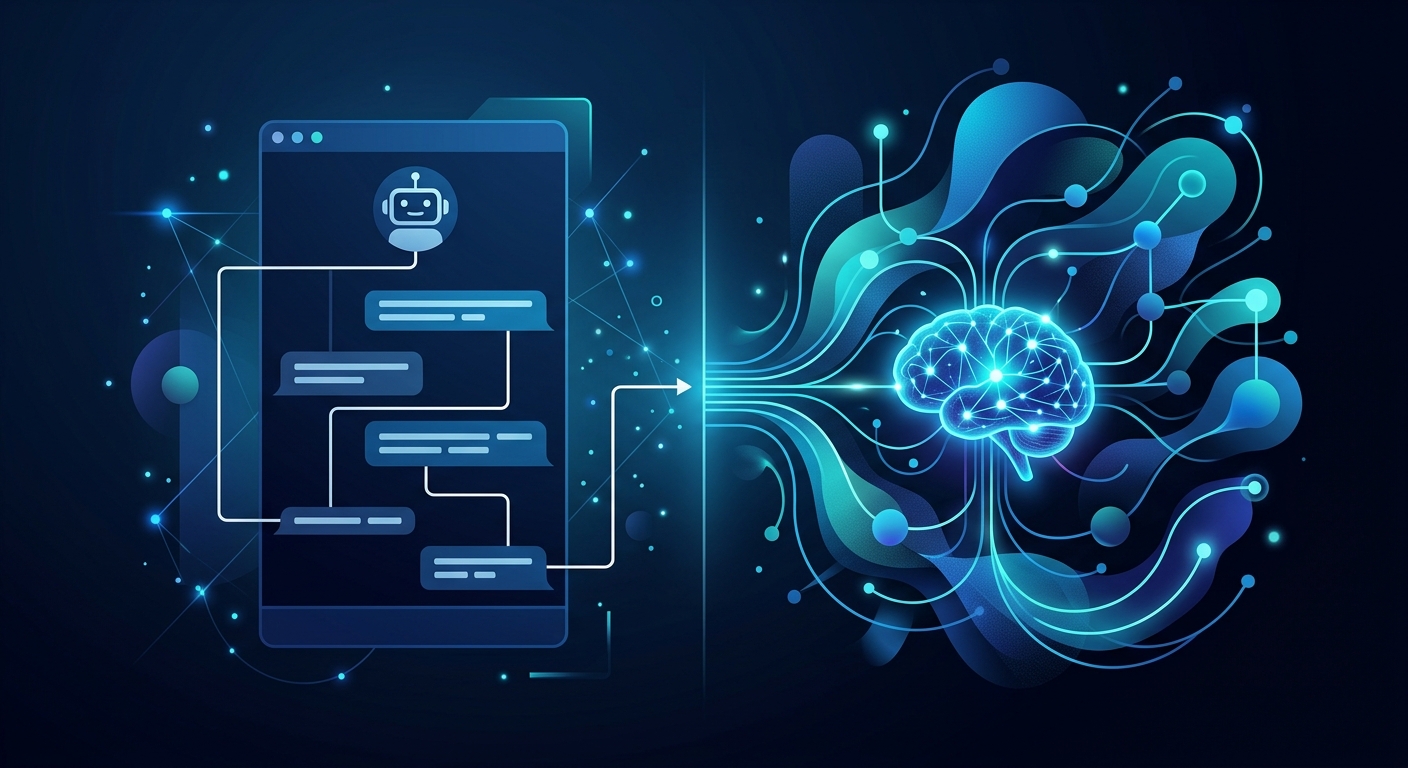
The distinction between a standard chatbot and conversational AI is no longer a matter of semantics—it represents a fundamental shift in how businesses interact with data and customers. For enterprise leaders, understanding this gap is critical for preventing technical debt and ensuring long-term scalability. While both technologies facilitate digital communication, their underlying architectures, capabilities, and costs vary significantly.
Following the COVID-19 pandemic, 52% of companies increased their adoption of automation and conversational interfaces to meet rising demand Yellow.ai. This surge has forced a maturation in the market, moving away from simple FAQ responders toward intelligent systems capable of complex reasoning and context retention.
Key Takeaways
- Chatbots are rule-based systems that follow rigid decision trees; they excel in controlled environments like simple FAQ handling.
- Conversational AI uses Natural Language Processing (NLP) and Machine Learning (ML) to understand intent, sentiment, and context.
- Adoption: Over half of modern enterprises have accelerated their transition to conversational interfaces since 2020 to handle volume spikes.
- Infrastructure: Moving from a chatbot to conversational AI requires a shift from manually authored scripts to federated data architectures and LLM integration.
What Are Chatbots? Understanding Scripted Logic
A chatbot is a software application designed to simulate human conversation through text or voice interactions, typically based on a predefined set of rules or scripts. These systems are often referred to as "rule-based" or "linguistic" bots. They function similarly to a digital flowchart: if a user asks a specific question that matches a keyword in the bot's database, the bot provides the corresponding pre-written answer.
Rule-based chatbots rely on predefined workflows and natural language understanding (NLU) technologies to ensure safety and control by restricting generative capabilities The Efficacy of Rule-Based Versus Large Language Model-Based Chatbots. Because they do not "learn" from interactions, their utility is limited to the scenarios their developers anticipated.
Key Insight: Rule-based systems remain vital in sectors like healthcare—specifically for cognitive behavioral therapy (CBT)—because their fixed intervention workflows ensure clinical safety and prevent the "hallucinations" common in generative models.
These systems are excellent for high-volume, low-complexity tasks. For example, a rule-based bot can efficiently handle password resets or shipping status inquiries where the parameters are binary and unchanging. However, when a user deviates from the script, these bots often fail, leading to the dreaded "I'm sorry, I didn't understand that" loop.
What Is Conversational AI? The Power of NLU
Conversational AI is a set of technologies, including Natural Language Processing (NLP) and Machine Learning (ML), that enable computers to understand, process, and respond to human language in a way that is natural and contextually aware. Unlike static chatbots, conversational AI does not rely on a fixed script. Instead, it uses Large Language Models (LLMs) to generate responses dynamically based on the user's unique input.
Natural language understanding (NLU) is a key component of NLP and includes the ability of AI to understand and interpret human language in a way that is similar to how a human would understand it Toward human-level concept learning. This allows the system to recognize synonyms, decipher intent despite typos, and maintain context over a multi-turn conversation.
For enterprise applications, conversational AI often integrates with internal data layers. For instance, platforms like Microsoft Copilot use Microsoft Graph to pull context from emails, calendars, and documents, making the AI's responses highly personalized and relevant to each user's environment CNET.
Chatbots vs. Conversational AI: Critical Technical Differences
When comparing these two technologies, the primary differentiator is intent recognition. A chatbot looks for keywords; conversational AI looks for meaning. This leads to several operational differences:
- Context Retention: A chatbot treats every interaction as a new event. Conversational AI remembers what was said three exchanges ago, allowing for a fluid, human-like dialogue.
- Scalability: To expand a chatbot, a human must manually write new rules. To expand conversational AI, the system is fed more data, and the model adjusts its understanding on its own.
- Generative Capabilities: Conversational AI using LLMs allows for generative capabilities beyond fixed intervention workflows The Efficacy of Rule-Based Versus Large Language Model-Based Chatbots.
| Feature | Traditional Chatbot | Conversational AI |
|---|---|---|
| Logic Basis | Rule-based (If/Then) | Neural Networks / LLMs |
| User Intent | Keyword matching | Semantic understanding |
| Learning | Manual updates only | Continuous machine learning |
| Complexity | Low (FAQ, simple tasks) | High (Advisory, reasoning) |
| Data Privacy | Low risk (Static data) | High risk (Requires PII filtering) |
Use Cases for Chatbot vs. Conversational AI in Customer Service
The choice between a chatbot and conversational AI often depends on the complexity of the service being provided.
Chatbot Use Cases
- Order Tracking: Providing real-time status updates from a database.
- Direct FAQ: Answering "What are your hours?" or "Where is your office?"
- Initial Triage: Collecting basic information (name, account number) before handing off to a human agent.
Conversational AI Use Cases
- Complex Troubleshooting: Diagnosing a technical issue with a product through a series of clarifying questions.
- Personalized Recommendations: Suggesting products based on a customer's past purchase history and current stated needs.
- Predictive Support: Using predictive analytics to identify patterns in data and forecast future outcomes, such as alerting a customer to a potential service outage Toward human-level concept learning.
In many AI agent solutions for customer support, organizations use a hybrid approach where a chatbot handles the initial greeting and basic data collection, while conversational AI takes over for substantive problem-solving.
Benefits of Conversational AI Over Traditional Chatbots
While conversational AI requires a higher initial investment, the long-term ROI is often superior for enterprise-scale operations. The primary benefit is deflection quality. While a chatbot might "deflect" a ticket by simply providing a link to a help article, conversational AI can actually resolve the issue, reducing the need for human intervention entirely.
Another significant benefit is multilingual support. Traditional chatbots require manual translation for every rule and response. Conversational AI models are often natively multilingual, allowing them to support global customer bases without the overhead of manual translation.
Furthermore, conversational AI provides deeper insights through conversational analytics. By analyzing the sentiment and common themes in thousands of conversations, businesses can identify product flaws or market opportunities that would remain hidden in the rigid data structures of a standard chatbot.
Transitioning from Rule-Based to AI: Technical Requirements
Moving from a legacy rule-based bot to a modern AI agent requires more than just a software update. It requires a new technical infrastructure. This is one of the gap areas many providers fail to mention: you cannot simply "turn on" AI on top of a flowchart.
Key Insight: Transitioning to a conversational AI model requires foundational infrastructure layers including federated data architecture, unified context frameworks, and agentic orchestration. These systems must move beyond traditional rule-based workflows to support reasoning and tool use.
Key requirements include:
- Semantic Search Integration: To allow the AI to read your documentation in real-time.
- PII Redaction Layers: To ensure that as the AI learns, it does not inadvertently store or repeat sensitive customer information.
- Human-in-the-loop (HITL) Protocols: Learning AI systems require ongoing maintenance of the underlying knowledge base and human oversight to correct drift in the model's accuracy.
Data Privacy and Compliance Implications (GDPR/CCPA)
A major differentiator that enterprise leaders must consider is the compliance burden. A rule-based chatbot is relatively simple to secure because its outputs are static and its data processing is predictable.
In contrast, conversational AI that learns from user inputs triggers complex GDPR and CCPA requirements. These systems process large amounts of personal data to improve their models. This creates a technical challenge for "the right to be forgotten." If a user requests their data be deleted, and that data was used to train a neural network, removing that specific influence is significantly more complex than deleting a row in a SQL database.
Organizations must implement strict AI agent data privacy compliance measures, including anonymization of training data and transparent disclosures regarding automated decision-making logic.
The Cost Factor: Is Premium AI Worth It?
The pricing models for these technologies differ as much as their capabilities. Simple chatbots are often available for a low monthly SaaS fee. Conversational AI, however, often involves consumption-based pricing or high-tier enterprise subscriptions.
For example, advanced generative models like "Project Genie" can be part of plans costing upwards of $200 per month for individual access CNET. For an enterprise, these costs scale with token usage (the amount of text processed by the model). While the outcome-based pricing model is gaining popularity—where you pay only for successfully resolved issues—the base infrastructure costs for AI remain significantly higher than those of rule-based bots.
The Future of Chatbots vs. Conversational AI
We are rapidly approaching a point where the term "chatbot" will become synonymous with "legacy system." The future lies in Agentic AI—systems that don't just talk, but act. While conversational AI understands the user's intent to "book a flight," an AI Agent will actually log into the booking system, apply the user's preferences, and complete the transaction.
As LLMs become more efficient and specialized, we expect to see a decline in general-purpose bots and a rise in specialized agents for compliance monitoring or predictive maintenance. The goal is no longer just conversation; it is autonomous task completion.
Frequently Asked Questions (FAQs)
1. Can a rule-based chatbot become conversational AI?
Not through simple updates. While you can add NLU layers to a rule-based bot to improve keyword recognition, true conversational AI requires a generative model or LLM foundation to handle non-linear dialogue and context.
2. Is conversational AI more expensive to maintain?
Yes. While chatbots require manual content updates, conversational AI requires ongoing monitoring for model drift, token cost management, and continuous refinement of the knowledge base or grounding data.
3. Which is better for small businesses?
For small businesses with limited budgets and straightforward needs (like booking appointments), a high-quality rule-based chatbot is often sufficient and more cost-effective. Conversational AI is better suited for enterprises with complex product catalogs or high-volume support needs.
4. How does conversational AI handle data privacy?
Unlike rule-based bots, conversational AI requires sophisticated filtering to ensure it does not learn from or repeat Personally Identifiable Information (PII). Compliance with GDPR and CCPA requires specific architectural safeguards.
5. Why do some industries still prefer rule-based bots?
Industries like healthcare and legal often prefer rule-based systems because they offer 100% predictability. In these fields, an AI "hallucination" (generating a false fact) can have serious safety or legal consequences.