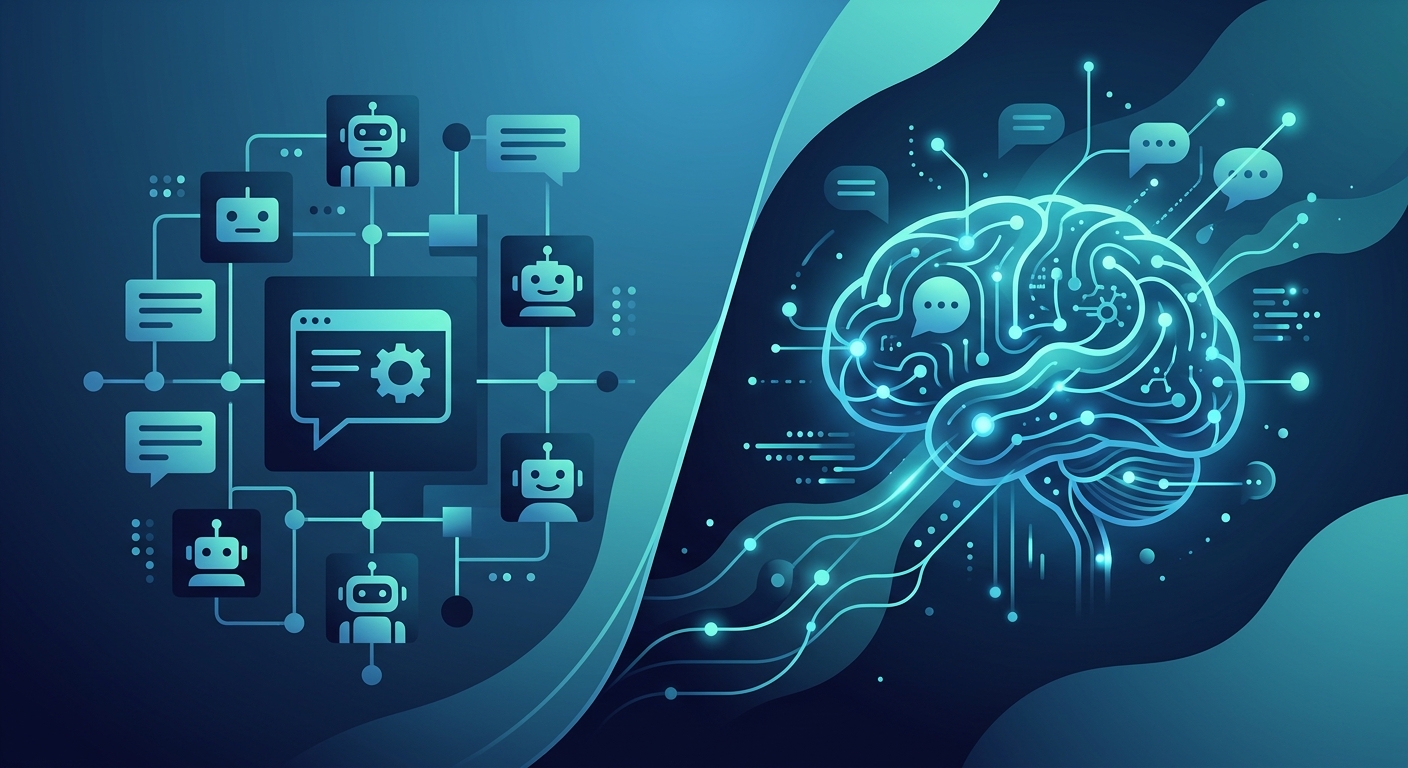
In today's digital landscape, the distinction between a simple chatbot and sophisticated conversational AI has become a critical decision point for enterprise digital transformation. While both technologies aim to automate communication, their underlying architectures, capabilities, and impact on user experience differ significantly. Understanding these nuances is no longer just a technical requirement; it is a strategic necessity for leaders aiming to improve customer loyalty and operational efficiency.
Key Takeaways
- Chatbots are typically rule-based systems that rely on predefined decision trees and keyword matching to answer specific, predictable queries.
- Conversational AI is a broader category that uses Natural Language Processing (NLP), machine learning, and speech recognition to understand context, intent, and sentiment.
- Adoption Trends: 52% of companies accelerated their adoption of automation and conversational interfaces during the COVID-19 pandemic to meet rising demand Yellow.ai.
- Impact: High-quality AI-chatbot service quality shows a significant positive correlation with customer e-brand loyalty ScienceDirect.
What is a Chatbot?
A chatbot is a software application designed to simulate human conversation through text or voice interactions, typically operating within a limited, predefined scope. Traditional chatbots, often referred to as "rule-based" or "linguistic" bots, function like a digital phone tree. They follow a script: if a user says "X," the bot responds with "Y."
These systems rely heavily on keyword-based matching. According to research from the University of Hawaii, keyword-based chatbots frequently encounter problems correctly identifying queries and misunderstanding customers when the input deviates from the expected script [PDF] Investigating the Role of Technical and Process Quality in Chatbots. Because they lack true understanding, they cannot handle complex questions or multi-turn dialogues that involve context switching.
What is Conversational AI?
Conversational AI is an advanced set of technologies that enables computers to understand, process, and respond to human language in a natural, intuitive way. Unlike static chatbots, conversational AI uses Natural Language Processing (NLP) and Natural Language Understanding (NLU) to interpret the meaning behind words, rather than just the words themselves.
Natural Language Processing (NLP) for conversational AI plays an important role in the usability and effectiveness of virtual assistants by allowing them to interpret and respond to human language with high accuracy IEEE Xplore. These systems are dynamic; they learn from every interaction through machine learning, refining their responses over time to better serve user needs. This makes them ideal for the "Agentic Enterprise," where AI acts as an autonomous representative of the brand.
Chatbots vs. Conversational AI: Technical Comparison
The primary difference lies in the "brain" of the system. A traditional chatbot uses an "if-then" logic gate, while a conversational AI system uses a neural network.
Key Insight: While traditional chatbots are often keyword-based and frequently misunderstand customer queries, conversational AI uses speech recognition and NLP to simulate human conversation so closely that users may not realize they are interacting with software.
Conversational AI integrates speech recognition, which is a fundamental element underlying NLP in modern virtual assistants IEEE Xplore. This allows for a multi-modal experience where users can switch between typing and speaking without losing the context of the conversation.
Use Cases for Chatbot vs. Conversational AI in Customer Service
When choosing between these two, the specific use case determines the right fit.
Chatbot Use Cases
- Order Tracking: A simple bot can take an order number and return a status from a database.
- FAQ Automation: Providing static answers to common questions like "What are your hours?"
- Lead Capture: Basic forms where a bot asks for a name and email.
Conversational AI Use Cases
- Complex Troubleshooting: Guiding a user through a multi-step technical repair where the user's answers are unpredictable.
- Personalized Recommendations: Analyzing a user's past purchase history and current sentiment to suggest products.
- Financial Transactions: Handling secure, multi-turn processes like transferring funds or disputing a charge, which requires integration with backend ERP systems.
For more on how these technologies compare to traditional workflows, see our guide on AI agents vs traditional automation.
Benefits of Conversational AI Over Traditional Chatbots
The transition to conversational AI offers several enterprise-grade advantages:
- Contextual Awareness: Conversational AI remembers what was said three sentences ago. A chatbot treats every message as a brand-new interaction.
- Scalability: While chatbots require manual updates to their scripts for every new product or policy, conversational AI can ingest documentation and update its knowledge base autonomously.
- Trust and Loyalty: Research published in ScienceDirect indicates that AI-chatbot service quality significantly influences customer e-brand loyalty ScienceDirect. Users trust systems that actually understand them.
- Omnichannel Consistency: Conversational AI provides a unified experience across WhatsApp, web chat, and voice, whereas traditional bots often feel fragmented across different platforms.
Transitioning from Rule-Based to Conversational Models
Moving from a rule-based chatbot to a conversational AI model requires a foundational shift in technical infrastructure. It is not merely a software update; it is a re-architecting of how data flows through the organization.
Infrastructure Requirements:
- Unified Context Frameworks: To maintain conversation history across sessions.
- Federated Data Architectures: To allow the AI to pull real-time data from CRMs, ERPs, and HR systems without creating data silos.
- Agentic Orchestration: The ability for the AI to not just talk, but to take actions—like updating a record in Salesforce or triggering a refund in a billing system.
This transition is essential for companies looking to move toward enterprise AI agent orchestration.
Total Cost of Ownership (TCO) and Maintenance
While simple chatbots have lower upfront costs, their long-term value is often limited by high maintenance requirements. Every time a business process changes, a developer must manually update the chatbot's decision tree.
In contrast, conversational AI requires a higher initial investment in data training and integration but offers lower maintenance costs over a 3-year period. These systems are designed to learn. Instead of manual script updates, maintenance involves continuous AI agent monitoring and fine-tuning of the underlying models.
| Feature | Simple Chatbot | Conversational AI |
|---|---|---|
| Initial Setup | Low | High |
| Maintenance | High (Manual) | Moderate (Automated) |
| User Satisfaction | Low/Variable | High |
| Data Integration | Limited | Deep/Real-time |
| Scalability | Linear | Exponential |
Data Privacy and Security Compliance
When handling Personally Identifiable Information (PII), the stakes are higher for conversational AI due to its generative nature. While static chatbots follow rigid paths that are easy to audit, conversational AI requires robust AI agent audit trails to ensure compliance with GDPR and SOC 2.
Key Insight: Security in conversational AI is not just about data encryption; it is about "prompt governance"—ensuring the AI does not leak sensitive information through its generated responses. For more details, refer to our AI agent data privacy compliance documentation.
The Future of Chatbots vs. Conversational AI
The future is moving toward "Agentic AI." We are seeing a shift from bots that answer questions to agents that complete tasks. In the next three years, the distinction between these two will likely disappear as the technology becomes commoditized. Every enterprise interface will be expected to be conversational, context-aware, and capable of autonomous action.
As AI continues to evolve, it is also reshaping the workforce. For more on the long-term implications, explore our research on jobs replaced by AI.
Chatbot vs. Conversational AI: Which is Best for Your Business?
Choosing the right solution depends on your operational maturity and goals:
- Choose a Chatbot if: You have a very small set of fixed questions, a limited budget, and no need for backend system integration.
- Choose Conversational AI if: You want to automate complex customer journeys, improve brand loyalty, and create a scalable support infrastructure that integrates with your tech stack.
For many enterprises, the goal is to reach a point where the AI can handle automated regulatory change tracking or autonomous SDR outreach. These high-value tasks are only possible through the advanced capabilities of conversational AI.
Frequently Asked Questions (FAQs)
1. Is ChatGPT a chatbot or conversational AI?
ChatGPT is a form of conversational AI. Specifically, it is built on a Large Language Model (LLM) that uses generative AI to understand and produce human-like text based on vast amounts of data, going far beyond the capabilities of a traditional rule-based chatbot.
2. Why do traditional chatbots often fail?
Traditional chatbots often fail because they rely on exact keyword matching. If a user phrases a question in a way the developer did not anticipate, the bot will fail to understand. Conversational AI solves this by focusing on intent rather than specific keywords.
3. How much does it cost to implement conversational AI?
Implementation costs vary based on the complexity of integrations. While simple bots can be built for a few thousand dollars, enterprise-grade conversational AI platforms typically involve significant investment but offer a much higher ROI through support automation.
4. Can conversational AI replace human agents?
Conversational AI is designed to augment human agents by handling repetitive, low-value tasks. This allows human representatives to focus on complex, high-empathy situations that require human judgment.
5. What is NLU in the context of AI?
NLU, or Natural Language Understanding, is a sub-field of NLP that focuses on machine reading comprehension. It is the component that allows conversational AI to understand the nuances, sentiment, and intent behind a user's message.