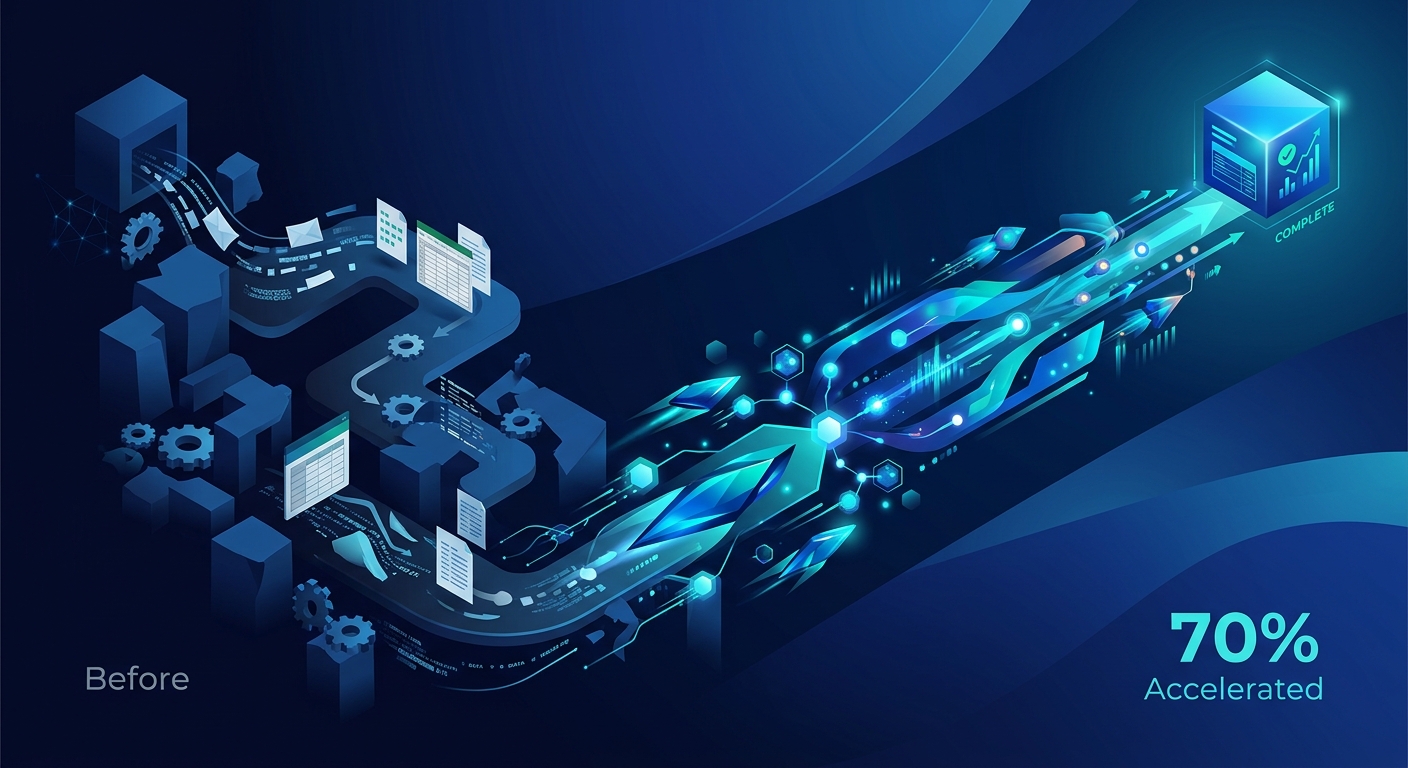
Speculative AI experimentation is obsolete. Outcome-driven workforce integration is now a financial imperative. This case study demonstrates how meo’s autonomous agent architecture restructured a traditional finance function, replacing manual overhead with verified operational velocity. By migrating from legacy close cycles to an automated, multi-agent workflow, finance leaders achieve unprecedented speed, precision, and strategic alignment.
The Challenge: Why Traditional Month-End Close Bottlenecks Finance
For most enterprises, the month-end close remains a predictable operational bottleneck. Manual journal entries, cross-system reconciliation, and fragmented data architectures create volatile close cycles that consistently miss executive deadlines. These inefficiencies conceal significant labor overhead, forcing reliance on costly seasonal contractors just to meet baseline reporting requirements. Compounding the issue, escalating compliance mandates and audit expectations demand flawless accuracy under compressed timelines. Industry data confirms that traditional close processes consume disproportionate finance bandwidth, diverting highly trained professionals from strategic value creation into repetitive validation loops. Without structural intervention, finance leaders remain trapped in reactive cycles, managing operational risk rather than driving forward-looking strategy. The cost of inaction is systemic margin erosion.
Designing the AI Workforce for Financial Operations
Transitioning from pilot programs to production-grade workforce integration requires deliberate architecture. We mapped critical close workflows to isolate high-friction, rule-based processes primed for autonomous execution. This diagnostic phase informed the configuration of specialized AI agents tailored to general ledger reconciliation, multi-dimensional variance analysis, and automated financial reporting. Crucially, we embedded robust governance into the architecture from deployment day one. Every decision point features immutable audit trails, role-based access controls, and strict human-in-the-loop escalation protocols for material exceptions. This design aligns with the industry’s pivot toward AI as an autonomous worker capable of executing multi-step financial workflows with verifiable precision. The result was not a simple automation tool, but a structured digital workforce engineered for accountability.
Deployment Architecture: How Agents Executed the Workflow
Enterprise deployment hinges on seamless interoperability and fault-tolerant orchestration. Rather than demanding costly ERP replacements, meo’s agents integrated directly into the client’s legacy ecosystem via secure, encrypted APIs. The digital workforce operated alongside existing infrastructure, extracting, normalizing, and reconciling data across disparate ERP, CRM, and sub-ledger modules without disrupting live transactions. At the core was a multi-agent orchestration layer engineered for concurrent execution. One cohort performed real-time bank and GL validation while another routed complex exceptions to finance controllers and a third executed pre-approved journal postings. This parallel architecture systematically eliminated the sequential dependencies that traditionally stretch close cycles across multiple days. Real-time monitoring dashboards tracked agent throughput, decision accuracy, and processing velocity, triggering alerts only when thresholds required human intervention. By decoupling expert oversight from high-volume execution, the architecture ensured continuous, auditable, and accelerated progress toward close certification.
The 70% Acceleration: Quantifiable Business Outcomes
The deployment delivered immediate, auditable value. The standardized month-end close accelerated from 10 days to three—a 70% reduction that consistently met board deadlines and eliminated the quarter-end reporting crunch. Agents achieved a 99.8% transactional accuracy rate across all reconciled accounts and sub-ledgers. By eliminating manual entry drift, formula errors, and redundant review loops, the organization eradicated costly month-end rework and proactively mitigated audit findings. The capital reallocation proved strategically transformative. Eliminating overtime premiums, contractor fees, and legacy bottlenecks unlocked $1.2M in annualized labor overhead. Finance leadership redirected this capital and FTE capacity toward high-impact FP&A initiatives, predictive liquidity modeling, and dynamic scenario planning. This performance shift validates a critical principle: AI adoption must be measured through operational velocity, risk reduction, and direct capital reallocation—not speculative efficiency metrics. When automation replaces overhead, strategic capacity compounds.
Pay-for-Performance in Practice: Zero-Risk AI Investment
Traditional technology procurements force enterprises to absorb upfront implementation risk, often locking capital into unproven platforms before ROI is verified. meo’s pay-for-performance model restructures this paradigm. Instead of billing for licenses, implementation hours, or speculative capacity, compensation ties strictly to verified close-cycle acceleration and accuracy. The client incurred zero upfront CapEx; billing triggered only after agents consistently delivered the three-day close target. Transparent performance tracking logged every journal entry, reconciliation match, and exception resolution against predefined SLAs. Organizations can now scale agent capacity during peak audit seasons or growth phases without long-term vendor lock-in or inflated IT budgets. By shifting deployment risk entirely to meo, finance leaders gain the agility to adopt autonomous solutions with complete financial predictability.
Executive Takeaways: Scaling AI Agent Deployments Enterprise-Wide
This deployment establishes a repeatable blueprint for enterprise-wide AI workforce expansion. The immediate priority is replicating this architecture across adjacent operations, including automated accounts payable matching, dynamic accounts receivable aging, and payroll compliance. Technological replication alone is insufficient. Sustainable scaling requires rigorous change management, cross-functional alignment between IT and finance, and deliberate upskilling that transitions accounting teams from data processing to analytical oversight. When organizations treat AI as an accountable extension of their workforce rather than an isolated IT project, they fundamentally alter the finance function’s strategic posture. Controllers and CFOs transition from historical compliance stewards to proactive business partners driving capital allocation. This evolution transforms cost centers into competitive advantages.
Next Steps: Transitioning from Pilot to Production AI Workforce
Moving from isolated pilots to a production-grade AI workforce begins with a disciplined workflow audit. Finance leaders must identify high-volume, rule-bound processes where automation yields immediate ROI without compromising compliance. A phased rollout ensures rapid deployment while maintaining continuous optimization based on live performance data. Partner with meo for a performance-backed AI assessment to map this trajectory without assuming upfront financial risk. We evaluate existing infrastructure, quantify baseline close metrics, and deploy a tailored agent cohort calibrated to your accounting standards. The transition from manual overhead to an accountable digital workforce is operational. With the right architecture and outcome-driven partnership, your next month-end close will operate on a fundamentally accelerated timeline.