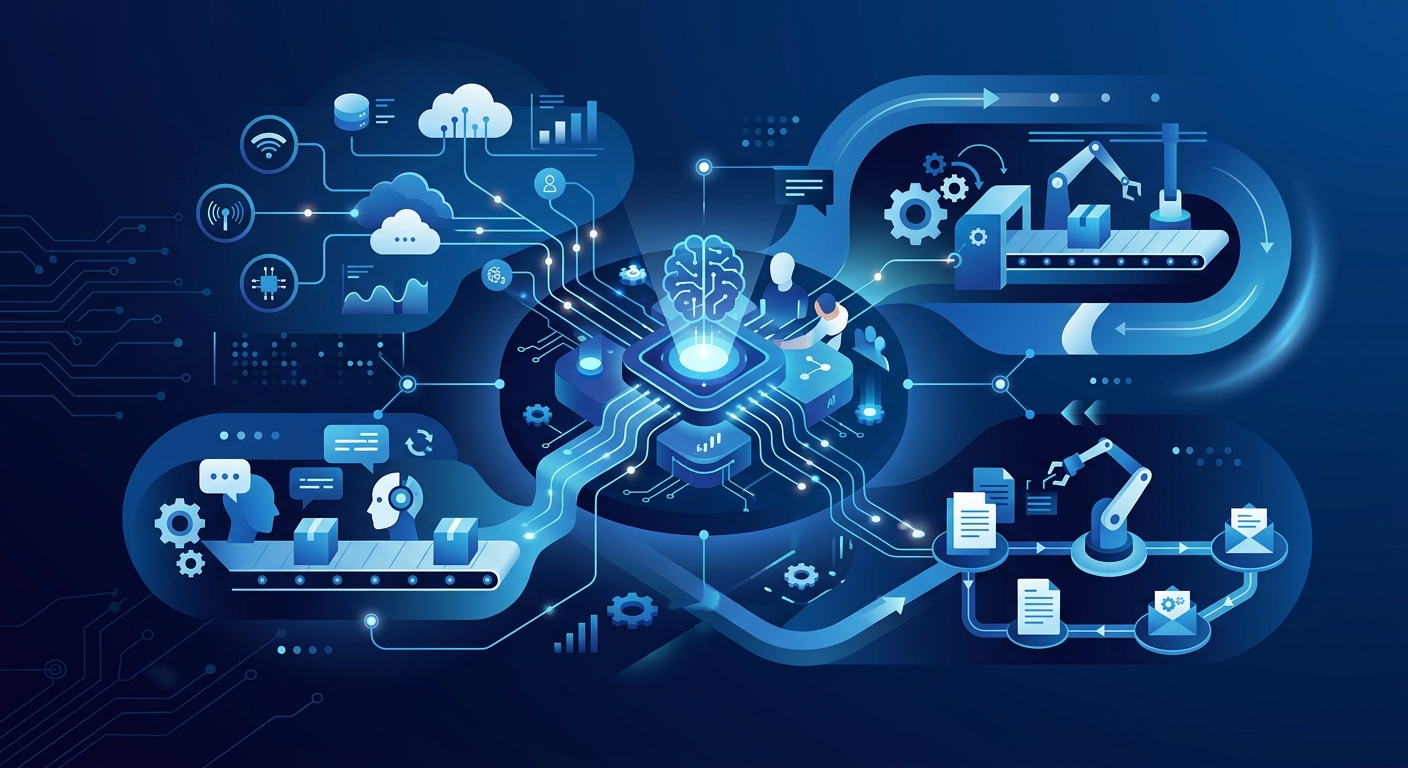
Intelligent automation (IA) is the strategic combination of Robotic Process Automation (RPA), Artificial Intelligence (AI), and Machine Learning (ML) to execute complex business processes that traditionally required human cognition. While traditional automation follows rigid, rule-based instructions, intelligent automation solutions have the "brainpower" to handle unstructured data, learn from historical patterns, and make informed decisions.
In the modern enterprise, the most prominent example of an intelligent automation solution is Intelligent Document Processing (IDP). This technology allows organizations to ingest, classify, and extract data from semi-structured or unstructured documents—such as invoices, medical records, or legal contracts—without manual data entry. According to Gartner, this capability is a cornerstone of hyperautomation, a trend where 80% of organizations are expected to continue or increase spending through 2024 to achieve operational resilience.
Key Takeaways
- Definition: Intelligent Automation (IA) is the convergence of execution-based RPA and cognitive decision-making AI.
- Core Example: Intelligent Document Processing (IDP) is the leading example, automating the extraction of unstructured data.
- Business Impact: Healthcare providers using IA have seen up to a 40% reduction in administrative costs.
- Future Outlook: The shift is moving from simple task automation to The Agentic Enterprise where AI agents orchestrate entire workflows.
What is Intelligent Automation?
Intelligent automation is a holistic suite of technologies that goes beyond basic scripting. It integrates the "doer" (RPA) with the "thinker" (AI). RPA excels at repetitive, high-volume tasks that follow "if-this-then-that" logic. However, RPA fails when it encounters variability, such as a different font on an invoice or a nuanced customer email.
This is where AI and ML step in. By incorporating Natural Language Processing (NLP) and Computer Vision, an intelligent automation solution can "read" a document the way a human does. It doesn't just look for a specific coordinate on a page; it understands the context of words like "Total" or "Due Date." This cognitive layer allows the system to adapt to changes in input without requiring a developer to rewrite the code.
Organizations use IA to bridge the gap between legacy systems and modern digital demands. As noted by the GSA, intelligent automation in government and large enterprises is critical for modernizing IT infrastructure and improving service delivery speeds.
How Does Intelligent Automation Work?
Intelligent automation works through a four-stage loop: Discovery, Extraction, Decisioning, and Execution.
- Discovery: The system identifies the incoming data source, such as an email inbox, a cloud storage folder, or a physical scanner stream.
- Extraction: Using technologies like AI-powered OCR (Optical Character Recognition), the system converts visual data into machine-readable text. It uses NLP to identify entities like names, prices, and dates.
- Decisioning: This is the "intelligent" core. The system compares the extracted data against business rules and historical data. For example, if an invoice amount matches a purchase order in the ERP system, the IA solution validates the transaction.
- Execution: The RPA component then takes the validated data and enters it into the target system, such as SAP or Oracle, completing the process without human touch.
Key Insight: Unlike traditional automation, IA solutions use a continuous feedback loop. When the system encounters an exception it cannot resolve, it routes the task to a human. The human's correction is then used to retrain the ML model, making the system smarter for the next iteration.
Why is Intelligent Automation Important for Modern Business?
In an era of "big data," most enterprise information is unstructured—think PDFs, images, and chat logs. Traditional software cannot process this information efficiently. Research published by the NIH highlights that in healthcare, where data is often trapped in separate systems and handwritten notes, IA is essential for reducing errors and administrative burnout.
Furthermore, IA provides scalability. A human team can only process a finite number of invoices or insurance claims per day. An intelligent automation solution can scale instantly to handle 10x the volume during peak seasons without a linear increase in cost. This elasticity is why IA is a primary driver of Smart Business Process Automation.
5 Examples of Intelligent Automation Solutions You Could Recreate
To understand the versatility of IA, consider these five high-impact use cases that are currently reshaping industries:
1. Intelligent Document Processing (IDP) in Finance
Finance departments use IDP to handle accounts payable. The system reads thousands of invoices from different vendors, each with a unique layout. It extracts the line items, calculates tax compliance, and flags duplicates. This often leads to a significant reduction in the cost-per-invoice processed.
2. Predictive Maintenance in Manufacturing
By combining IoT sensor data with ML algorithms, manufacturers can predict when a machine is likely to fail. The IA solution monitors vibrations and temperatures in real time. If it detects an anomaly, it automatically generates a maintenance ticket in the CMMS and orders the necessary replacement parts. For more on this, see our Predictive Maintenance Guide.
3. Conversational AI for Customer Support
Modern chatbots are no longer simple decision trees. They use NLP to understand intent and sentiment. An IA-powered bot can verify a customer's identity, look up their order history, and process a refund autonomously, escalating to a human only if the customer expresses high levels of frustration.
4. Automated Regulatory Change Tracking
In highly regulated industries like banking, IA solutions monitor thousands of regulatory websites for updates. The system uses NLP to summarize the changes and assess how they affect current internal policies. This is an example of best practices for automated regulatory change tracking agents.
5. AI-Driven Talent Acquisition
HR departments use IA to screen thousands of resumes. Instead of searching for keywords, the system understands skills and experiences in context. It can also schedule interviews by syncing with the calendars of both the candidate and the hiring manager.
Benefits of Intelligent Automation
Implementing IA solutions produces measurable improvements across several key performance indicators (KPIs):
| Benefit Category | Impact Description | Data Source/Metric |
|---|---|---|
| Cost Reduction | Healthcare providers reported a 40% drop in admin costs. | NIH 2024 |
| Accuracy | Reduction in manual data entry errors by up to 99%. | Industry Benchmark |
| Speed | 90% faster time-to-contract in legal departments. | Sirion |
| Employee Satisfaction | Shifting staff from rote tasks to high-value work. | MIT Professional Education |
Handling Exceptions: The Human-in-the-Loop Factor
A common misconception is that intelligent automation is 100% autonomous. In reality, the most robust solutions use a "Human-in-the-Loop" (HITL) architecture. Even the most advanced ML models may face a 10–15% exception rate where a document is too blurry or a request too ambiguous to process with high confidence.
When the system's confidence score falls below a predefined threshold (e.g., 85%), the IA solution automatically routes the task to a human supervisor. The human provides the "ground truth" correction. The system then captures this interaction to improve its underlying model. This ensures that the same error does not occur twice, producing a system that matures over time. For more on managing these workflows, explore AI agents for invoice exception handling.
Getting Started with Intelligent Automation
Transitioning to IA requires a shift from a "task-based" mindset to a "process-based" mindset. Organizations should follow these steps:
- Process Mining: Use software to identify which of your current workflows are the most repetitive and data-heavy.
- Pilot a Use Case: Start with a high-impact, low-complexity project like automated invoice data extraction.
- Define ROI: Measure success not just by headcount reduction, but by error reduction and increased throughput. See our guide on measuring AI agent ROI.
- Scale and Govern: Once the pilot succeeds, establish a Center of Excellence (CoE) to manage the deployment of IA across other departments.
The Future of Intelligent Automation: Agentic Workflows
We are moving beyond static automation toward "Agentic AI." In this model, intelligent automation solutions won't just follow a workflow; they will plan and execute it. Enterprise AI Agent Orchestration will involve multiple specialized agents—one for data extraction, one for compliance, and one for customer communication—all working together to achieve a business goal.
Key Insight: The future of IA is characterized by "hyper-personalization." Systems will adapt their responses and processes based on the specific history and preferences of an individual customer or employee, moving from mass automation to mass individualization.
Frequently Asked Questions
What is the difference between RPA and Intelligent Automation?
RPA is a "digital worker" that follows specific, pre-defined rules. Intelligent Automation is the "digital brain" that uses AI and ML to handle unstructured data and make decisions when rules aren't enough.
Is Intelligent Document Processing (IDP) the same as OCR?
No. OCR (Optical Character Recognition) only converts images of text into machine-encoded text. IDP uses OCR as a base but adds AI and NLP to understand what the text actually means in context.
Can small businesses use intelligent automation?
Yes. Many cloud-based IA solutions offer "pay-as-you-go" models, making them accessible for smaller firms that want to automate their accounting or customer service without heavy upfront infrastructure costs.
How long does it take to implement an IA solution?
A pilot project can typically be deployed in 4 to 8 weeks. However, a full-scale enterprise rollout involving multiple departments may take 6 to 12 months to ensure proper integration and governance.
Does intelligent automation replace human jobs?
While IA automates specific tasks, it primarily serves to augment human workers. By removing the "drudge work" of data entry, employees can focus on strategic decision-making and relationship management. For a deeper look, see Jobs Replaced by AI.