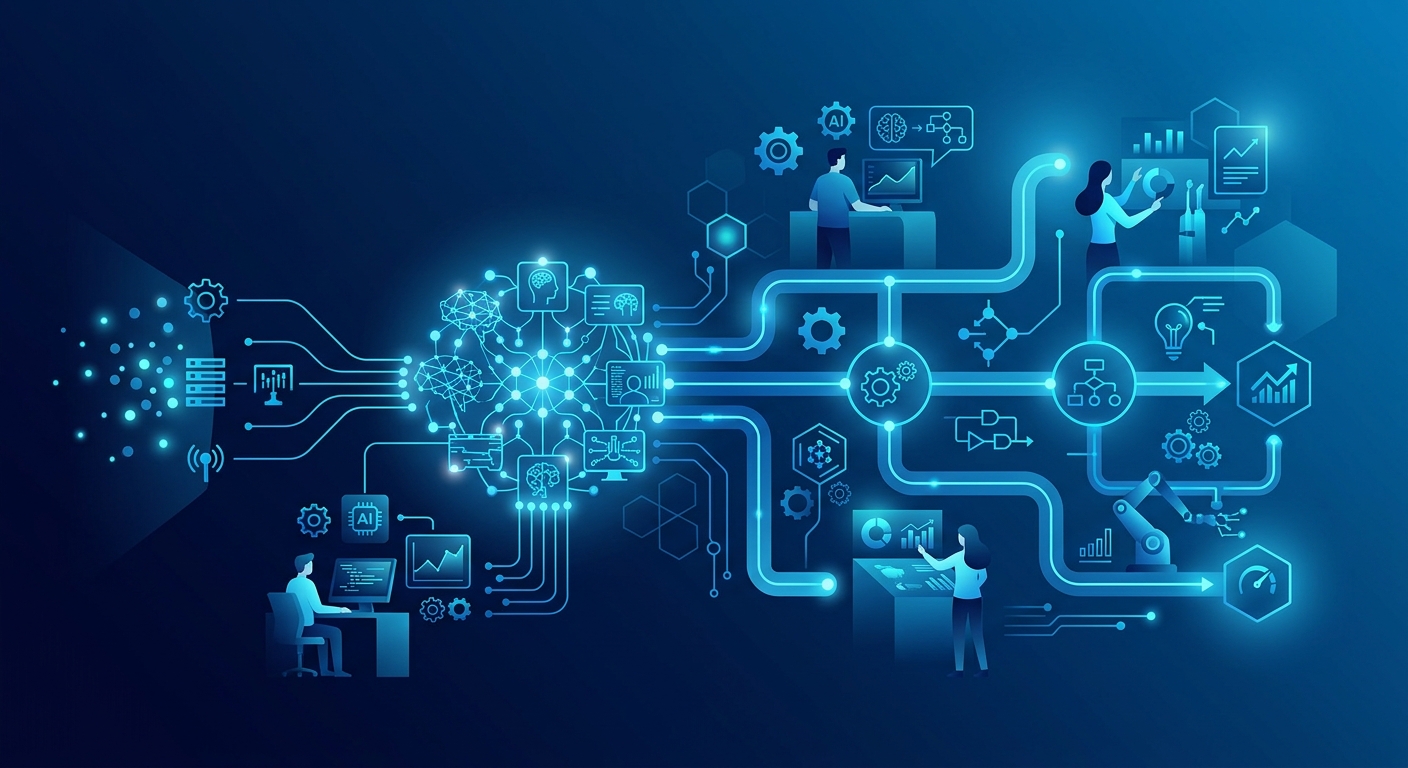
Intelligent Process Automation (IPA) is the next evolution of digital labor, representing a fundamental shift from simple task execution to complex, cognitive decision-making. As organizations move beyond the limitations of rigid, rule-based systems, IPA provides the bridge to a truly autonomous enterprise. By integrating advanced technologies like Machine Learning (ML) and Natural Language Processing (NLP) with traditional automation, businesses can now automate processes that were previously considered too complex for machines.
What is Intelligent Process Automation (IPA)?
Intelligent Process Automation (IPA) is a collection of technologies that combine Robotic Process Automation (RPA) with Artificial Intelligence (AI) and Machine Learning (ML) to manage, automate, and integrate digital processes. Unlike traditional automation, which follows strict "if-then" logic, IPA is designed to handle ambiguity, learn from data, and improve over time. According to Deloitte, IPA refers to the application of AI and related new technologies—such as Computer Vision and Cognitive Automation—combined with RPA applications to create a self-learning system.
At its core, IPA acts as the "brain" to RPA's "hands." While a standard robot might copy data from one spreadsheet to another, an IPA system can read an incoming email, understand the sentiment, extract relevant data from an attached PDF, and decide whether to process the request or escalate it to a human supervisor. This capability is critical for modern enterprises dealing with the explosion of unstructured data, which accounts for nearly 80% of all corporate information.
Key Takeaways
- IPA Definition: IPA is the synthesis of RPA and AI, enabling the automation of complex, non-linear workflows.
- Cognitive Capabilities: It uses ML, NLP, and Computer Vision to interpret unstructured data.
- Efficiency Gains: Organizations typically see a 20-35% improvement in operational efficiency when transitioning from RPA to IPA.
- Continuous Learning: IPA systems improve their accuracy over time through constant data feedback loops.
The Main Purpose of Intelligent Process Automation
The main purpose of Intelligent Process Automation is to remove the "human-in-the-loop" requirement for tasks that involve judgment and unstructured data. While traditional Smart Business Process Automation focuses on speed and accuracy for repetitive tasks, IPA extends those benefits to higher-value cognitive work. The goal is to create an end-to-end automated environment that can adapt to changing business conditions without constant manual reprogramming.
By implementing IPA, organizations aim to achieve three primary objectives:
- Operational Agility: The ability to scale processes up or down instantly based on demand.
- Enhanced Decision Making: Using AI to analyze vast datasets and provide actionable insights or autonomous actions.
- Customer Experience Transformation: Reducing response times from days to seconds by automating complex service requests.
Technology Beyond Intelligent Process Automation
To understand IPA, one must look at the technology stack that powers it. It is not a single software package but an orchestration of several distinct layers. These include:
- Robotic Process Automation (RPA): The foundational layer that handles structured, repetitive tasks.
- Machine Learning (ML): Algorithms that identify patterns in data to make predictions or decisions.
- Natural Language Processing (NLP): The ability for a system to understand, interpret, and generate human language.
- Computer Vision: Technology that allows machines to "see" and interpret visual information, such as handwritten documents or UI elements.
- Cognitive Automation: The integration of these tools to mimic human perception and reasoning.
Research published by the National Center for Biotechnology Information (NCBI) highlights that IPA is particularly transformative in healthcare, where it can reduce manual data entry tasks by up to 50% in clinical settings. This is achieved by using Computer Vision to read medical records and NLP to categorize patient symptoms.
Intelligent Process Automation vs. Robotic Process Automation
The distinction between IPA and RPA is often misunderstood, yet it is vital for setting realistic ROI expectations. RPA is inherently "dumb"—it follows a script. If the script breaks because a button on a website moved two pixels to the left, the RPA bot fails. IPA, however, uses Computer Vision to recognize the button regardless of its coordinates.
| Feature | Robotic Process Automation (RPA) | Intelligent Process Automation (IPA) |
|---|---|---|
| Data Type | Structured (Excel, Databases) | Unstructured (Email, Images, Speech) |
| Logic | Rule-based (If/Then) | Cognitive (Probabilistic/Learning) |
| Complexity | Simple, repetitive tasks | Complex, end-to-end workflows |
| Adaptability | Low; requires manual updates | High; learns from data patterns |
| User Interaction | Mostly back-office | Front and back-office integration |
Key Insight: While RPA excels at "doing" tasks, IPA excels at "thinking" about them. Transitioning from Process Automation RPA to IPA allows enterprises to automate up to 50-70% of tasks that were previously un-automatable.
IPA and AI: How It Complements the Automation Process
AI is the engine that drives IPA. Without AI, automation is limited to the "happy path"—the perfect scenario where everything goes exactly as planned. AI allows the automation process to handle exceptions. In an AI agents for invoice exception handling scenario, AI can identify why an invoice doesn't match a purchase order, suggest a correction, and even learn from a human's manual fix to handle the same issue autonomously next time.
This complementary relationship creates a feedback loop. RPA generates data by executing tasks, and AI analyzes that data to optimize the RPA scripts. This collaboration is what drives the 20-35% efficiency gains cited by Deloitte.
Benefits of Intelligent Process Automation
The benefits of IPA extend far beyond simple cost savings. While reducing headcount is often the initial driver, the long-term value lies in quality and speed.
- Error Reduction: Human fatigue is the leading cause of data entry errors. IPA systems do not get tired, ensuring 100% accuracy in data processing once the models are calibrated.
- Improved Compliance: IPA provides a complete audit trail. Every decision made by the AI is logged, which is essential for automated regulatory change tracking.
- Employee Empowerment: By removing repetitive, low-value work, employees can focus on strategic tasks that require empathy and creative problem-solving. This is particularly relevant as we observe jobs replaced by AI shifting toward high-value roles.
- Scalability: An IPA system can handle a 1000% spike in volume without needing to hire or train new staff, providing a significant competitive advantage during peak seasons.
How Can IPA Help Your Business? Use Cases and Examples
IPA is currently being deployed across every major industry to solve complex operational bottlenecks.
- Financial Services: Automating the Know Your Customer (KYC) process. IPA can scan ID documents, verify them against global databases, and flag suspicious patterns for human review.
- Insurance: Claims processing is a prime candidate. IPA can ingest photos of car accidents, estimate repair costs using Computer Vision, and initiate a payout without human intervention.
- Human Resources: Screening thousands of resumes. IPA uses NLP to understand the context of a candidate's experience, rather than just searching for keywords, ensuring better talent matching.
- Supply Chain: Predictive maintenance combined with IPA can automatically order replacement parts before a machine fails, coordinating the entire logistics chain autonomously.
Overcoming Implementation Failures: The Technical Debt Gap
Despite the promise of IPA, many implementations fail. A primary reason is Technical Debt. Legacy systems often lack the APIs necessary for modern AI tools to communicate effectively. When non-technical staff deploy "low-code" IPA tools, they may inadvertently create "Shadow Automation"—unmonitored scripts that lack proper governance.
To mitigate these risks, organizations must adopt continuous AI agent monitoring protocols. This involves establishing a Center of Excellence (CoE) that oversees all automation projects, ensuring they adhere to data security standards and don't create silos of unmaintained code.
Key Insight: Technical debt in the form of fragmented data and lack of documentation is the #1 inhibitor of IPA scaling. Organizations must audit their "Data Debt" before layering AI on top of legacy processes.
Calculating the Total Cost of Ownership (TCO) for IPA
Calculating the ROI for IPA is more complex than for RPA because of the hidden costs associated with AI. Organizations must look beyond the initial license fee and consider:
- Model Retraining: AI models "drift" over time as data patterns change. Regular retraining is required to maintain accuracy.
- API Maintenance: IPA often relies on third-party APIs (e.g., Google Vision or OpenAI). Changes to these APIs can break the workflow.
- Governance and Oversight: The cost of human supervisors who monitor the AI's performance and handle edge cases.
To accurately measure success, enterprises should use ROI and performance metrics that account for these ongoing operational expenses, rather than just the initial deployment cost.
How to Kickstart Your IPA Transformation Journey
Starting an IPA journey requires a strategic, phased approach. Jumping straight into complex AI models often leads to frustration. Instead, follow this roadmap:
- Process Discovery: Use process mining tools to identify which workflows are the best candidates for automation.
- Stabilize with RPA: Automate the structured portions of the process first to establish a baseline.
- Layer in Intelligence: Introduce ML or NLP to handle specific unstructured elements, such as document classification.
- Scale and Orchestrate: Use an Intelligent Automation Platform to manage multiple bots and AI models across the enterprise.
IPA: The New Wave of Digital Innovation
We are entering an era where the distinction between "software" and "worker" is blurring. IPA is the catalyst for the Agentic Enterprise, where autonomous agents handle the majority of administrative and cognitive tasks. This is not just about efficiency; it is about reinventing how business is done. Companies that embrace IPA today will be the ones defining the market of tomorrow, using their data as a strategic asset rather than a storage burden.
Frequently Asked Questions
What is the difference between IPA and AI?
AI is a broad field of computer science focused on creating systems capable of performing tasks that require human intelligence. IPA is a specific application of AI that uses those intelligent capabilities to automate business processes, usually in conjunction with RPA.
Can IPA work with legacy systems?
Yes, one of the strengths of IPA is its ability to interact with legacy systems through the UI (using Computer Vision) even when modern APIs are unavailable. However, reducing technical debt is recommended for long-term stability.
Is IPA secure?
IPA can be highly secure if implemented with proper AI agent data privacy compliance frameworks. Because it reduces manual handling of sensitive data, it can actually decrease the risk of data breaches caused by human error.
How long does it take to see ROI from IPA?
Most enterprises see a positive return within 12 to 18 months, depending on the complexity of the processes automated and the initial state of their data infrastructure.
Does IPA replace human workers?
While IPA automates tasks, it typically shifts the human role from "task doer" to "process orchestrator." It changes the nature of work, as explored in our research on occupations reshaped by AI.