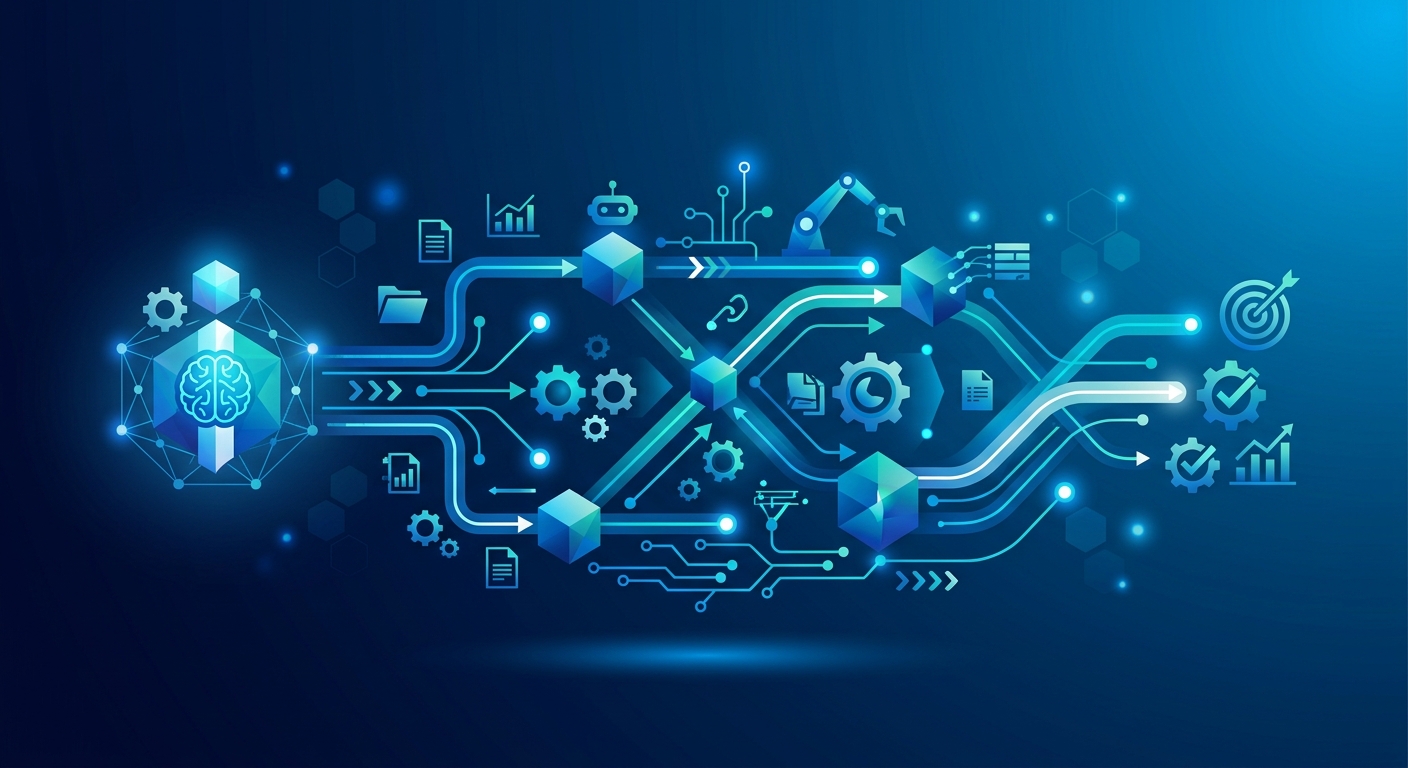
As enterprises face increasing pressure to scale operations while maintaining lean cost structures, the limitations of traditional automation have become apparent. An intelligent process automation solution (IPA) is an integrated set of technologies that combines fundamental process redesign with robotic process automation and machine learning to create a system that mimics human intelligence. Unlike legacy systems that rely solely on "if-then" logic, IPA solutions can process unstructured data, learn from historical patterns, and make autonomous decisions.
Key Takeaways
- Efficiency Gains: Intelligent Process Automation enables organizations to automate between 50% and 70% of their operational tasks and functions.
- Cost Reduction: Most enterprises achieve cost reductions of 20% to 35% through holistic IPA implementation.
- Cycle Time: IPA can reduce process cycle times by 50% to 60%, particularly in administrative and document-heavy sectors.
- Technology Stack: A modern IPA solution unifies RPA, Artificial Intelligence (AI), Machine Learning (ML), and Business Process Management (BPM).
What is Intelligent Process Automation (IPA)?
Intelligent Process Automation (IPA) is an advanced suite of technologies that integrates Robotic Process Automation with cognitive tools like Machine Learning (ML), Computer Vision, and Natural Language Processing (NLP). At its core, IPA is designed to manage and automate end-to-end workflows that involve both structured and unstructured data. While traditional automation handles repetitive, rule-based tasks, IPA introduces a "thinking" layer that allows systems to interpret context, recognize patterns, and improve over time.
According to Gartner, modern IPA solutions are increasingly built on AI-first low-code platforms. These platforms enable enterprises to model, automate, and orchestrate complex, content-centric business processes at scale. This evolution is critical because it moves beyond the "band-aid" approach of simple task automation toward a unified framework of Smart Business Process Automation.
Key Insight: Intelligent Process Automation enables organizations to automate between 50% and 70% of their operational tasks and functions, often resulting in ROI within the first 12 months of deployment. Kissflow
Intelligent Process Automation vs. Robotic Process Automation
Understanding the distinction between IPA and RPA is essential for strategic planning. RPA is the "brawn" of the automation world—it excels at executing high-volume, repetitive tasks by mimicking user clicks and keystrokes. However, RPA is brittle; it fails when faced with a change in user interface or a non-standard document format.
An intelligent process automation solution serves as the "brain." It uses AI to handle the cognitive load of a process. For example, while RPA can copy data from an invoice into an ERP system, an IPA solution can read an unstructured email, determine the intent, extract the relevant invoice details using NLP, and then trigger the RPA bot to perform the data entry.
| Feature | Robotic Process Automation (RPA) | Intelligent Process Automation (IPA) |
|---|---|---|
| Data Type | Structured only | Structured and Unstructured |
| Logic | Rule-based (If/Then) | Cognitive (Learning/Probabilistic) |
| Adaptability | High failure rate on UI changes | Self-healing and adaptive |
| Primary Goal | Task efficiency | End-to-end process orchestration |
| Human Interaction | Minimal (Unattended) | High (Human-in-the-loop) |
The Main Purpose of Intelligent Process Automation
The primary objective of an intelligent process automation solution is to remove the friction between disparate business systems and human decision-makers. In most legacy environments, employees act as the "glue" between software applications—manually moving data, validating documents, and resolving exceptions.
IPA aims to replace this manual glue with an integrated digital workforce. By automating 50% to 70% of operational tasks Accelirate, IPA allows human workers to focus on higher-value activities, such as strategy, customer relationship management, and complex problem-solving. This shift is particularly impactful in Computer and Mathematical Occupations where data processing can be largely offloaded to intelligent agents.
How IPA and AI Complement the Automation Process
AI is the engine that drives the "intelligence" in IPA. Without AI, automation is limited to static environments. AI complements the automation process through three primary capabilities:
- Machine Learning (ML): ML algorithms analyze historical process data to predict future outcomes. This is vital for Predictive Maintenance and financial forecasting.
- Natural Language Processing (NLP): NLP allows the IPA solution to "read" and "understand" human language. This enables the automation of customer support tickets, legal contract reviews, and medical record processing.
- Computer Vision: This technology allows bots to "see" and interpret visual information, which is essential for processing handwritten forms or navigating legacy software that lacks an API.
By layering these technologies, organizations can move from simple task automation to Enterprise AI Agent Orchestration, where autonomous agents manage entire departments with minimal oversight.
Benefits of an Intelligent Process Automation Solution
Implementing an IPA solution offers transformative benefits that extend beyond simple headcount reduction.
- Enhanced Accuracy: Human error is a significant risk in data-heavy industries. IPA solutions do not get tired or distracted, ensuring 99.9% accuracy in data extraction and entry.
- Scalability: Digital workers can be scaled up or down instantly. During peak seasons, an enterprise can deploy 100 additional bots without the overhead of hiring and training.
- Regulatory Compliance: IPA provides a complete audit trail of every action taken. For industries requiring Autonomous Regulatory Change Monitoring, IPA ensures that every process step adheres to the latest legal requirements.
- Cost Efficiency: Deloitte research indicates that IPA can lead to cost reductions of 20% to 35% Deloitte.
Key Insight: In healthcare administrative workflows, IPA has been documented to reduce process cycle times by 50% to 60%, significantly improving patient throughput. NIH
IPA Use Cases: How It Can Help Your Business
IPA is not a vertical-specific tool; its applications are horizontal across the enterprise.
1. Finance and Accounting
In finance, IPA is used for AI Invoice Exception Handling. When an invoice does not match a purchase order, an IPA bot can investigate the discrepancy, contact the vendor for clarification, and only flag the issue for a human if it cannot be resolved autonomously.
2. Customer Support
By integrating NLP with backend systems, IPA solutions can resolve up to 80% of routine customer inquiries. This significantly improves ROI for Customer Support Automation by reducing the cost per ticket to pennies.
3. Supply Chain and Logistics
IPA can monitor global shipping data, predict delays due to weather or geopolitical events, and automatically re-route shipments or update inventory levels in real time.
Technology Beyond Intelligent Process Automation
As we look toward 2026 and beyond, the technology is shifting from IPA toward the "Agentic Enterprise." This involves the use of autonomous AI agents that do not just follow a predefined workflow but can reason through complex goals.
Modern platforms, such as those reviewed by Gartner, now include "Process Discovery" tools. These tools use AI to observe how employees work and automatically generate the automation scripts required to replicate those tasks. This narrows the gap between human labor and digital execution, leading to a future where Jobs Replaced by AI are those characterized by high-volume data manipulation.
Navigating Compliance: GDPR, HIPAA, and the EU AI Act
A critical gap in many IPA discussions is how autonomous decision-making interacts with global privacy frameworks. As IPA solutions make more decisions without human intervention, they face scrutiny under the GDPR (General Data Protection Regulation) and the EU AI Act (effective August 2026).
These frameworks require "explainability." If an IPA solution denies a loan application or rejects a healthcare claim, the organization must be able to explain the logic behind that decision. Furthermore, AI Agent Data Privacy Compliance is paramount when handling sensitive PII (Personally Identifiable Information). Organizations must ensure their IPA vendors offer robust data masking and encryption to meet HIPAA and international standards.
How to Kickstart Your IPA Transformation Journey
Transitioning from legacy RPA or manual processes to a full IPA solution requires a structured approach:
- Inventory Your RPA Estate: Identify existing RPA scripts that are high-maintenance. These are prime candidates for IPA upgrades using low-code platforms.
- Establish a Center of Excellence (CoE): A CoE bridges the gap between IT and business units, ensuring that automation efforts align with corporate strategy.
- Define Human-in-the-Loop (HITL) Protocols: For low-confidence exceptions, the system must have a seamless interface to hand off tasks to a human. This requires Continuous AI Agent Monitoring to maintain quality.
- Select a Unified Platform: Avoid fragmented tools. Look for a solution like NewgenONE or similar Gartner-rated platforms that unify workflow, content services, and AI.
IPA: The New Wave of Digital Innovation
We are entering a phase where the "Digital Enterprise" is no longer a goal but a requirement for survival. IPA is the engine of this innovation. By combining the speed of RPA with the intelligence of AI, businesses can build resilient operations that adapt to market changes in milliseconds.
For those in Architecture and Engineering Occupations or Software Engineering, IPA represents a shift in how work is designed—moving from CAD and code to system orchestration.
Frequently Asked Questions
What is the difference between IPA and AI?
AI is a broad field of computer science focused on creating systems capable of performing tasks that typically require human intelligence. IPA is a specific application of AI that uses those capabilities to automate and optimize business processes.
Can IPA handle handwritten documents?
Yes. Modern IPA solutions use advanced Computer Vision and Optical Character Recognition (OCR) powered by deep learning to accurately transcribe and interpret handwritten text.
How much does an IPA solution cost?
Costs vary based on the number of processes, but many enterprises are moving toward Outcome-based Pricing, where you pay based on the successful completion of tasks rather than a flat licensing fee.
Is IPA only for large corporations?
While large enterprises were the early adopters, the rise of low-code IPA tools has made the technology accessible to mid-market companies looking to scale without increasing headcount.
Does IPA replace human workers?
IPA replaces tasks, not necessarily jobs. It automates the repetitive parts of a role, allowing employees to focus on strategic work that requires empathy, creativity, and complex reasoning.