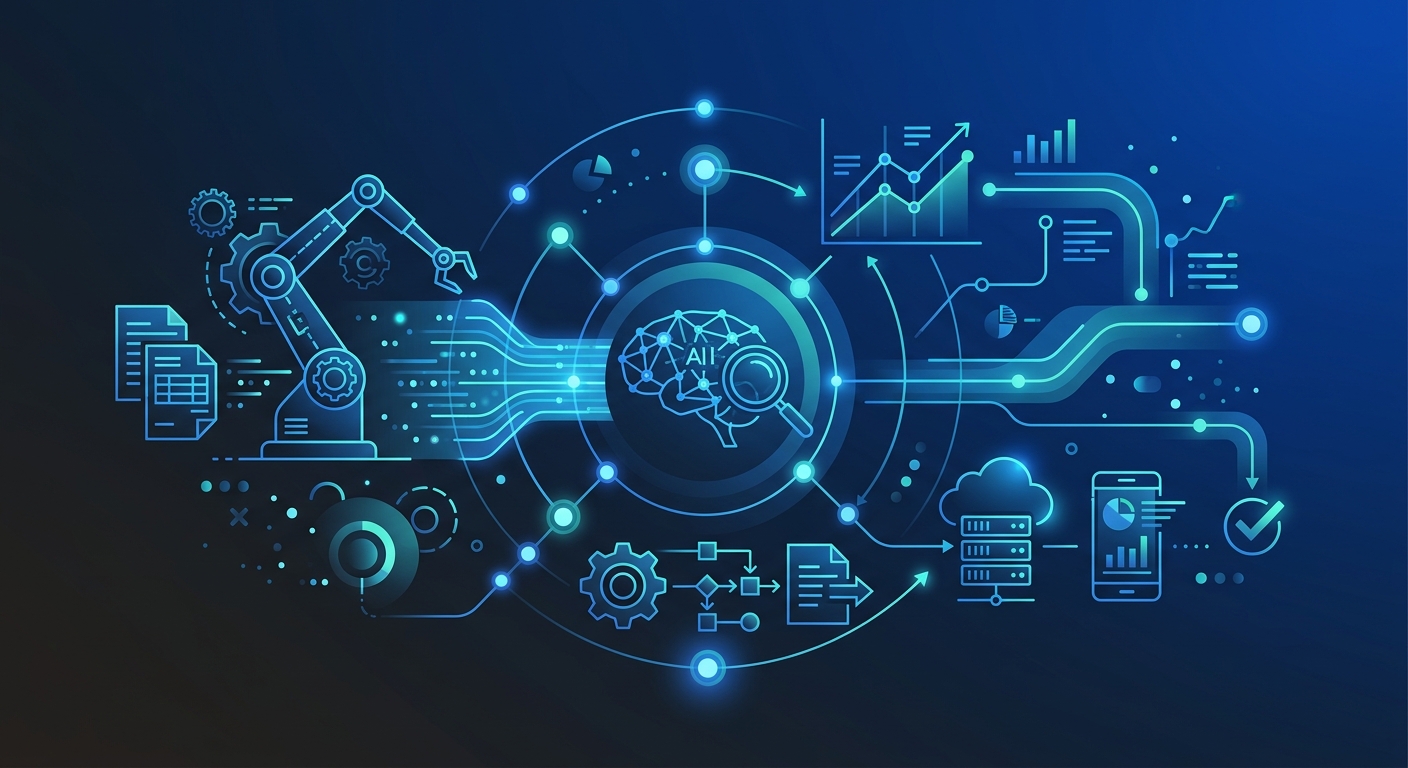
Intelligent Process Automation (IPA) is the convergence of Robotic Process Automation (RPA), Artificial Intelligence (AI), and Machine Learning (ML) to create self-learning workflows that handle unstructured data and complex decision-making. Unlike traditional automation that follows rigid rules, IPA adapts to changing inputs, allowing enterprises to automate cognitive tasks that were previously reserved for human workers. By integrating Natural Language Processing (NLP) and advanced computer vision, IPA bridges the gap between simple task execution and high-level business orchestration.
Key Takeaways
- IPA Evolution: Intelligent Process Automation combines RPA with ML and NLP to handle unstructured data, surpassing the capabilities of traditional rule-based tools.
- Finance Leadership: Accounts Payable is a primary driver for IPA, where AI-driven capture is replacing legacy OCR for companies like Adyen and Billerud.
- Quantifiable Gains: Implementations in finance have shown up to an 85% reduction in manual data entry errors Forrester.
- Broad Utility: Beyond finance, IPA is streamlining patient scheduling in healthcare and document classification in government sectors.
Defining Intelligent Process Automation (IPA) for the Enterprise
Intelligent Process Automation (IPA) is a collection of technologies that work together to manage, automate, and integrate digital processes. The core components of IPA include RPA, which handles structured tasks; Machine Learning, which provides predictive analytics; and NLP, which enables the system to understand human language. This combination creates a smarter automation layer that does not break when it encounters a slight variation in a document or a new data format.
In the context of the Agentic Enterprise, IPA serves as the foundational infrastructure. While traditional Robotic Process automation focuses on "doing," IPA focuses on "thinking and doing." This distinction is critical for modern businesses dealing with massive volumes of unstructured data, such as emails, PDFs, and legal contracts, which account for roughly 80% of all enterprise data.
Key Insight: Intelligent Process Automation is not a single tool but a technology stack. By combining the execution power of RPA with the cognitive capabilities of AI, organizations can automate end-to-end processes that require judgment, such as AI agents for invoice exception handling.
10 Real-World Cases of Intelligent Process Automation
To understand the impact of this technology, we must look at how leading organizations are deploying these tools to solve complex operational bottlenecks. Here are ten prominent intelligent process automation examples across various sectors:
- Accounts Payable Automation: Companies like Adyen and Billerud have moved beyond simple OCR to AI-driven data capture, significantly increasing accuracy in invoice processing Forrester.
- Patient Scheduling in Healthcare: IPA systems analyze physician availability, patient history, and urgency to optimize clinical calendars without human intervention NCBI.
- Government Document Classification: Federal agencies use IPA to classify benefits claims and route them to the appropriate departments based on content analysis GAO.
- Know Your Customer (KYC) Compliance: Banks use NLP to scan global news and sanctions lists, automatically flagging high-risk profiles for review.
- Supply Chain Demand Forecasting: ML models analyze historical sales data and external market signals to trigger autonomous procurement orders.
- Insurance Claims Processing: IPA extracts data from accident photos and medical reports to calculate initial settlement offers.
- HR Onboarding: Automated systems handle everything from background checks to hardware provisioning, adjusting workflows based on the new hire's role.
- Customer Support Triaging: AI agents categorize incoming tickets by sentiment and urgency, resolving common queries while escalating complex issues to humans.
- Legal Contract Analysis: IPA tools identify high-risk clauses in thousands of contracts simultaneously, highlighting deviations from standard company policy.
- Regulatory Change Tracking: Automated agents monitor global regulatory updates and map them to internal controls to ensure continuous compliance.
What is Intelligent Automation and How Does it Differ from RPA?
Intelligent automation is the broader category that encompasses IPA. The primary difference between standard automation and intelligent automation lies in the ability to handle ambiguity. Traditional RPA is "brittle"; if an invoice changes its layout by a few millimeters, the bot may fail. Intelligent automation, however, uses computer vision and ML to "understand" that a field labeled "Total Due" is the same as "Amount Payable," regardless of its position on the page.
| Feature | Traditional RPA | Intelligent Process Automation (IPA) |
|---|---|---|
| Data Type | Structured (Excel, SQL) | Unstructured (Email, PDF, Voice) |
| Logic | Rule-based (If/Then) | Cognitive (Probabilistic/ML) |
| Adaptability | Low (Requires reprogramming) | High (Learns from data) |
| Goal | Task Efficiency | Process Orchestration |
| Human Interaction | Minimal/Back-office | High (Human-in-the-loop) |
For organizations looking to scale, moving toward smart business process automation is essential. It allows the workforce to shift from manual data entry to exception management, where human judgment is most valuable.
Beyond Extraction: The New Standard for Enterprise Document Processing
Enterprise document processing has evolved from simple data extraction to contextual understanding. In the past, Optical Character Recognition (OCR) merely turned images into text. Today, IPA solutions provide "Beyond Extraction" capabilities, meaning they understand the relationship between data points. For example, an IPA system doesn't just see a date; it understands whether that date refers to the invoice issuance, the delivery, or the payment deadline.
According to Forrester, traditional OCR is being rapidly outpaced by AI-driven solutions. These modern systems can achieve an 85% reduction in manual data entry errors. This is particularly vital for companies like Adyen that handle high-volume global transactions where even a 1% error rate can result in millions of dollars in lost revenue or compliance fines.
Use Cases and Examples That Fit IPA in Finance and Healthcare
Finance: Transforming the Back Office
In the financial sector, IPA is most prevalent in Accounts Payable (AP) and Accounts Receivable (AR). AI models are now used for sophisticated invoice matching, comparing purchase orders, delivery receipts, and invoices across multiple languages and currencies. The result is a touchless process where only the most complex discrepancies require human intervention. This aligns with the transition toward autonomous regulatory change monitoring.
Healthcare: Clinical and Administrative Efficiency
In healthcare, IPA is used for clinical documentation support and billing. A systematic review published by the NCBI highlights that healthcare administrative tasks automated via IPA can lead to 20–30% operational cost savings. By automating the extraction of data from electronic health records (EHRs) for billing purposes, providers reduce the lag time between service and payment while ensuring higher coding accuracy.
5 Key Facts About Intelligent Process Automation
- Data Fluidity: IPA can process data from diverse sources, including handwritten notes, scanned images, and recorded voice calls.
- Scalability: Unlike human teams, IPA systems can scale up instantly to handle seasonal spikes, such as end-of-quarter financial reporting or holiday shipping surges.
- Continuous Learning: Every time a human corrects an IPA output (Human-in-the-loop), the underlying ML model learns, reducing the likelihood of the same error occurring in the future.
- Legacy Integration: IPA acts as a bridge, allowing modern AI capabilities to interact with legacy mainframe systems that lack APIs.
- ROI Speed: Most enterprises report positive ROI within 6–12 months of deployment due to significant reductions in error rates and processing times.
Getting Started with Intelligent Automation: A 5-Step Guide
Implementing IPA is a journey that requires strategic planning rather than just technical installation. Organizations should follow this structured approach:
- Process Discovery: Use process mining tools to identify bottlenecks where high volumes of unstructured data are currently handled manually.
- Tool Selection: Evaluate vendors based on their ability to integrate AI/ML with existing RPA workflows. Refer to the Gartner Magic Quadrant for BOAT (Business Orchestration and Automation Technologies) for market-leading platforms.
- Pilot Deployment: Start with a high-impact, low-complexity use case, such as invoice exception handling.
- Establish Governance: Define the "Human-in-the-Loop" (HITL) frameworks. Decide which confidence thresholds trigger a human review and how those reviews will be audited for compliance.
- Scale and Optimize: Once the pilot is successful, expand the IPA footprint to adjacent processes, using the data collected to further retrain and refine the AI models.
Addressing the Total Cost of Ownership (TCO) and Model Drift
A common gap in automation planning is failing to account for the long-term costs of AI. The Total Cost of Ownership (TCO) for an IPA system involves more than just the initial license and implementation. Research suggests that initial development typically represents only 15% to 25% of the lifetime cost. The remaining 75% to 85% is spent on ongoing operations, specifically managing "model drift."
Model drift occurs when the data the AI encounters in the real world begins to differ significantly from the data it was trained on. For example, a change in international tax law might change how invoices are structured, causing the AI's accuracy to drop sharply. Organizations must budget for continuous AI agent monitoring and periodic retraining to maintain performance levels.
Key Insight: AI total cost of ownership should include automated monitoring pipelines and the periodic retraining needed to counter model drift.
Frequently Asked Questions
What is the difference between AI and IPA?
AI is the broad field of creating machines capable of intelligent behavior. IPA is a specific application of AI (alongside RPA and ML) designed to automate and optimize business processes.
Can IPA work with handwritten documents?
Yes, modern IPA solutions use advanced Intelligent Character Recognition (ICR) and computer vision to extract data from handwritten forms with high degrees of accuracy, though these often require a human-in-the-loop for final verification.
How does IPA ensure GDPR compliance?
IPA systems can be configured with data protection by design. They can automatically redact Personally Identifiable Information (PII) and maintain detailed audit logs of every decision made, ensuring transparency for regulatory audits.
Does IPA replace human workers?
While IPA automates tasks, it typically shifts the human role from data entry to data oversight. For a deeper look at this transition, see our analysis on jobs replaced by AI.
What is a 'Human-in-the-Loop' in IPA?
Human-in-the-loop (HITL) refers to a governance framework where an AI system flags low-confidence data for a human to review. The human's decision then serves as a training signal to improve the AI's future performance.
How long does it take to implement an IPA solution?
A pilot project can typically be deployed in 8–12 weeks, while a full enterprise-scale rollout may take 6–18 months depending on the complexity of the internal systems.