Defining the Agent: A Strategic Overview
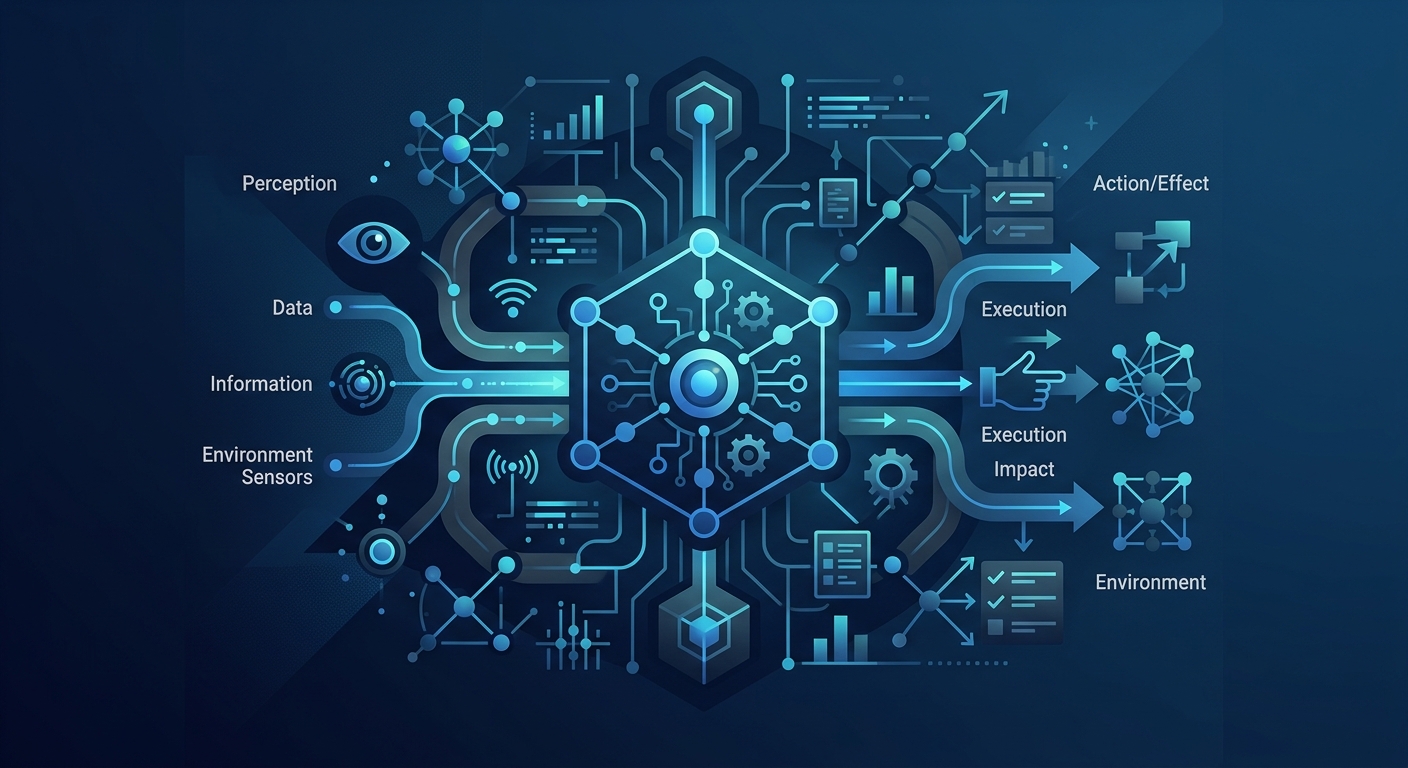
An agent is an entity that perceives its environment through sensors and acts upon that environment through actuators to achieve specific goals. In the context of modern business, an agent is no longer just a human representative; it is increasingly a digital system capable of autonomous decision-making. Unlike traditional software that operates on rigid, linear logic, an agent possesses the capacity for reasoning and independent action.
According to the NIST Glossary, an autonomous agent is defined as a system that can operate in a complex, changing environment with a high degree of independence. This independence is the hallmark of agency. While a standard computer program might execute a script when a button is clicked, an agent monitors a stream of data, identifies a deviation from a goal, and initiates a corrective measure without human intervention.
In the enterprise, the definition of an agent has shifted toward Agentic AI. This refers to Large Language Model (LLM) based systems that do not merely generate text but execute workflows. These systems are defined by their ability to decompose complex instructions into actionable steps. For example, rather than simply answering a query about invoice status, an agentic system can access a database, identify a discrepancy, contact a vendor for clarification, and update the internal ledger.
Key Takeaways
- Autonomy is the Core: Agents differ from standard software by their ability to make independent decisions without constant human oversight.
- Perception-Reasoning-Action: Modern agents operate in a continuous loop, sensing environmental data, reasoning through potential outcomes, and executing actions.
- Enterprise Adoption: According to IBM, 82% of enterprises are currently exploring or deploying AI agents for process automation in 2024.
- Goal-Orientation: In both philosophy and computer science, an agent must have intentionality—a mental or programmed state directed toward a specific objective.
Core Functions and Responsibilities of Modern Agents
The fundamental operation of an agent is often described as the 'Perception-Reasoning-Action' loop. This cycle allows the agent to remain effective in dynamic environments where static rules would fail.
- Perception: The agent gathers data from its surroundings. In a digital enterprise, this 'environment' consists of APIs, databases, email inboxes, and user interfaces.
- Reasoning: This is the 'brain' of the agent. Modern AI agents use LLMs to interpret the perceived data against a set of goals. They ask: "Given what I see, what is the best next step to reach my objective?"
- Action: The agent executes a command. This could be sending an email, triggering an API call, or moving a file in a cloud storage system.
Key Insight: IBM research indicates that 82% of enterprises are exploring or deploying AI agents for process automation, marking a shift from assistive AI to autonomous AI. Source: IBM
Beyond technical execution, agents carry fiduciary-like responsibilities. In a business context, an agent acts on behalf of a principal (the company or a specific executive). This relationship means the agent must prioritize the principal's goals, maintain data integrity, and operate within the ethical and legal boundaries defined by the organization. This is particularly critical when deploying AI agent data privacy compliance protocols to ensure that autonomous actions do not violate regulatory standards.
Types of Agents in Enterprise Ecosystems
Understanding the landscape of agency requires categorizing agents based on their scope of authority and technical architecture. In the Agentic Enterprise, we typically see a hierarchy of agent types:
1. Simple Reflex Agents
These are the most basic form of agents. They act based on current perceptions, ignoring the history of the environment. They follow "if-then" rules. While limited, they are highly efficient for low-complexity tasks like basic data entry or alert triggering.
2. Goal-Based Agents
These agents are more sophisticated; they possess information about the desirability of specific situations. They don't just follow rules; they choose actions that lead to a desired goal state. This is the foundation for Enterprise AI Sdr Deployment Strategy, where the goal is lead qualification.
3. Utility-Based Agents
Utility-based agents go a step further by evaluating not just whether a goal is met, but how efficiently it is met. They use a utility function to rank different paths to a goal, choosing the one that maximizes ROI or minimizes time.
4. Learning Agents
These agents improve their performance over time. They consist of a learning element, which makes improvements, and a performance element, which selects actions. This is vital for continuous AI agent monitoring protocols where the system must adapt to changing market conditions.
| Agent Type | Decision Logic | Best Use Case |
|---|---|---|
| Simple Reflex | Condition-Action Rules | Basic form validation |
| Model-Based | Internal State Tracking | Inventory management |
| Goal-Based | Search and Planning | Complex project scheduling |
| Utility-Based | Optimization Functions | Dynamic pricing and logistics |
The Philosophical Roots of Agency
To fully grasp what an agent is, we must look at the philosophical foundations. In philosophy, agency is the capacity of an actor to act in a given environment. As noted in the Stanford Encyclopedia of Philosophy, agency requires intentionality. This means that for an entity to be a true agent, its actions must be directed toward a mental state or a predefined purpose.
In the realm of AI, this translates to 'goal-directed behavior.' We do not attribute agency to a calculator because it has no 'intent' to solve a problem; it simply processes circuits. However, as AI systems begin to use reasoning to determine how to solve a problem, the line between mechanical calculation and agency blurs. This shift is why The Agentic Enterprise is such a transformative concept; it represents the first time we have non-human entities that exhibit the 'intentionality' previously reserved for human staff.
Technical Architecture: The LLM as the Agent's Brain
Modern autonomous agents are built on a specific architectural stack that distinguishes them from previous iterations of automation. According to A Survey on Large Language Model based Autonomous Agents, the architecture typically includes:
- Profiling Module: Defines the agent's role (e.g., "You are a senior compliance officer").
- Memory Module: Stores past experiences and short-term context, allowing the agent to learn from previous interactions.
- Planning Module: Breaks down the ultimate goal into smaller, manageable sub-tasks.
- Action Module: The interface through which the agent interacts with the world (e.g., writing code, calling an API).
This structure allows for AI agents for invoice exception handling to be far more effective than traditional rule-based workflows. Traditional workflows break when a vendor sends a PDF in a new format; an LLM-based agent 'reasons' through the new format to find the necessary data points.
The Business Value of Professional Agency
The primary driver for adopting agents in the enterprise is the decoupling of labor from output. When a business employs human agents or traditional software, scaling often requires a linear increase in headcount or complex coding. Autonomous agents offer a non-linear scaling model.
Strategic ROI
By deploying agents, enterprises can achieve significant cost reductions in high-volume, high-complexity tasks. For instance, measuring AI agent ROI for customer support often reveals that agents can handle up to 70% of initial inquiries without human escalation. This allows human talent to focus on high-value strategy rather than repetitive execution.
Risk Mitigation
Agents are also becoming essential in compliance. Autonomous regulatory change monitoring allows firms to stay ahead of shifting legal landscapes. Because an agent never sleeps and can process vast amounts of text, it identifies risks that a human team might miss due to volume.
Key Insight: The shift toward agency allows for outcome-based pricing models. Instead of paying for software seats, enterprises can pay for successful outcomes, such as a resolved support ticket or a processed invoice. Source: Meo Advisors
Implementation Challenges and Governance
While the promise of agents is significant, the transition is not without hurdles. The primary challenge is 'alignment'—ensuring the agent's autonomous decisions remain perfectly aligned with company policy and ethical standards. This is why AI agent audit trail best practices are a non-negotiable component of any deployment.
Governance frameworks must address:
- Transparency: Can we explain why the agent took a specific action?
- Safety: Are there 'guardrails' to prevent the agent from taking harmful actions?
- Security: How do we protect the agent from 'prompt injection' or other malicious attacks?
Addressing these concerns is a prerequisite for moving from pilot programs to full-scale production in sensitive industries like finance or healthcare.
Frequently Asked Questions
What is the difference between an AI agent and a chatbot?
A chatbot is typically reactive and follows a script to answer questions. An AI agent is proactive and goal-oriented; it can use tools, access databases, and execute multi-step workflows to solve a problem rather than just talking about it.
How do agents make decisions?
Modern agents use Large Language Models (LLMs) to reason. They evaluate the current state of their environment against their programmed goals and use a planning module to determine the most efficient sequence of actions to take.
Can an agent replace a human employee?
Agents are designed to augment human work by handling repetitive and data-heavy tasks. While they may change the nature of certain roles, they often free humans to perform higher-level reasoning and creative work. For more on this, see our guide on jobs replaced by AI.
What are 'actuators' in a digital agent?
In a physical robot, an actuator is a motor. In a digital agent, an actuator is an API call, a database write command, or a generated email. It is the mechanism that allows the agent to affect its environment.
Is an agent always autonomous?
Agency exists on a spectrum. Some agents require human-in-the-loop (HITL) approval for sensitive actions, while others are fully autonomous. The level of autonomy usually depends on the risk profile of the task.
What is 'Agent Orchestration'?
Agent orchestration is the process of managing multiple agents working together to solve a complex problem. You can learn more about this in our orchestration terms and implementation patterns guide.